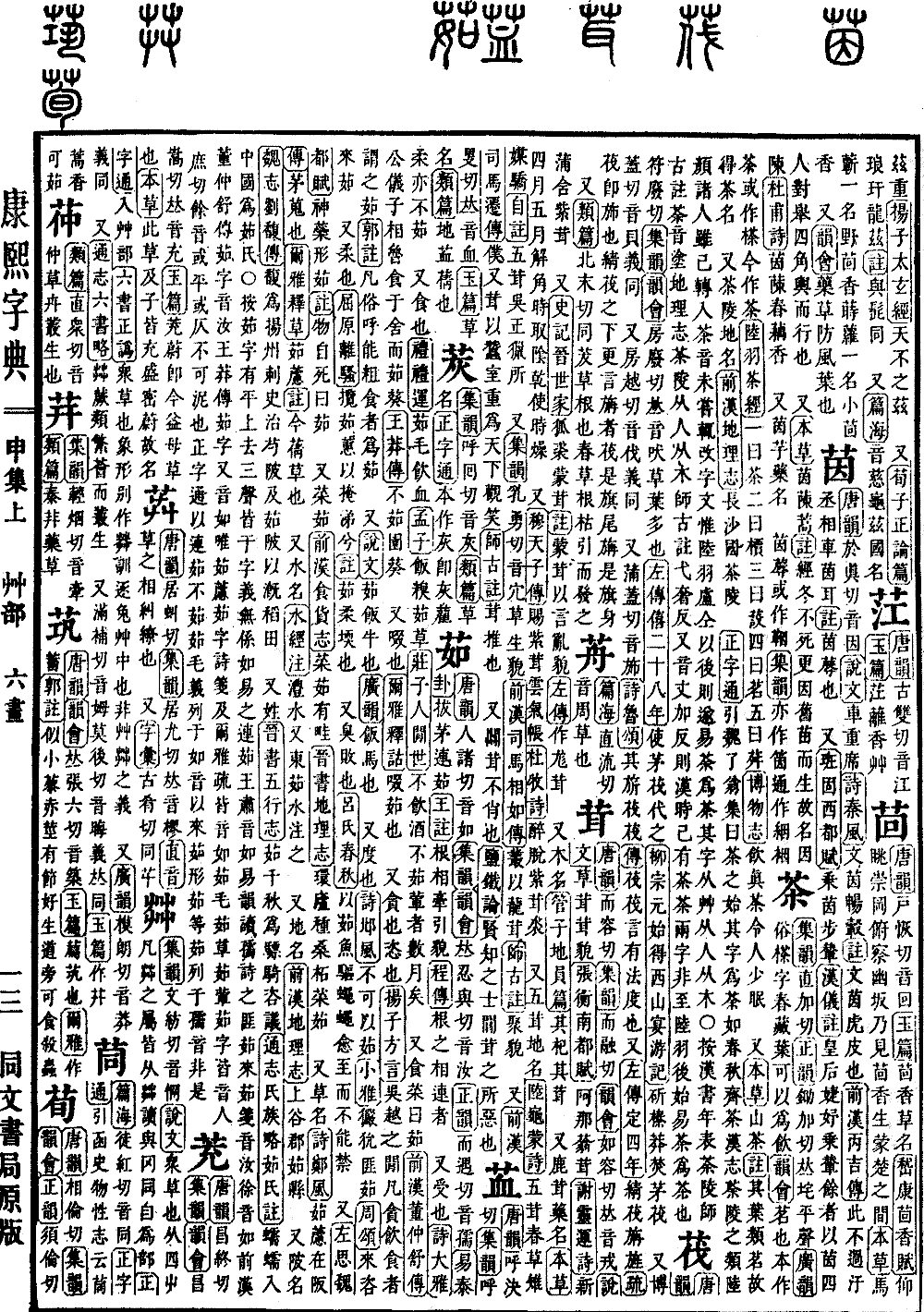
Shen Collection, Upper Volume
Radical: Grass (cǎo)
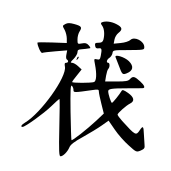
茷
Kangxi Strokes: 12
Page 1029, Entry 05
Tang Rhymes (Tangyun): Pronounced fei (falling tone). Refers to a profusion of grass and leaves. Zuo Commentary (Zuozhuan), 28th Year of Duke Xi: "Sent Mao Fei to replace him." Liu Zongyuan, Record of the First Excursion to West Mountain (Shi de Xishan yanyou ji): "Clearing away thickets and reeds, burning the tall grass."
Also pronounced bei (falling tone). Same meaning.
Also pronounced fa (falling tone). Same meaning.
Also pronounced pei (falling tone). Book of Odes (Shijing), Lu Hymns (Lu song): "Its banners are grand." Commentary: Grand, implies they follow established standards. Zuo Commentary (Zuozhuan), 4th Year of Duke Ding: "Qian-pei banners." Sub-commentary: The term refers to a pennant. Because it is mentioned separately from the banner, it refers to the tail of the flag, while the banner is the body.
Also, according to Classified Chapters (Leipian), pronounced mo (falling tone). Same as the variant form (ba), meaning the roots of grass. The roots of spring grasses wither, then are pulled and sprout forth.