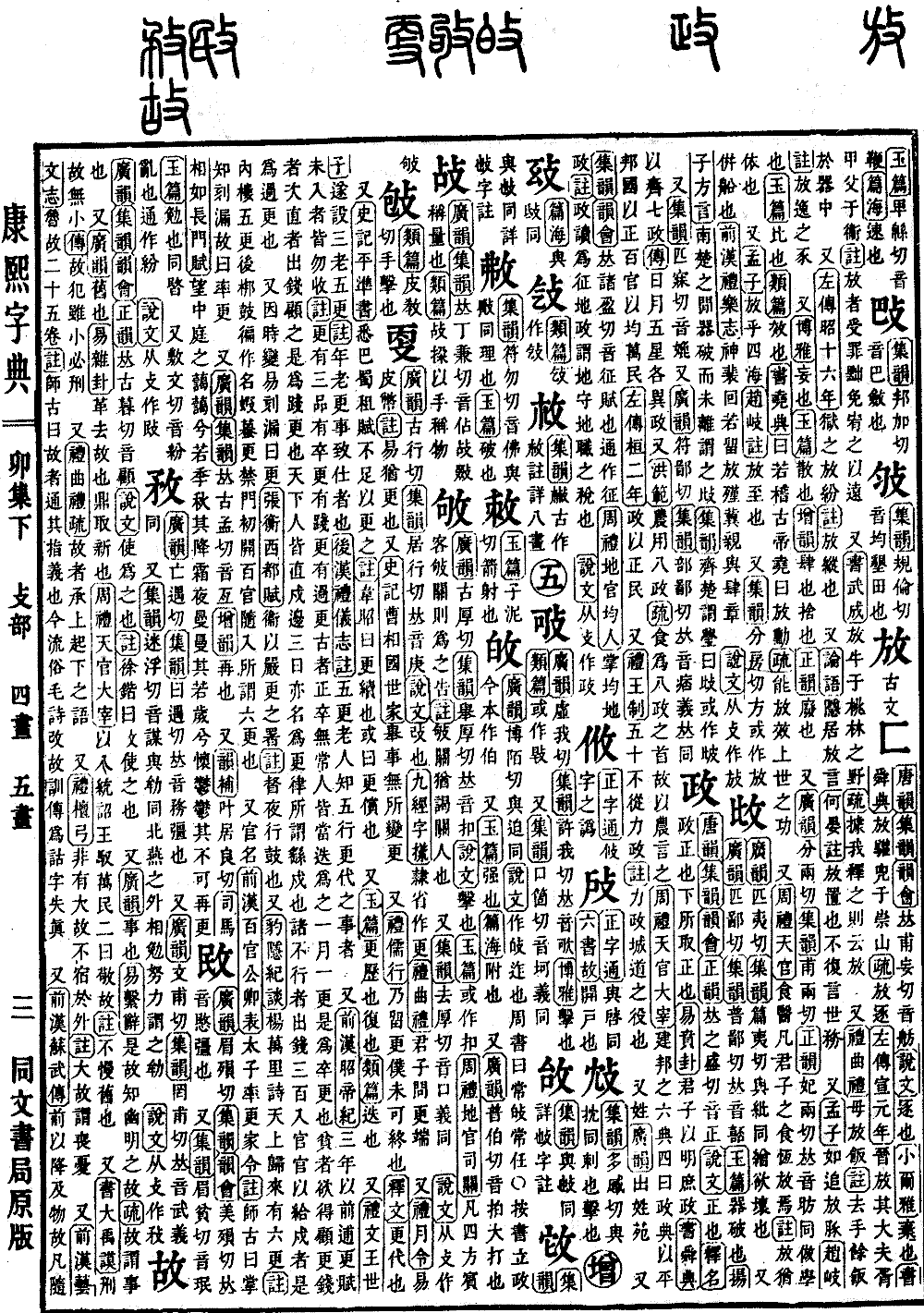
Mao Collection, Lower Volume
Radical: Tapping (pū)
Page 469, Entry 03
Ancient form: Xi (yǐn)
Tang Rhyme (Tangyun), Collected Rhymes (Jiyun), and Collection of Rhymes (Yunhui) dictionaries state it is pronounced fang (falling tone).
Shuowen Jiezi (Explanation of Writing and Analysis of Characters) states: To expel.
Xiao Erya (Small Approaches to Elegance) states: To cast aside.
Book of Documents (Shujing), Canon of Yao: To banish Huan Dou to Mount Chong.
Commentary: To exile.
Zuo Tradition (Zuozhuan), First Year of Duke Xuan: The State of Jin exiled its high official Xu Jiafu to the State of Wei.
Commentary: Fang refers to being relieved of duty due to committing a crime, and receiving a lenient sentence of exile to a distant place.
Also, Book of Documents (Shujing), Successful Completion of the War: To release oxen to graze in the wilderness of Taolin.
Commentary: To release from one's control is called fang.
Also, Book of Rites (Liji), Songs of Rites: Do not put leftover rice from one's hand back into the food container.
Commentary: To put excess rice from one's hand back into the vessel.
Also, Zuo Tradition (Zuozhuan), Sixteenth Year of Duke Zhao: Litigation and lawsuits were indulgent and chaotic.
Commentary: Fang means indulgence.
Also, Analects (Lunyu): To live in seclusion, ignoring worldly affairs, and refusing to discuss right from wrong.
He Yan's Commentary: Fang means to set aside and no longer discuss worldly affairs.
Also, Mencius (Mengzi): Like chasing an escaped pig.
Zhao Qi's Commentary: Fang refers to an escaped pig.
Also, Guangya (Expanded Elegance) defines it as: Disorderly.
Yupian (Jade Chapters) defines it as: To disperse.
Zengyun (Expanded Rhymes) defines it as: To indulge or to abandon.
Zhengyun (Rectified Rhymes) defines it as: To discard.
Also, Guangyun (Broad Rhymes) and Jiyun (Collected Rhymes) and Zhengyun (Rectified Rhymes) pronounce it fang (rising tone).
Identical to fang (to imitate). To study.
Yupian (Jade Chapters) defines it as: To compare.
Leipian (Categorized Chapters) defines it as: To emulate.
Book of Documents (Shujing), Canon of Yao: To examine the ancient Emperor Yao, known as Fangxun.
Commentary: Being able to emulate the meritorious deeds of predecessors.
Also, Rites of Zhou (Zhouli), Offices of Heaven: Food physicians, all food and drink of a gentleman follow these standards.
Commentary: Fang means to follow or accord with.
Also, Mencius (Mengzi): To reach the four seas.
Zhao Qi's Commentary: Fang means to arrive at.
Also, Jiyun (Collected Rhymes) notes it is pronounced fang. Fang (a side) is sometimes written as fang, meaning two boats lashed together.
History of the Former Han (Qianhan Shu), Treatise on Rites and Music: The spirits linger as if staying or departing, sincerely hoping to draw near to manifest the patterns of the law.
Shuowen Jiezi (Explanation of Writing and Analysis of Characters): Composed of the Tapping radical. The character originally included the Tapping radical.
Textual Research: History of the Former Han (Qianhan Shu), Treatise on Rites and Music. The original text has been corrected to replace the character for to die/corpse with the character for because/by means of.