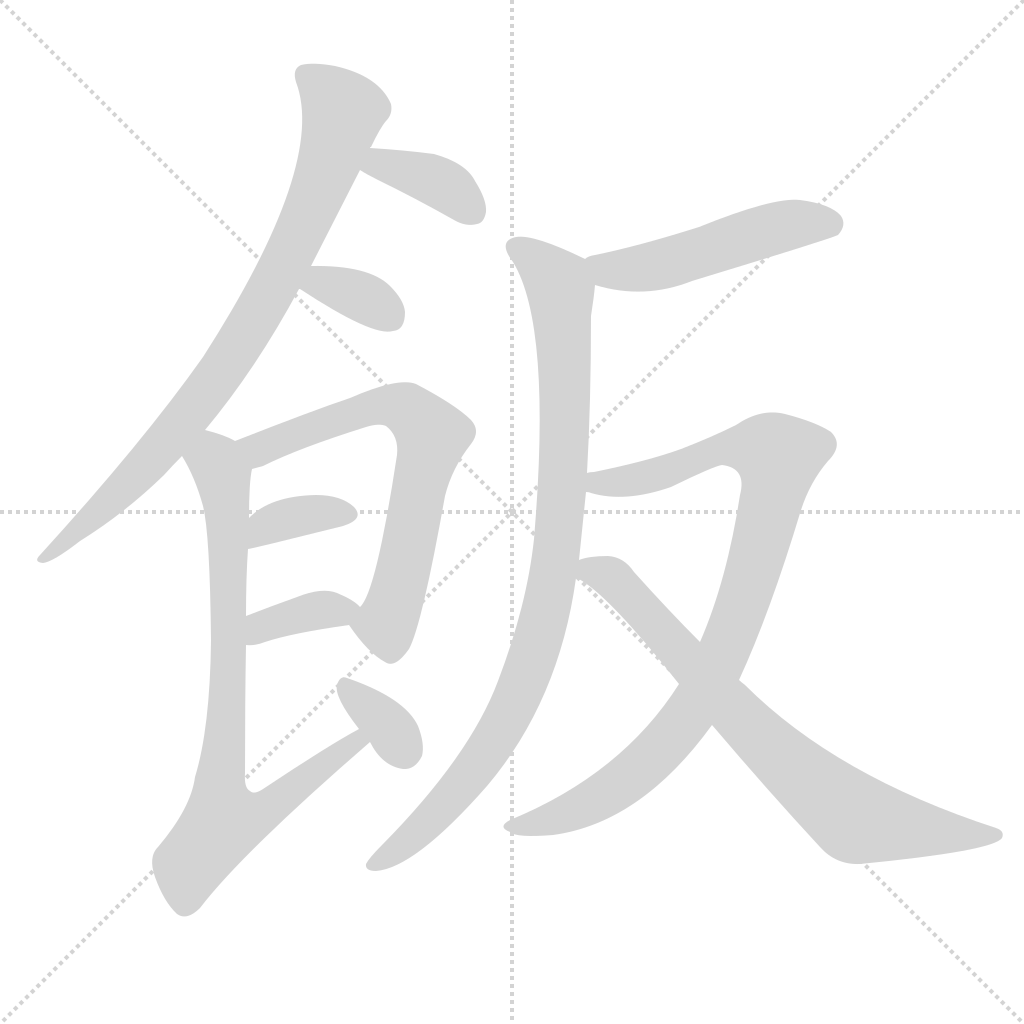
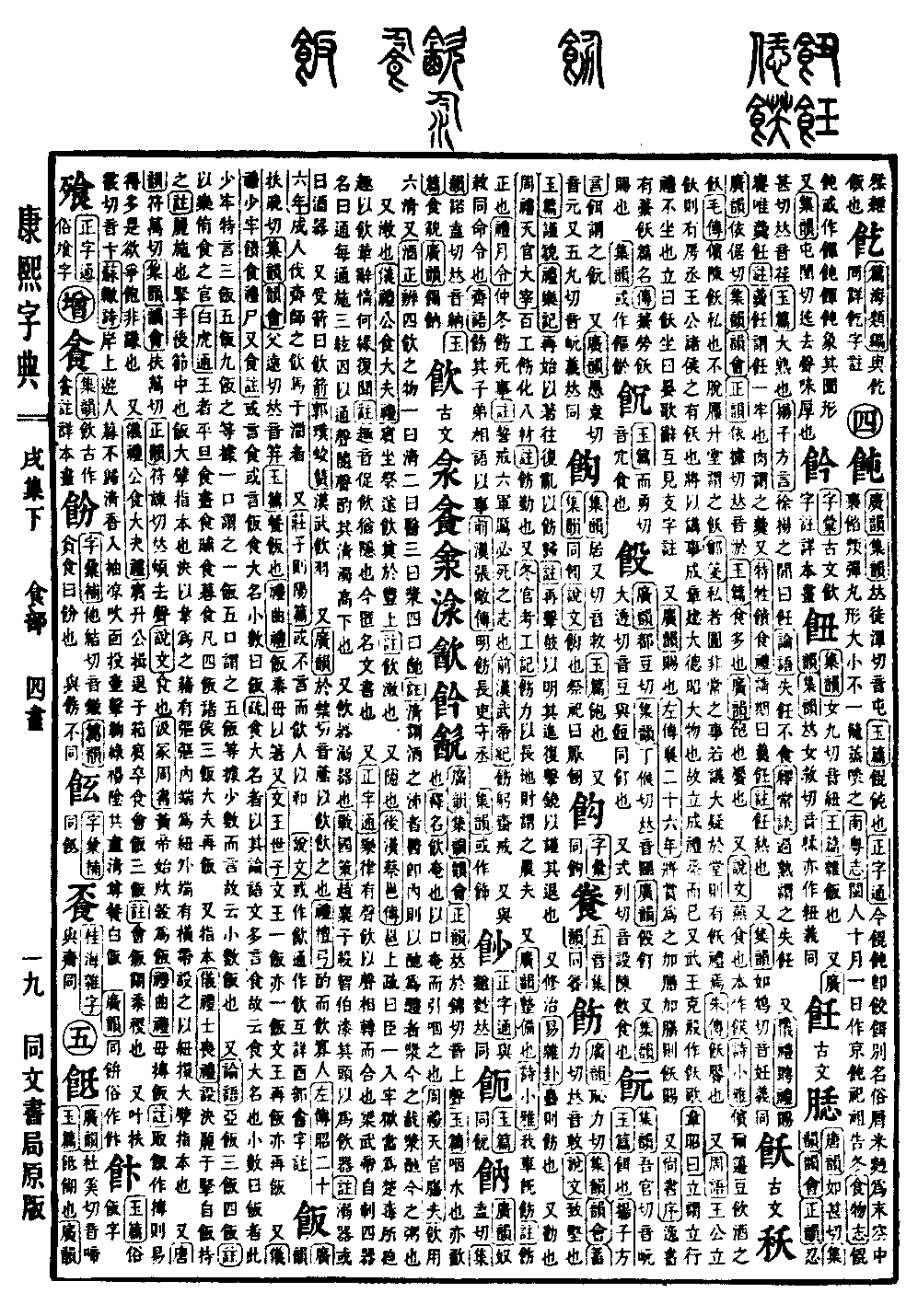
Xu Collection, Lower Volume
Radical: Food (shí)
Kangxi Strokes: 13
Page 1417, Entry 27
Guangyun (Guangyun): Pronounced fan (rising tone). Jiyun (Jiyun) and Yunhui (Yunhui): Pronounced fan (rising tone).
Yupian (Yupian): To eat rice.
Book of Rites (Liji), Qu Li: Do not use chopsticks while eating.
Wen Wang Shi Zi: When King Wen eats one mouthful of rice, everyone else eats one mouthful; when King Wen eats two mouthfuls, everyone else follows suit.
Yi Li (Yili), Shao Lao Kui Shi Li: Sometimes it is called shi, sometimes it is called fan. Shi is the general term; when counting in detail, it is called fan.
Shu (Commentary): Shi is the general term; because the Analects of Confucius (Lunyu) often uses the word shi, it is considered the general term. When counting in detail, it is called fan, because in the Shao Lao, it specifically mentions three-fan, five-fan, and nine-fan; one mouthful is called one-fan, and five mouthfuls are called five-fan, which is based on a detailed count.
Analects of Confucius (Lunyu): Ya-fan, san-fan, si-fan.
Commentary: These refer to official positions associated with music during meals.
Bai Hu Tong (Bai Hu Tong): The Son of Heaven eats four meals a day, at dawn, noon, dusk, and night; the feudal lords eat three meals; the high officials eat two meals.
Also refers to the base of the thumb.
Yi Li (Yili), Shi Sang Li: Wear the jue (leather thumb ring) on the wrist, grasping it from the base of the thumb.
Commentary: Li means to apply. Qian is the joint behind the wrist. Fan is the base of the thumb. Jue is a protective sheath made of leather, equipped with a hook; the inner end of the hook is a button, and the outer end has a horizontal band. When setting it up, use the button to secure it to the base of the thumb.
Tang Yun (Tang Yun): Pronounced fan (falling tone). Jiyun (Jiyun) and Yunhui (Yunhui): Pronounced fan (falling tone). Zhengyun (Zhengyun): Pronounced fan (falling tone).
Shuowen Jiezi (Shuowen): The meaning of eating.
Jizhong Zhoushu (Jizhong Zhoushu): The Yellow Emperor was the first to boil grains to make rice.
Book of Rites (Liji), Qu Li: Do not knead rice into balls with your hands.
Shu (Commentary): Kneading rice into balls makes it easy to take too much. This indicates a desire to compete for a full stomach rather than showing modesty.
Yi Li (Yili), Gong Shi Da Fu Li: When the guest ascends to the hall and the ruler retires to the side chamber after the ceremony, the guest finishes the meal, eats millet rice, and drinks three times.
Commentary: Hui-fan refers to millet rice.
Also rhymes with bian (falling tone).
Su Zhe poem: Visitors on the bank do not return at dusk, a clear fragrance enters the sleeves as a cool breeze blows on the face. Playing pitch-pot and polo in the shade of green willows, we finish the clear wine and eat white rice.
Guangyun (Guangyun): Same as fan. Commonly written as a variant form (fàn).
Textual Corrections:
Yili Commentary: Shi is the general term; when counting in detail, it is called fan.
Shu (Commentary): According to detailed counting, it is called fan.
Textual note: According to the original text, changed to read as a detailed count and called fan.
Qu Li: Do not knead rice.
Commentary: Taking rice and kneading it makes it easier to take too much.
Textual note: According to the original text, changed from Commentary to Shu (Commentary).
Yi Li (Yili), Gong Shi Da Fu Li: The guest ascends, the duke bows and retires to the side chamber, the guest finishes eating, meets the meal and drinks three times.
Textual note: According to the original text, changed from three-fan to three drinks.