Wei Collection, Lower Volume
Radical: Flesh (ròu)
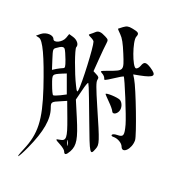
胕
Kangxi Stroke Count: 11
Page 978, Entry 13
Pronounced fu (falling tone). As noted in Broad Rhymes (Guangyun), Collected Rhymes (Jiyun), and Collection of Rhymes (Yunhui), and also noted in Correct Rhymes (Zhengyun), the pronunciation is the same as fu (falling tone). In the Taixuan Jing by Yangzi, there is the phrase, the movement of the lungs and heart. Broad Rhymes defines this as lung and heart, referring to the heart and the spine. Collected Rhymes defines this as the six internal organs of a human. Correct Rhymes points out that writing this as lung and internal organs in the History of Jin (Jinshu) is incorrect.
Also, Collected Rhymes gives the pronunciation as fu (level tone), same as skin. It refers to the foot. Sometimes written in a variant form (fu). In the Strategies of the Warring States (Zhanguoce), it is recorded: Dragging a salt cart up the Taihang Mountains, the hooves stretched and knees bent, the tail soaked and the foot festered. In the Explanation of Texts (Shiwen), the pronunciation is given as skin.
Also, Five Sounds Collected Rhymes gives the pronunciation as fu (level tone), same as support, referring to swelling. In the Classic of Mountains and Seas (Shanhaijing), it is recorded: There is a grass on Zhushan Mountain named huangguan. Bathing in it cures scabies, and it can also cure swelling. The commentary defines this as treating swelling, with a pronunciation same as fu (rising tone).
Also, Collection of Rhymes points out that it can be used as a loan character for attach. In the Biography of Liu Xiang in the Former Han (Qianhan), there is the phrase, I am fortunate to be entrusted as a close confidant. The commentary defines this as the liver and lungs being attached to one another.