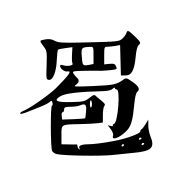
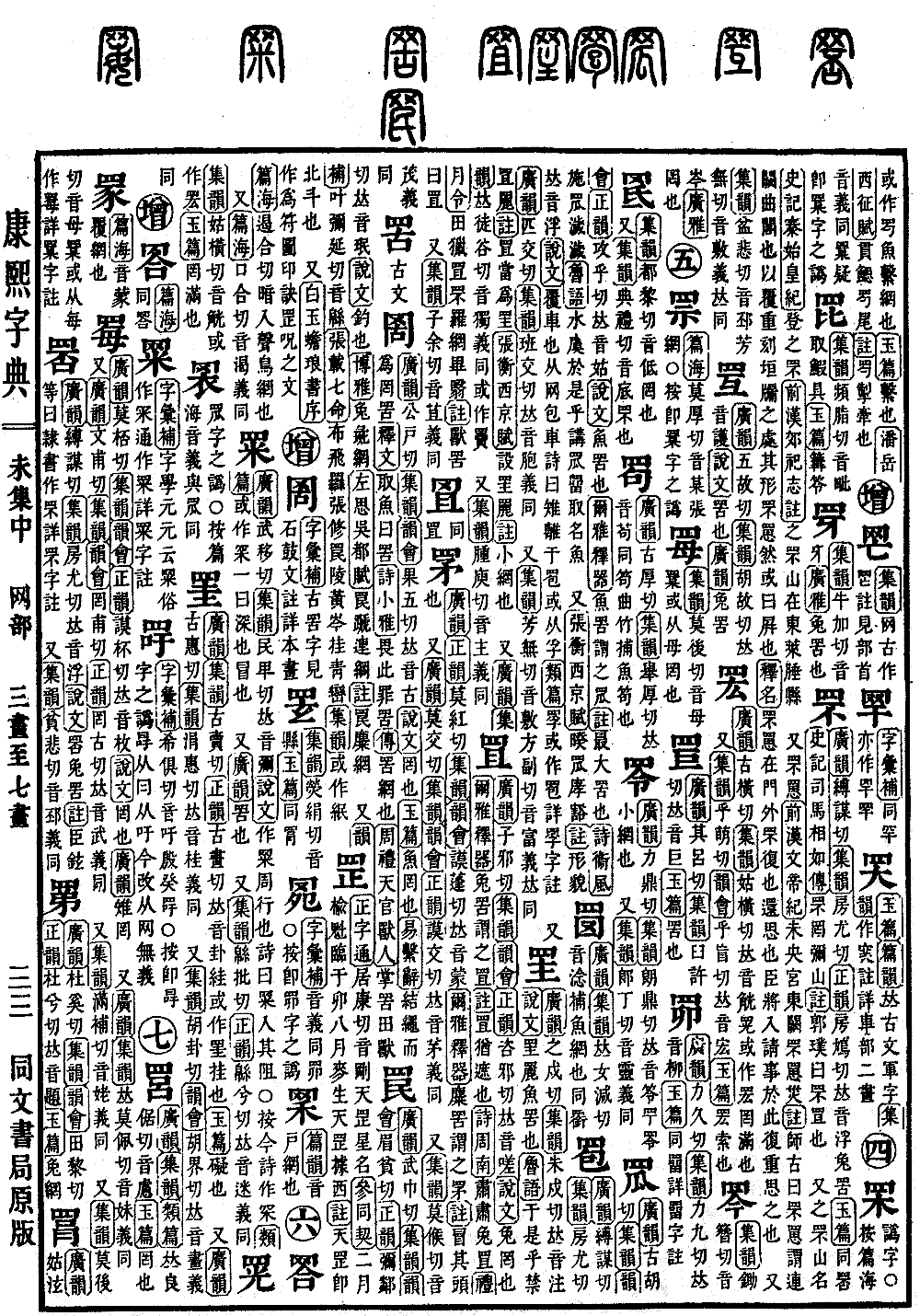
Pronounced fu (falling tone), from the rhyme book Guangyun (Guangyun), and fang you qie (falling tone), from the rhyme book Jiyun (Jiyun). The pronunciation is the same as fu. The text Shuowenjiezi (Shuowenjiezi) explains it as a hunting tool used to overturn vehicles. The character's form is composed of "net" (wang) enclosing "vehicle" (che). There is a sentence in the Book of Odes (Shijing) that says: "Wild chickens crash into the trap." This character is also written in a variant form with "fu" (fu). The text Leipian (Leipian) records that "fu" is sometimes also written as "fu". For a detailed explanation, please refer to the annotation of the character "fu".
Additionally, pronounced pi jiao qie (falling tone), from the rhyme book Guangyun (Guangyun), and ban jiao qie (falling tone), from the rhyme book Jiyun (Jiyun). The pronunciation is the same as bao. The meaning is the same.
Furthermore, pronounced fang wu qie (falling tone), from the rhyme book Jiyun (Jiyun). The pronunciation is the same as fu. Pronounced fang fu qie (falling tone), the pronunciation is the same as fu. The meaning is the same.