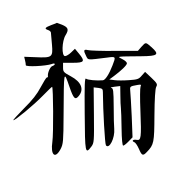
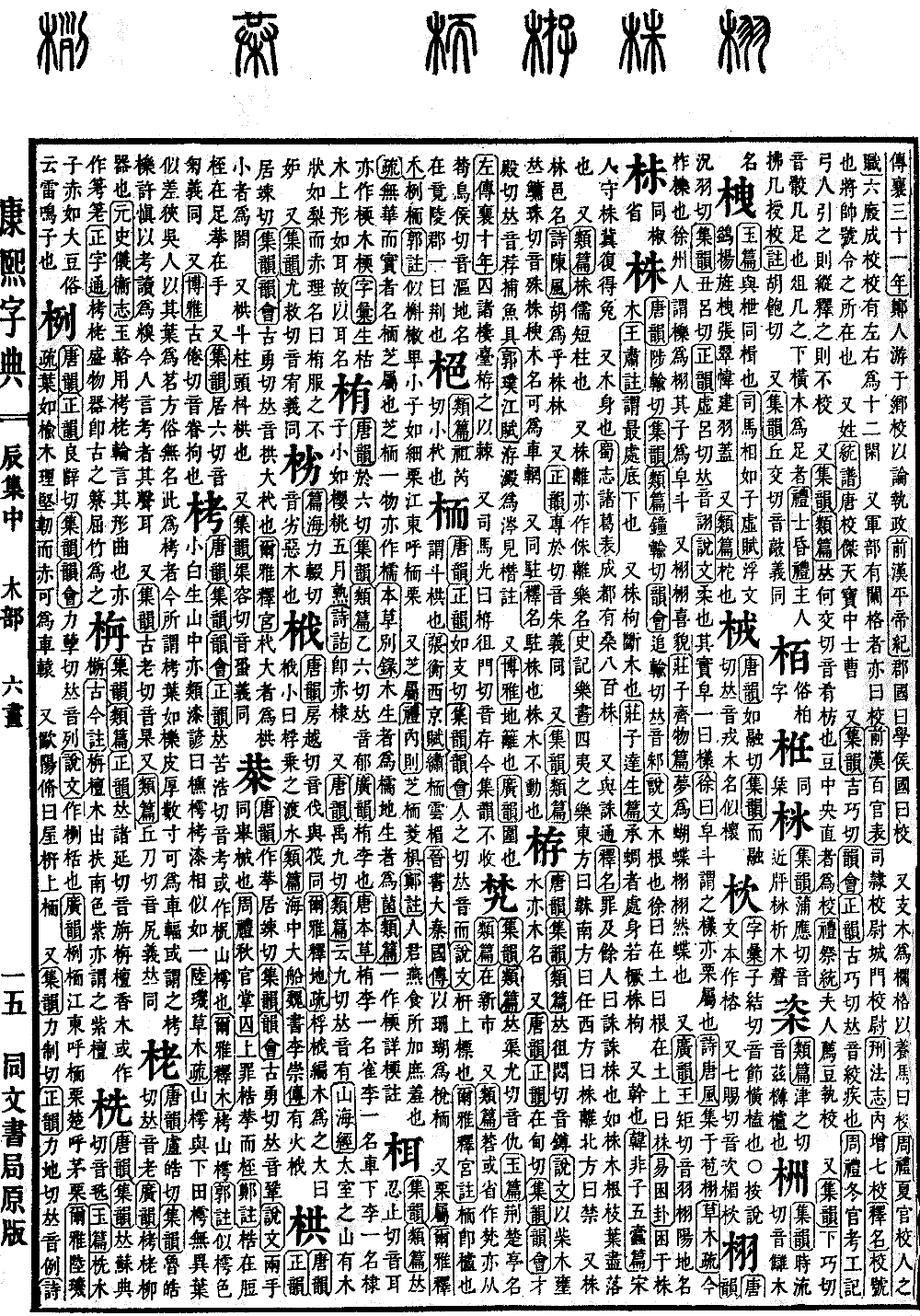
Chen Collection, Middle Volume
Radical: Tree (mù)
Er
Kangxi strokes: 10
Page 523, Entry 15
Pronounced er
In the Shuo Wen Jie Zi (Explaining Graphs and Analyzing Characters), it is a support above a pillar. In the commentary to the Erya (Approaching Elegance), the section on palaces, it is noted that this is a pedestal, referring to the bracket system in architecture. In the Western Capital Rhapsody (Xijing Fu) by Zhang Heng: embroidered brackets and cloud-patterned lintels. In the History of Jin (Jin Shu), biography of the Roman Empire: using coral for kingposts and brackets.
Also a type of chestnut. In the Erya, section on trees: the liew tree is called er. According to the commentary by Guo, it resembles the oak but is smaller, with fruit like a small chestnut; in the regions east of the Yangtze River, it is called the er chestnut.
Also a type of fungus. In the Book of Rites (Liji), section on inner discipline: fungus, mushrooms, water caltrops, and hovenia. According to the commentary by Zheng, these are the various delicacies added to the meals of the ruler. According to the sub-commentary, things that have no flowers but bear fruit are called er, which is a type of fungus. Fungus and er are the same thing. Sometimes also written in a variant form (nuo). In the Additional Records of the Materia Medica (Bencao Bieli), it is stated that those growing on wood are called nuo, and those growing on the ground are called mushrooms. In the Lei Pian (Classified Chapters), it is also written as another variant form. See detailed note.