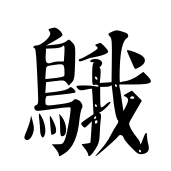
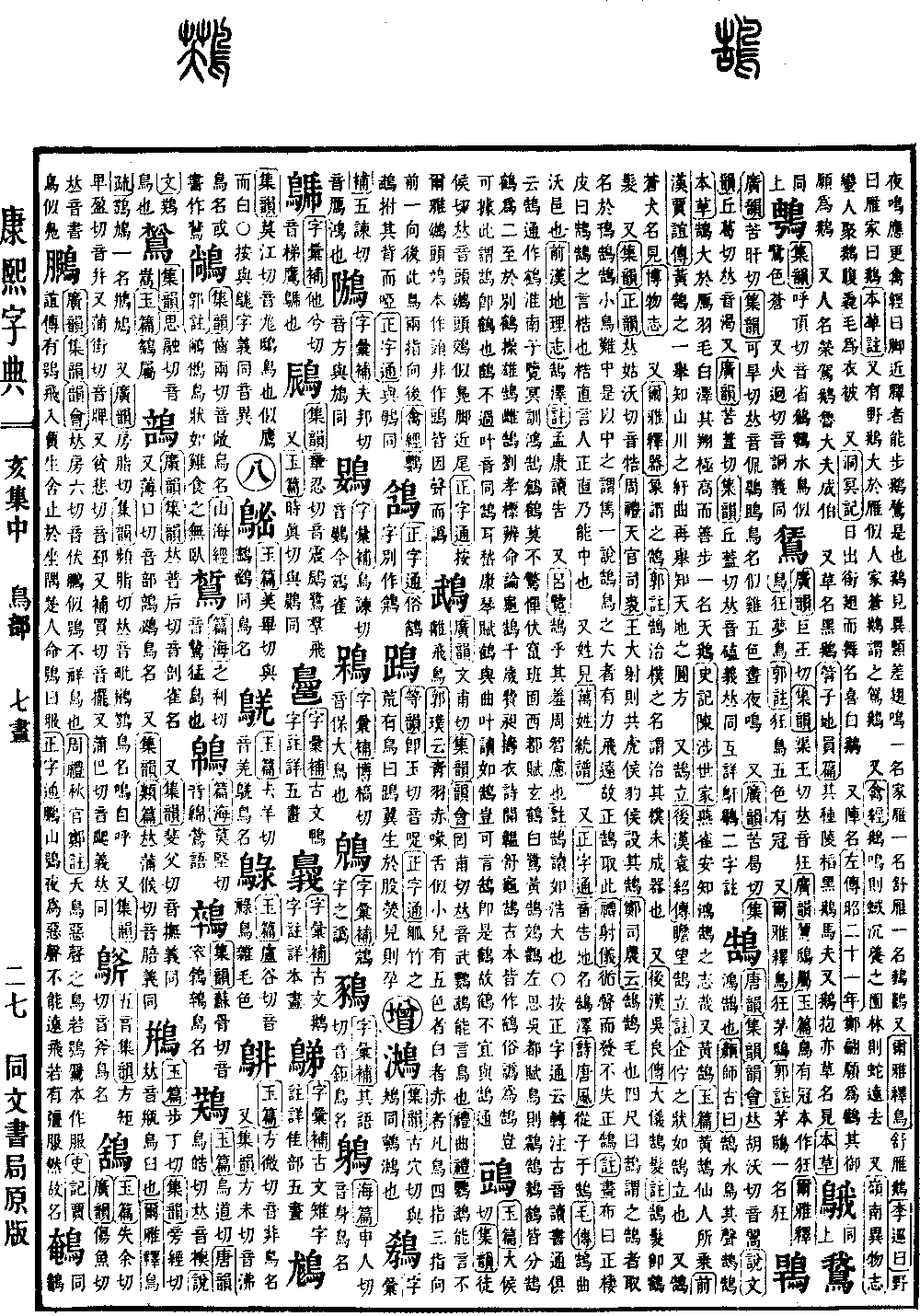
Hai Collection, Middle Volume, Radical: Bird (niǎo)
Goose (é); Kangxi Stroke Count: 18; Page: Page 1490, Entry 31
Classical Literature:
From the "Tang Yun" (Táng Yùn), the pronunciation is 'wu he qie'. From the "Ji Yun" (Jí Yùn), "Yun Hui" (Yùn Huì), and "Zheng Yun" (Zhèng Yùn), the pronunciation is 'niu he qie', with the same reading as "e" (峩).
"Shuo Wen" (Shuō Wén) explains it as a goose. With a long neck, it is good at calling out, and its head is held high as if with an arrogant posture, hence it is called "e" (鵝).
"Pi Ya" (Pī Yǎ) states that the goose's neck resembles a tumor, and in the Jiangdong region today, geese are called "qie" (鴚). Li Shizhen says: The goose has green eyes, a yellow beak, red feet, is good at swimming, and its calls at night correspond to the watchman's drum. The "Qin Jing" (Qín Jīng) says: Birds whose feet are close to their tails are good at walking; geese and ducks are of this kind. Geese spread their wings and call when they see strangers. Another name is domestic goose. It is also called "shu yan" (舒雁). It is also called "yì mián" (鵱鷜).
Also, in the "Er Ya - Shi Niao" (Ěr Yǎ - Shì Niǎo), it is recorded: "Shu yan" (舒雁) is the goose. Li Xun explains: Wild ones are called geese (雁), and domesticated ones are called geese (鵝).
"Ben Cao Zhu" (Běn Cǎo Zhù) mentions: There are also wild geese, larger than domestic geese, resembling domesticated gray geese, called "ge e" (鴐鵝).
Furthermore, the "Qin Jing" (Qín Jīng) records: When the goose calls, the 'yu' (蜮) will sink into the water. Raising geese in gardens keeps snakes away.
Also, the "Ling Nan Yi Wu Zhi" (Lǐng Nán Yì Wú Zhī) records: Southern ethnic minorities collect the fine down from the goose's belly to make clothes and bedding.
Also, the "Dong Ming Ji" (Dòng Míng Jì) records: There is a type of goose that dances at sunrise, holding its wings, named the "xi bai e" (喜白鵝).
It also refers to a type of military formation. The "Zuo Zhuan - Zhao Gong Twenty-One Years" (Zuǒ Zhuàn - Zhāo Gōng Èr Shí Yī Nián) records: Zheng Pian wished to form a crane formation, and his charioteer wished to form a goose formation.
It also refers to a person's name. Rong Jia'e (榮駕鵝) was a minister of Lu.
It also refers to a type of grass. Black goose (黑鵝). The "Guan Zi - Di Yuan Pian" (Guǎn Zi - Dì Yuán Piān) records: Among the Ling rice they planted were black goose (黑鵝) and coachman grass. There is also "e bao" (鵝抱), which is also a type of grass, found in the "Ben Cao" (Běn Cǎo).