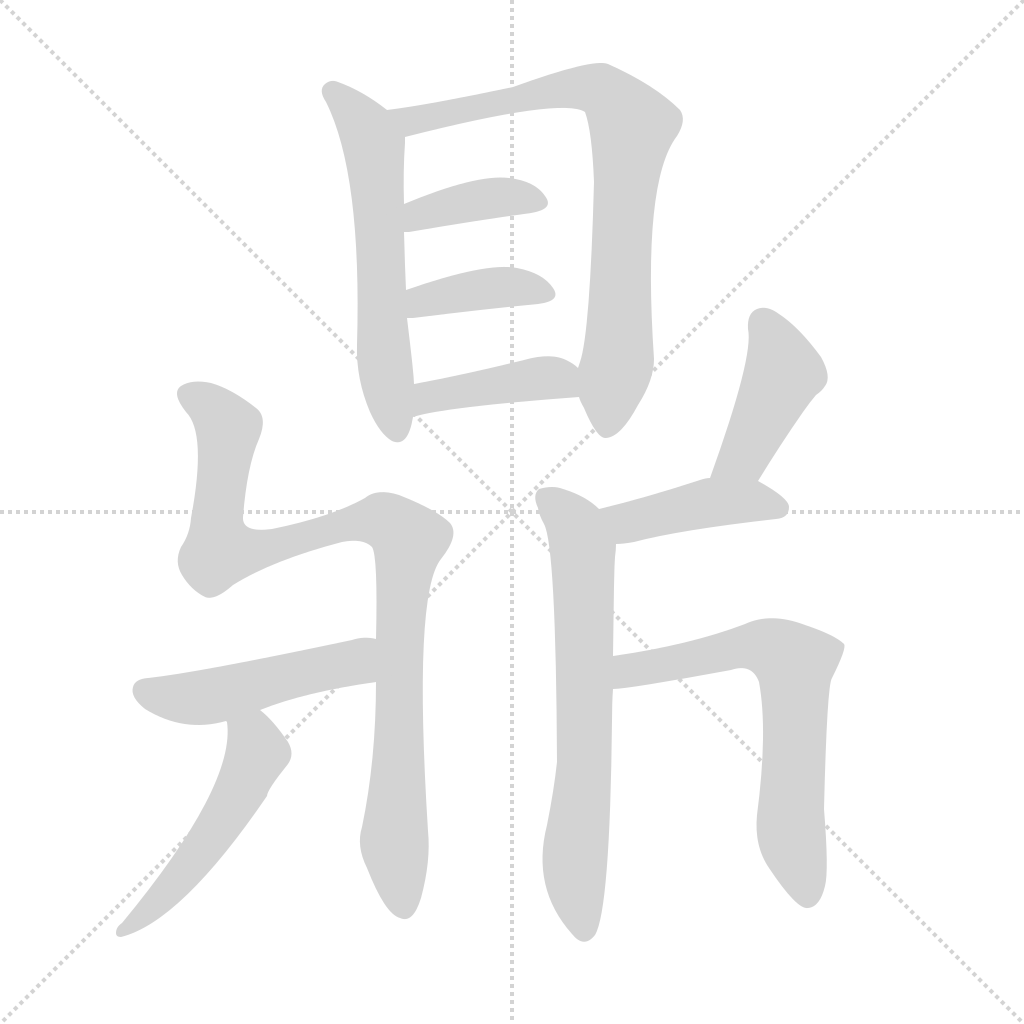
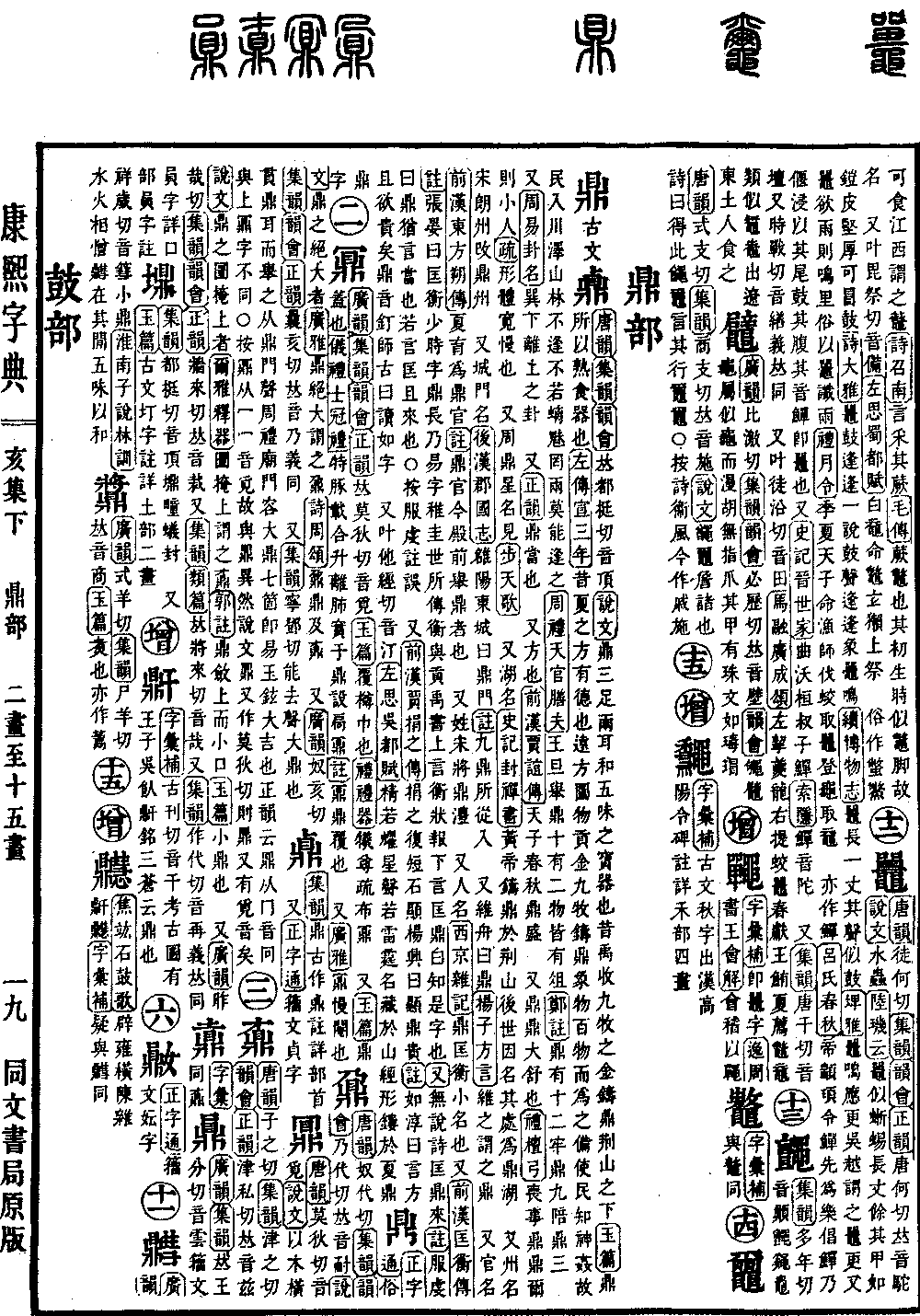
Hai Collection, Lower Volume, Radical: Tripod (dǐng), Kangxi strokes: 13, Page 1525, Entry 08.
The ancient form is written as a variant form (dǐng).
Pronounced ding.
Explaining Chinese Characters (Shuowen Jiezi): The tripod is a precious vessel with three legs and two ears, used to harmonize various flavors. Long ago, Great Yu collected metal contributed by the officials of the Nine Provinces and cast tripods at the foot of Mount Jing.
Jade Chapters (Yupian): The tripod is a vessel used for cooking food.
Chronicle of Zuo (Zuo Zhuan), Year 3 of Duke Xuan: In the past, when the Xia dynasty possessed virtue, it had images of the various things from distant lands depicted. The officials of the Nine Provinces contributed metal, and tripods were cast with these images engraved upon them. All things were thus represented, allowing the people to identify spirits and strange phenomena. Therefore, when the people entered rivers, lakes, mountains, or forests, they did not encounter adversity, and the demons of the mountains, forests, rivers, and marshes could not harm them.
Rites of Zhou (Zhouli), Office of Heaven, Chief Steward: The Son of Heaven slaughters a sacrificial animal daily for the grand feast, using twelve tripods; the meat served is accompanied by cutting boards.
Zheng Xuan's Commentary: There are twelve tripods, consisting of nine "Lao" tripods for beef, lamb, and pork, and three "Pei" tripods for additional delicacies.
Also, it is the name of a hexagram in the Book of Changes (Zhouyi), referring to the hexagram with the Wind (Xun) trigram below and the Fire (Li) trigram above (known as the Fire-Wind Tripod hexagram).
Also, according to Correct Rhymes (Zhengyun), the character signifies the meaning of "to be" or "to correspond to."
It also carries the meanings of "square" and "upright."
History of the Former Han (Qian Hanshu), Biography of Jia Yi: The Son of Heaven is just in the prime of his life.
Also "ding ding" refers to an appearance of being greatly relaxed or at ease.
Book of Rites (Liji), Tan Gong: If one is overly relaxed and at ease while conducting funeral rites, that is the behavior of a base person.
Commentary: This refers to a physical appearance that is loose and lacking in reverence.
Also, "Zhou Tripod" is the name of a star constellation. Found in the Star Chart Song (Butian Ge).
Also, the name of a lake.
Records of the Grand Historian (Shiji), Treatise on the Feng and Shan Sacrifices: The Yellow Emperor cast a tripod at Mount Jing, and later generations therefore named that place Tripod Lake.
Also, the name of a prefecture. During the Song dynasty, Lang Prefecture was renamed Ding Prefecture.
Also, the name of a city gate.
History of the Later Han (Hou Hanshu), Treatise on Administrative Geography: The eastern gate of the city of Luoyang was called the Tripod Gate.
Commentary: This is the gate through which the Nine Tripods later passed when they entered the city.
Also, the act of mooring a boat is called "ding."
Fangyan (Local Dialects): To tie up or moor (a boat) is called "ding."
Also, the name of an official post.
History of the Former Han (Qian Hanshu), Biography of Dongfang Shuo: Xia Yu served as a Tripod Official.
Commentary: The Tripod Official is the person who lifts the tripod before the palace hall.
Also, a surname. Wei Jiang (a person's name) Ding Li.
Also, a personal name.
Miscellaneous Records of the Western Capital (Xijing Zaji): "Ding" was the childhood name of Kuang Heng.
Also, Commentary on the History of the Former Han (Qian Hanshu), Biography of Kuang Heng: Zhang Yan says: Kuang Heng's childhood character was "Ding," and he changed it to "Zhigui" only after he grew up. In the letter Kuang Heng wrote to Gong Yu that has been passed down, it begins with "Heng reports" and ends with "Kuang Ding bows," from which we know that "Ding" was his character.
Also: "Do not say to Kuang Ding [Kuang Heng] about the poems."
Commentary: Fu Qian says: "Ding" is like saying "to be," as if saying Kuang Heng should come for now. Note: Fu Qian's annotation is incorrect.
Also, History of the Former Han (Qian Hanshu), Biography of Jia Juanzhi: Jia Juanzhi slandered Shi Xian. Yang Xing said: Shi Xian is just about to be in a prominent position.
Commentary: Ru Chun says: The meaning is that he is about to become prominent. "Ding" is pronounced like the word for "nail." Yan Shigu says: It should be read according to the original pronunciation of the character.
Also, used as a rhyme, pronounced ting.
Zuo Si, Rhapsody on the Capital of Wu (Wu Du Fu): The brilliance is like shining stars, the momentum like a thunderclap. The name is recorded in the Classic of Mountains and Seas (Shanhaijing), and the image is carved upon the Xia Tripod.
Textual research: In Rites of Zhou, Office of Heaven, Chief Steward, there is the phrase "The King daily lifts." Note: The character for "daily" (ri) combined with "one" (yi) is a corruption of the character for "sun" (ri). According to the original text, this has been corrected to "The King makes one daily offering."