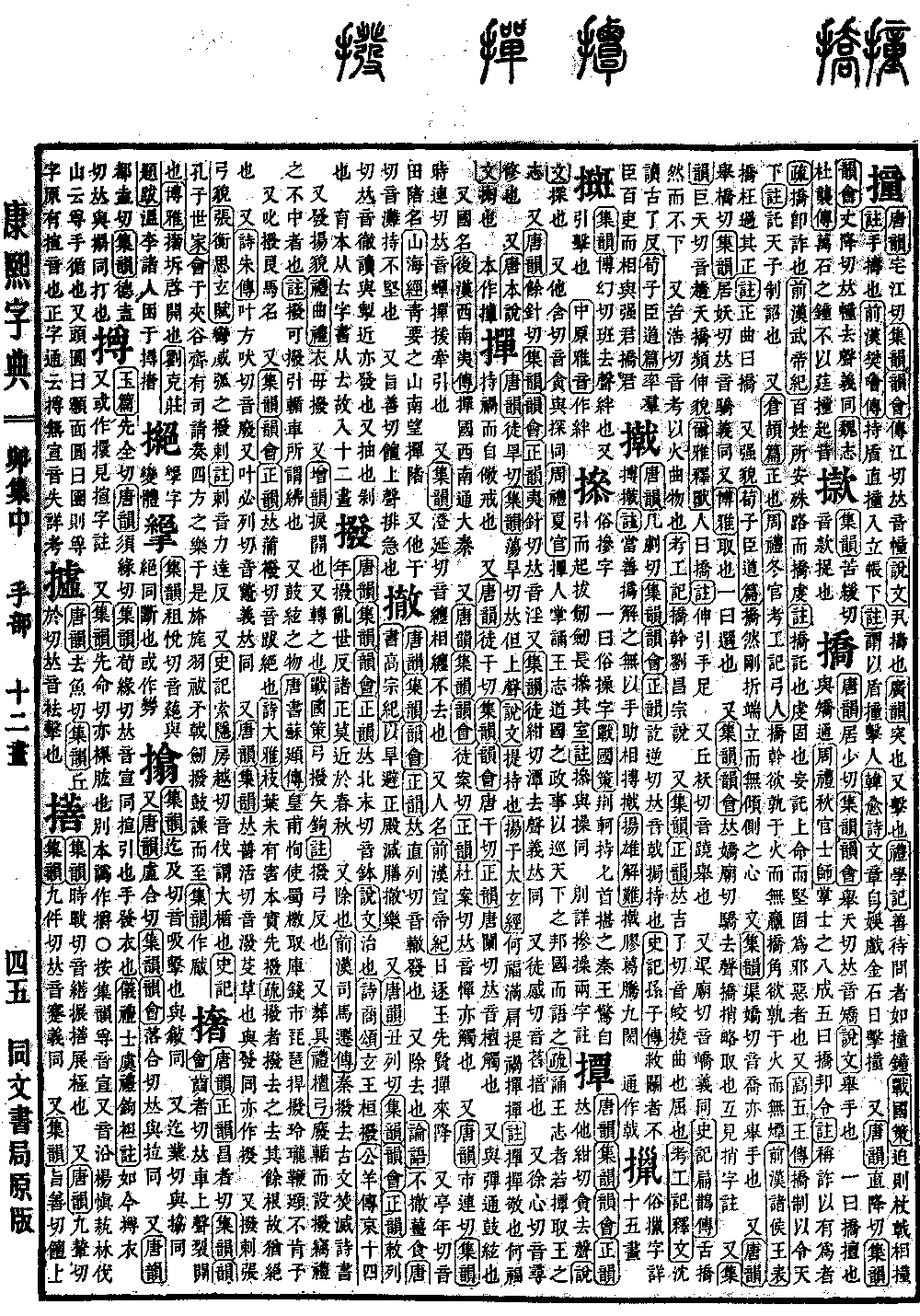
Mao Collection, Middle Volume. Radical: Hand (shǒu). Kangxi strokes: 16. Page 455, Entry 09.
Pronounced dan (rising tone). According to the Shuowen Jiezi, it means to lift or hold. In the Grand Mystery (Taixuanjing) by Yangzi, it is written: What fortune fills the shoulders, lifting misfortune as if it were dan. The commentary states: Dan-dan is an expression of respect. It means to hold fortune and misfortune in one's hands while remaining self-vigilant.
Also, pronounced tan. It means to touch or brush against. Also interchangeable with the character tan, meaning to pluck the strings of a zither.
Also, the name of a country. According to the History of the Later Han (Hou Hanshu), in the account of the Southwestern Barbarians, the country of Dan is located in the southwest, leading to the Great Qin Empire.
Also, pronounced dan (falling-rising tone). It also means to touch or brush against.
Also, pronounced chan. Dan-yuan means to pull or lead.
Also, pronounced chan. It means to be intertwined and unable to separate.
Also, used in a personal name. In the Annals of Emperor Xuan of the Former Han (Hanshu), the Ri-zhu King Xian-xian-dan came to surrender.
Also, pronounced tian. The name of a small piece of land in the water. According to the Classic of Mountains and Seas (Shanhaijing), looking south from the Green Essential Mountain, there is Dan-zhu.
Also, pronounced tan. It means to hold something insecurely.
Also, pronounced zhan (rising tone). It means to exclude or alleviate urgency.