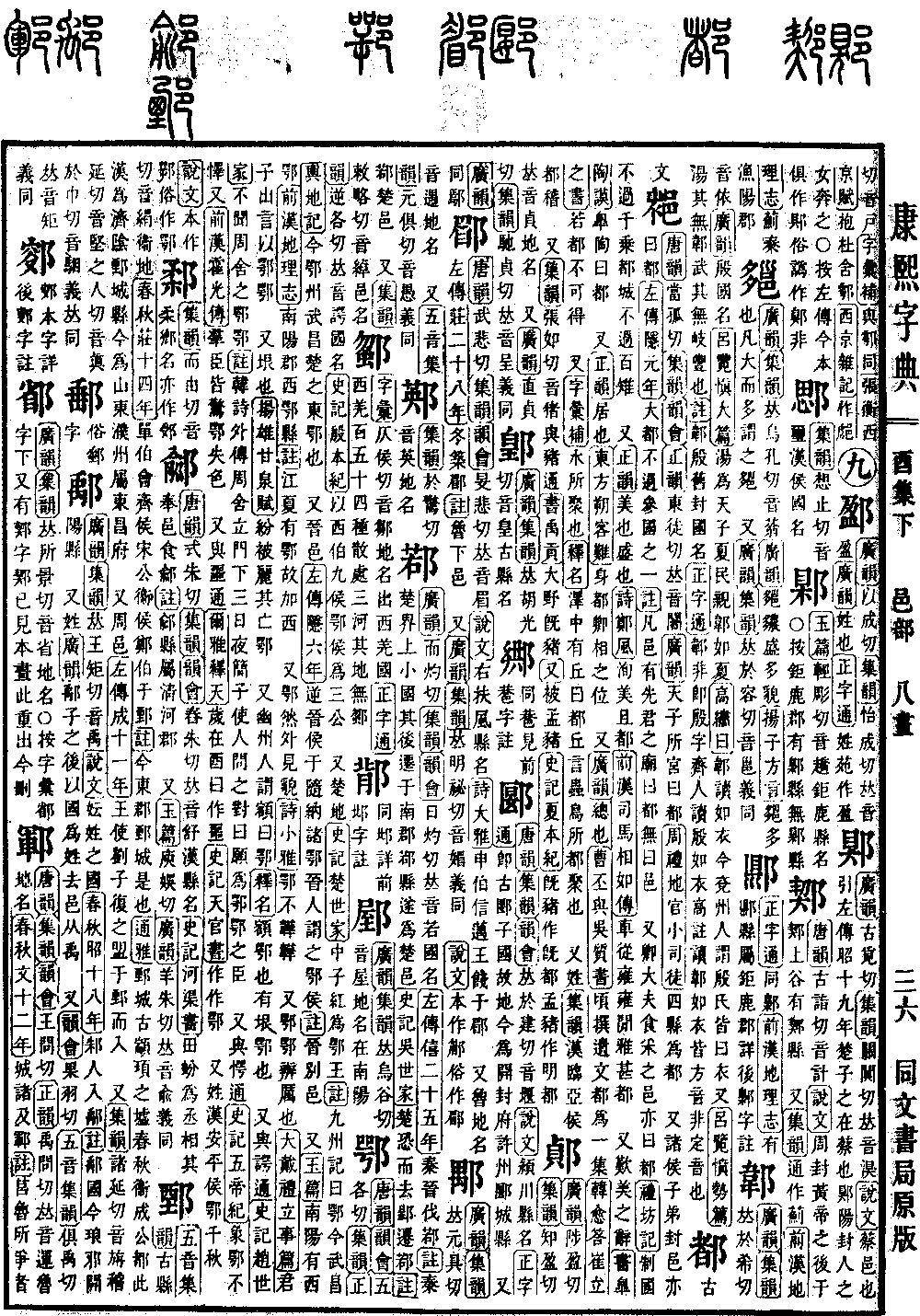
You Collection, Lower Volume; Radical: City (yì); Character: 都; Kangxi Strokes: 16; Page: 1274, Entry 09
Ancient Pronunciation: In Tangyun (Tángyùn), pronounced dàngū qiè. In Jiyun (Jíyùn), Yunhui (Yùnhuì), and Zhengyun (Zhèngyùn), pronounced dōngtú qiè, pronounced similarly to shé.
Guangyun (Guǎngyùn): The palace where the Son of Heaven resides is called dù.
Zhou Li (Zhōulǐ), Official of Earth, Minor Minister: Four counties combined are called dù.
Also, the fiefdoms of feudal lords' sons are also called dù.
Zuo Commentary (Zuǒzhuàn), Year 1 of Duke Yin: A large capital city must not exceed one-third the size of the national capital.
Zuo Commentary, Year 28 of Duke Zhuang: Any city or town that has an ancestral temple and offers sacrifices to ancestral spirits is called dù.
Also, the stipend-fiefs (shíyì) of ministers and high officials are also called dù.
Book of Rites (Lǐjì), Fang Ji: A feudal state should not exceed a thousand chariots in scale, and the city walls of its capital should not exceed three hundred zhang.
Also, Zhengyun: means beautiful, grand.
Book of Odes (Shijing), Odes of Zheng: Indeed beautiful and elegant.
Former Han (Qiánhàn), Biography of Sima Xiangru: The accompanying carriages and horses were graceful and harmonious, their demeanor very leisurely and elegant.
Also, a word expressing exclamation.
Book of Documents (Shūjīng), Gao Yao's Counsel: Gao Yao said, "Dū!" (expressing approval).
Also, Zhengyun: means to reside.
Dongfang Shuo (Dōngfāng Shuò), Ke Nan: Occupying the high position of a minister or prime minister.
Also, Guangyun: means altogether, to compile.
Cao Pi (Cáo Pī), Letter to Wu Zhi: Recently I compiled their surviving writings, gathering them into one collection.
Han Yu (Hán Yù), Letter in Reply to Cui Lizhi: If none of them are obtained.
Also, Zihui Bu (Zìhuì Bǔ): The place where water flows gather.
Shiming (Shìmíng): A small mound in a marsh is called dúqiū, meaning that insects and birds all gather there.
Also, a surname.
Jiyun: In the Han Dynasty, there was Linya Hou Dū Jī.
Also, Jiyun: Pronounced zhāngrú qiè, sounding like zhū. Interchangeable with zhū.
Book of Documents, Tribute of Yu: The Daye Marsh was already full of water.
Also: Covered the Mengzhu Marsh.
Records of the Grand Historian (Shǐjì), Annals of Xia: "Jì zhū" is written as "jì dū", and "Mèng zhū" is written as "Míng dū".
Correction Note: Zuo Commentary, Year 1 of Duke Yin: A large capital city must not exceed one-third the size of the national capital. Annotation: Any city or town that has an ancestral temple is called dù; one without is called yì. It is respectfully noted that the annotation cited is from Zuo Commentary, Year 28 of Duke Zhuang, and not an annotation for Year 1 of Duke Yin. It is now revised according to the original text of Zuo Commentary as: Zuo Commentary, Year 28 of Duke Zhuang: Any city or town that has an ancestral temple and offers sacrifices to ancestral spirits is called dù.