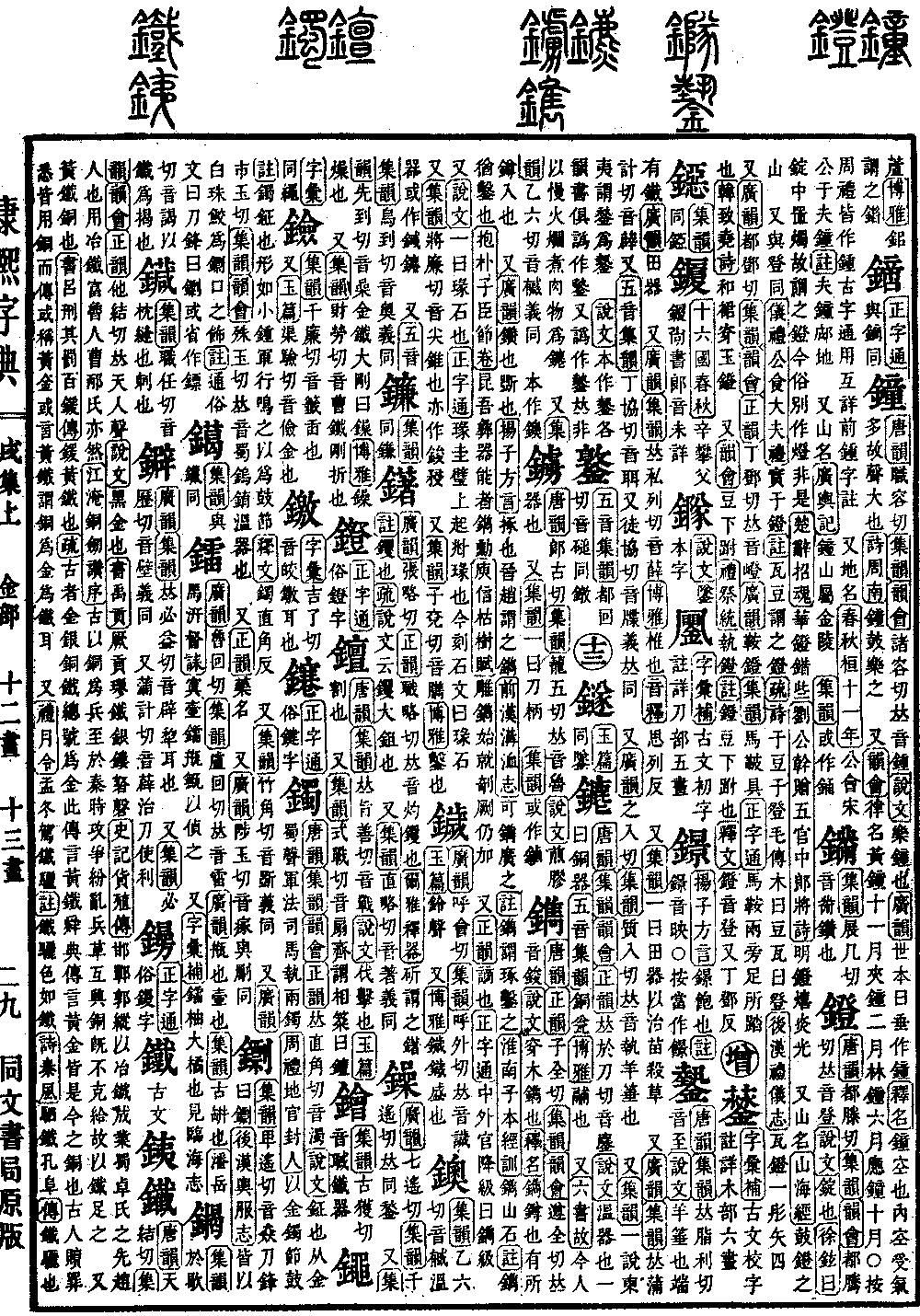
Xu Collection, Upper Volume
Radical: Metal (jīn)
鐺
Kangxi stroke count: 21
Page 1323, Entry 01
Tang Rhymes (Tangyun), Collection Rhymes (Jiyun), Rhyme Meetings (Yunhui), and Orthodox Rhymes (Zhengyun) state the pronunciation is dāng.
In Explaining Graphs and Analyzing Characters (Shuowen), it refers to chains used for locking. See the detailed entry for the character lang.
Also, according to Collection Rhymes (Jiyun) and Rhyme Meetings (Yunhui), the pronunciation is tāng. This is the same as the character tang, referring to the sound of a drum.
Records of the Grand Historian (Shiji), Biography of Sima Xiangru: The sound of kēng qiāng dāng. The commentary states: Dang refers to the sound of a drum.
Also, according to Broad Rhymes (Guangyun), the pronunciation is qiāng. This refers to cooking utensils.
The General Explanations (Tongsufen) states: A pot with legs is called a dang.
The Weilue states: A three-legged vessel for warming wine. During the Tang dynasty, officials Xue Dading, Jia Dunyi, and Zheng Deben were nicknamed the Dang-Leg Censors.
History of Song (Songshi), Annals of Emperor Taizu: Lei Dexiang, serving as a judge in the Grand Court of Revision, impeached Zhao Pu for forcibly purchasing private residences. The Emperor angrily rebuked him: Even a cauldron and a dang have ears to listen; have you not heard that Zhao Pu is a vital minister of my state?
Textual research: In Records of the Grand Historian (Shiji), Biography of Sima Xiangru, the text reads kēng qiāng dāng. The commentary states: Dang refers to the sound of a drum. The text has been corrected to match the original source accordingly.