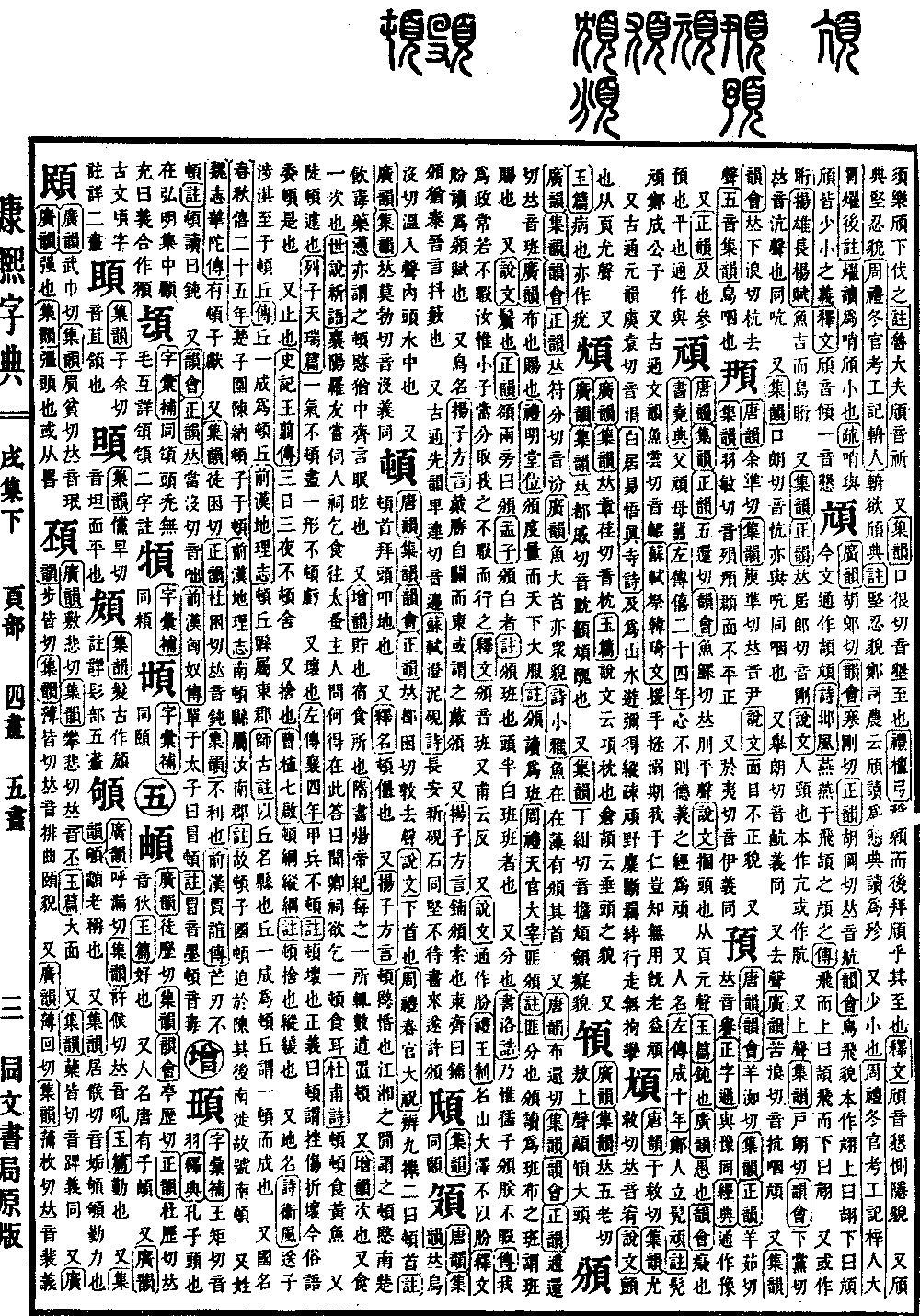
Xu Collection, Lower Volume
Radical: Page (yè)
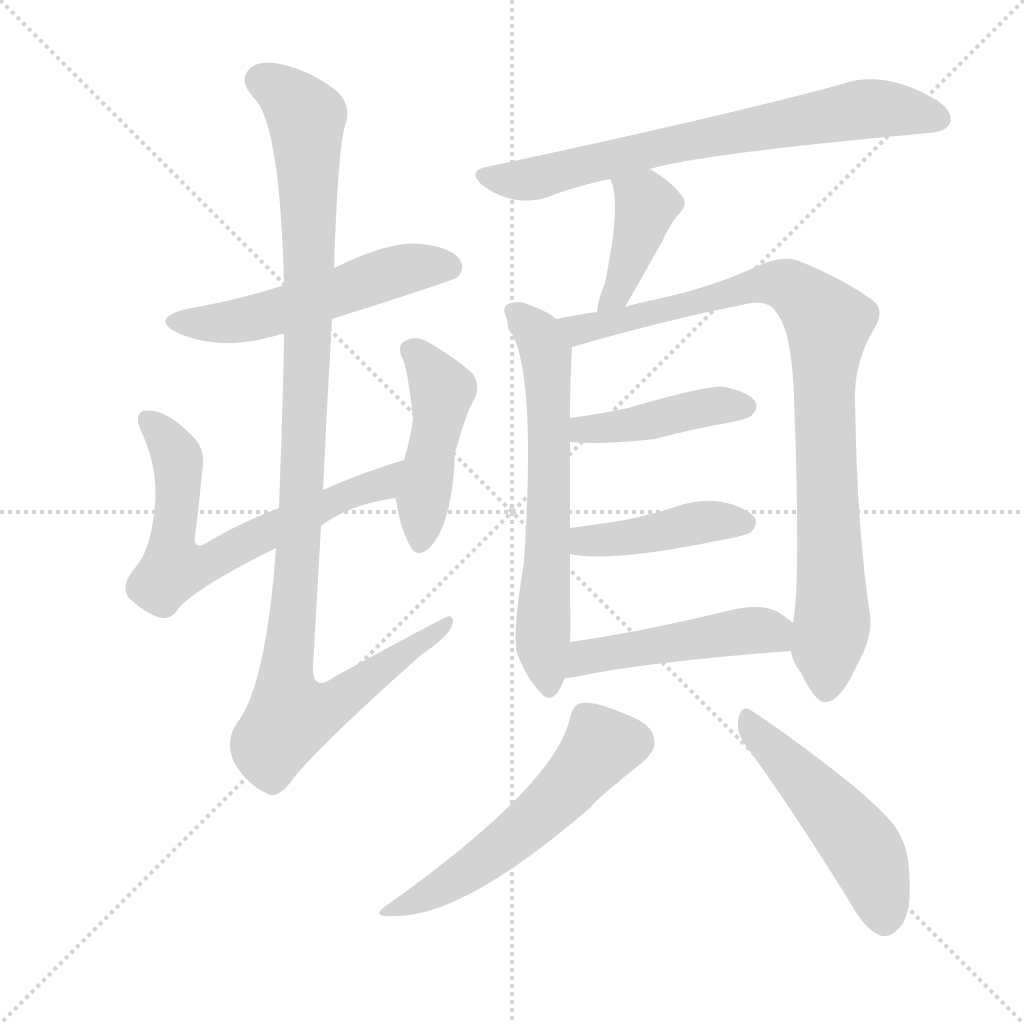
顿
Kangxi strokes: 13
Page 1401, Entry 11
Tang Rhyme (Tangyun), Collection Rhyme (Jiyun), Rhyme Compilation (Yunhui), Correct Rhymes (Zhengyun): Pronounced dun (falling tone).
Shuowen Jiezi: To lower the head.
Book of Rites (Zhouli), Spring Offices, Great Invocation: To distinguish the nine types of obeisance; the second is the kowtow (dunshou). Commentary: The kowtow is to bow and strike the head against the ground.
Expanded Glossary (Guangya): To collapse or become stiff.
Master Yang’s Dialects (Fangyan): Dunmin means confused. Between the Jiang and Xiang rivers, it is called dunmin. In Southern Chu, to be overcome by the distress of poison is also called dunmin, which is like the Qi dialect term for feeling dizzy and faint.
Expanded Rhymes (Zengyun): To store or deposit; a place where food is kept overnight.
Book of Sui (Suishu), Annals of Emperor Yang: Whenever he went to a place, he would establish rest stations (dun) along several routes.
Expanded Rhymes (Zengyun): A stage or stop. Also, one meal.
New Account of Tales of the World (Shishuo Xinyu): Luo You of Xiangyang once waited for someone to offer a sacrifice so that he could beg for food. He arrived too early, and the host asked why he was there. He replied, "I heard you were holding a sacrifice and wanted to beg for a meal (dun)."
Du Fu’s Poetry: Eating yellow croaker meal after meal (dun-dun).
Suddenly or hurriedly.
Liezi, Heavenly Questions Chapter: One breath does not disappear suddenly, one form does not decay suddenly.
To be ruined or worn out.
Zuo Tradition (Zuo Zhuan), Year 4 of Duke Xiang: Armored soldiers and weapons were not blunted (dun). Commentary: Dun means to be frustrated, damaged, or ruined; the modern vernacular expression for exhausted (weidun) comes from this.
To stop or halt.
Records of the Grand Historian (Shiji), Biography of Wang Jian: For three days and three nights, they did not halt or lodge (dun-she).
To lodge or set down.
Cao Zhi, Seven Exhortations (Qi Qi): To set down (dun) the net and loosen the cords. Commentary: Dun means to set down; zong means to loosen.
Place name.
Book of Odes (Shijing), Odes of Wei: Seeing you off across the Qi River, as far as Dunqiu. Commentary: A hill formed in one stage is called a Dunqiu.
History of the Former Han (Qianhan Shu), Treatise on Geography: Dunqiu County belonged to the Eastern Commandery. Commentary: The county was named after the hill. A hill formed in one stage is called a Dunqiu, meaning it was formed in a single stage (dun).
Name of a state.
Spring and Autumn Annals (Chunqiu), Year 25 of Duke Xi: The people of Chu besieged Chen and restored the Viscount of Dun to Dun.
History of the Former Han (Qianhan Shu), Treatise on Geography: Nandun County belonged to Runan Commandery. Commentary: This was the site of the former state of the Viscount of Dun. Dun was pressed by the state of Chu; later it moved south, hence it was called Nandun.
Surname.
Records of the Three Kingdoms (Weizhi), Biography of Hua Tuo: There was a man named Dun Zi-xian.
Collection Rhyme (Jiyun): Pronounced dun (falling tone); Correct Rhymes (Zhengyun): Pronounced dun (falling tone), sounding like blunt (dun).
Collection Rhyme (Jiyun): Not sharp.
History of the Former Han (Qianhan Shu), Biography of Jia Yi: The sharp edges were not blunted (dun). Commentary: Dun is read as blunt (dun).
Rhyme Compilation (Yunhui), Correct Rhymes (Zhengyun): Pronounced duo (entering tone).
History of the Former Han (Qianhan Shu), Biography of the Xiongnu: The Chanyu’s crown prince was called Modun. Commentary: Mo is pronounced mo; dun is pronounced du.