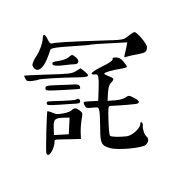
Tang Yun pronounces this as gu. Jiyun, Yunhui, and Zhengyun pronounce this as du, with a pronunciation identical to the word for jealousy. Shuowen Jiezi explains it as the act of placing a wine goblet. The character is formed with the Radical: Cover (mì), using the phonetic element for entrust (tuo). The Book of Documents (Shangshu), Zhou Documents (Zhou Shu), records: The king performed three overnight stays, three sacrifices, and three offerings. Xu Kai explains that the term dian means to place. This refers to the ritual of offering three times, sacrificing three times, and performing three libations by placing the wine goblet upon the ground. The goblet has a covering used to shield the mouth of the vessel. The Modern Text Book of Documents (Jinwen Shangshu) writes this character as zha. Changjian posits that the term for three zha in the Zhou Documents should be written as this character. Jiyun notes that this character may also be written as zhai or cha.
Additionally, Tang Yun and Jiyun pronounce this as jia, with a pronunciation identical to the word for boast. The meaning remains the same. Liushu Zheng'e points out that some people currently use the character for shout, but this is incorrect.