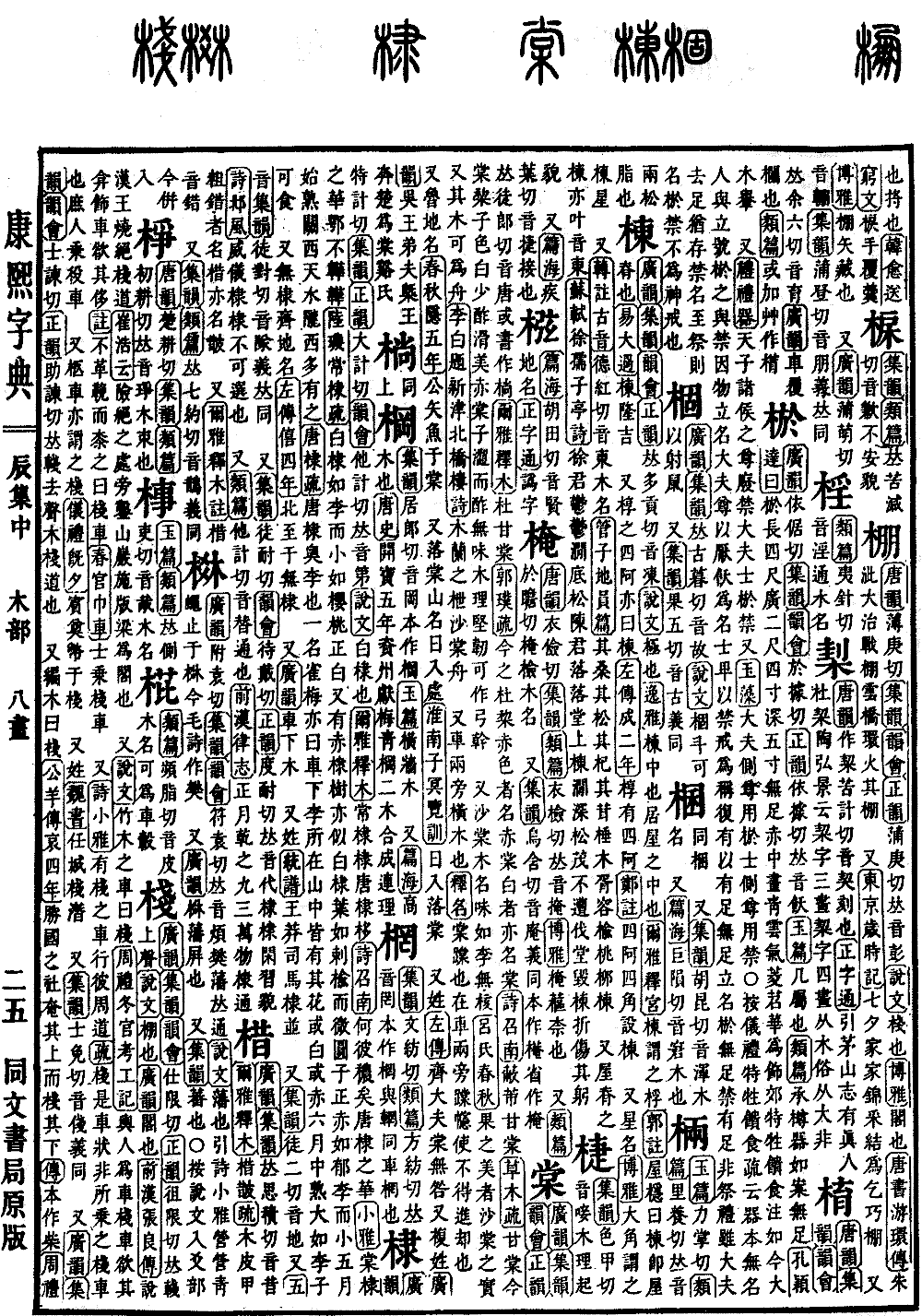
Chen Collection, Middle Volume
Radical: Tree (mù)
棟
Kangxi strokes: 12
Page 533, Entry 10
Pronounced dòng. According to the Classic of Etymology (Shuowen Jiezi), it refers to a ridgepole. According to the Explanations of Names (Shiming), a ridgepole is the center; it resides in the middle of a house. According to the Erya: Explanations of Palaces (Erya: Shigong), the ridgepole is called a raft. According to the commentary by Guo Pu, the support of a roof is called a ridgepole, which is the roof ridge. According to the Book of Changes (Yijing), in the Great Excess hexagram, it says the ridgepole is high, which is auspicious.
Furthermore, the four sloping sides of an outer coffin are also called ridgepoles. According to the Zuo Commentary (Zuozhuan), in the second year of Duke Cheng, it mentions the outer coffin has four sloping sides; the commentary by Zheng Xuan states that the four sloping sides have ridgepoles installed at the corners.
Also, the name of a star. According to the Guangya, the star Arcturus is called the Ridgepole Star.
Also, pronounced dōng. A type of tree. According to the Guanzi: On the Characteristics of Soil, it mentions mulberry, pine, wolfberry, and fleeceflower. Planting trees such as the elm, peach, willow, and ridgepole tree.
Also, regarding the ridgepole of a roof, it also rhymes with dōng. According to a poem by Su Shi regarding the Xu Ruzi Pavilion, it mentions the lush pines of Master Xu and the towering ridgepoles in the hall of Master Chen; the deep pines grow without being cut, but when the hall collapses and the ridgepole breaks, he injures his own person.
Textual Research:
In the逸雅 (Yiya), it states that the ridgepole is the middle. Following the original text of the Explanations of Names (Shiming), this is corrected.
In the Guanzi: On the Characteristics of Soil, it mentions the mulberry and the pine. Corrected according to the original text which uses the character for wood-beater (chui) rather than plant (zhong).