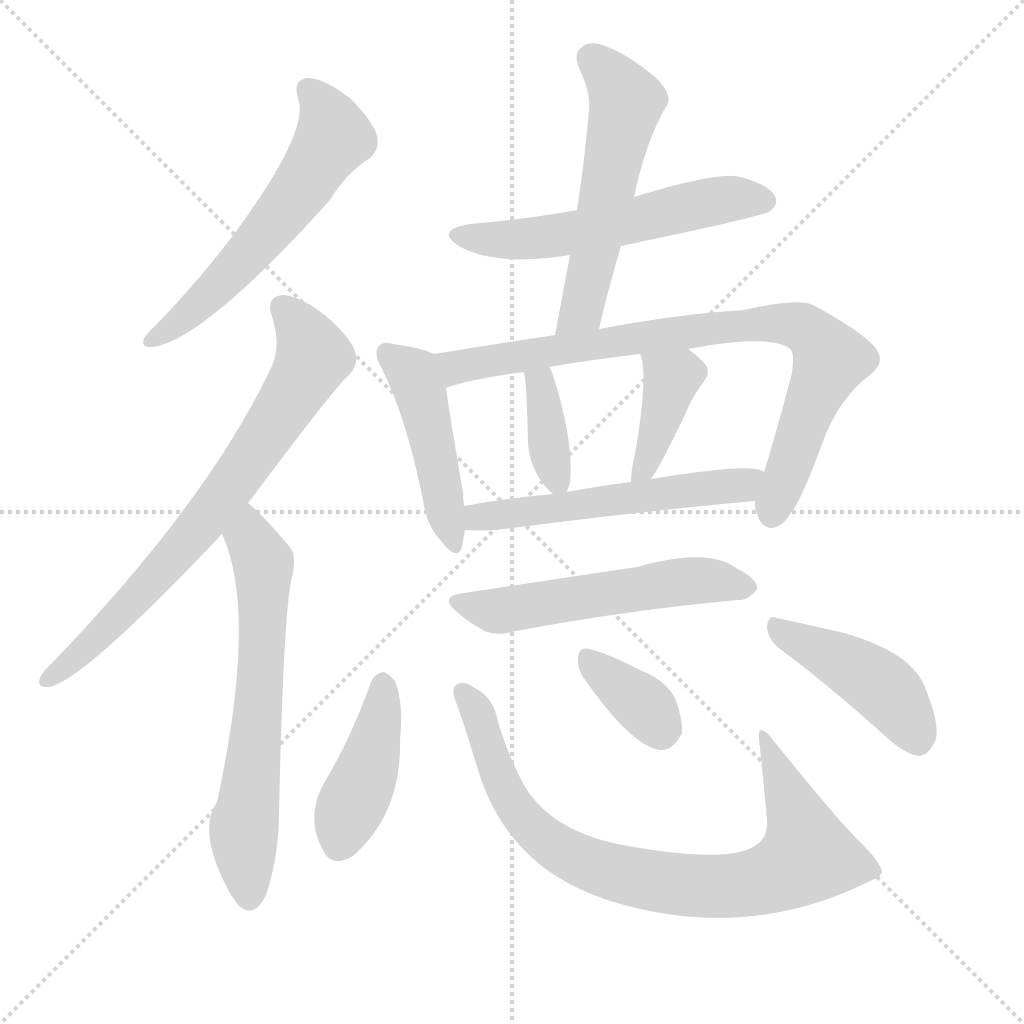
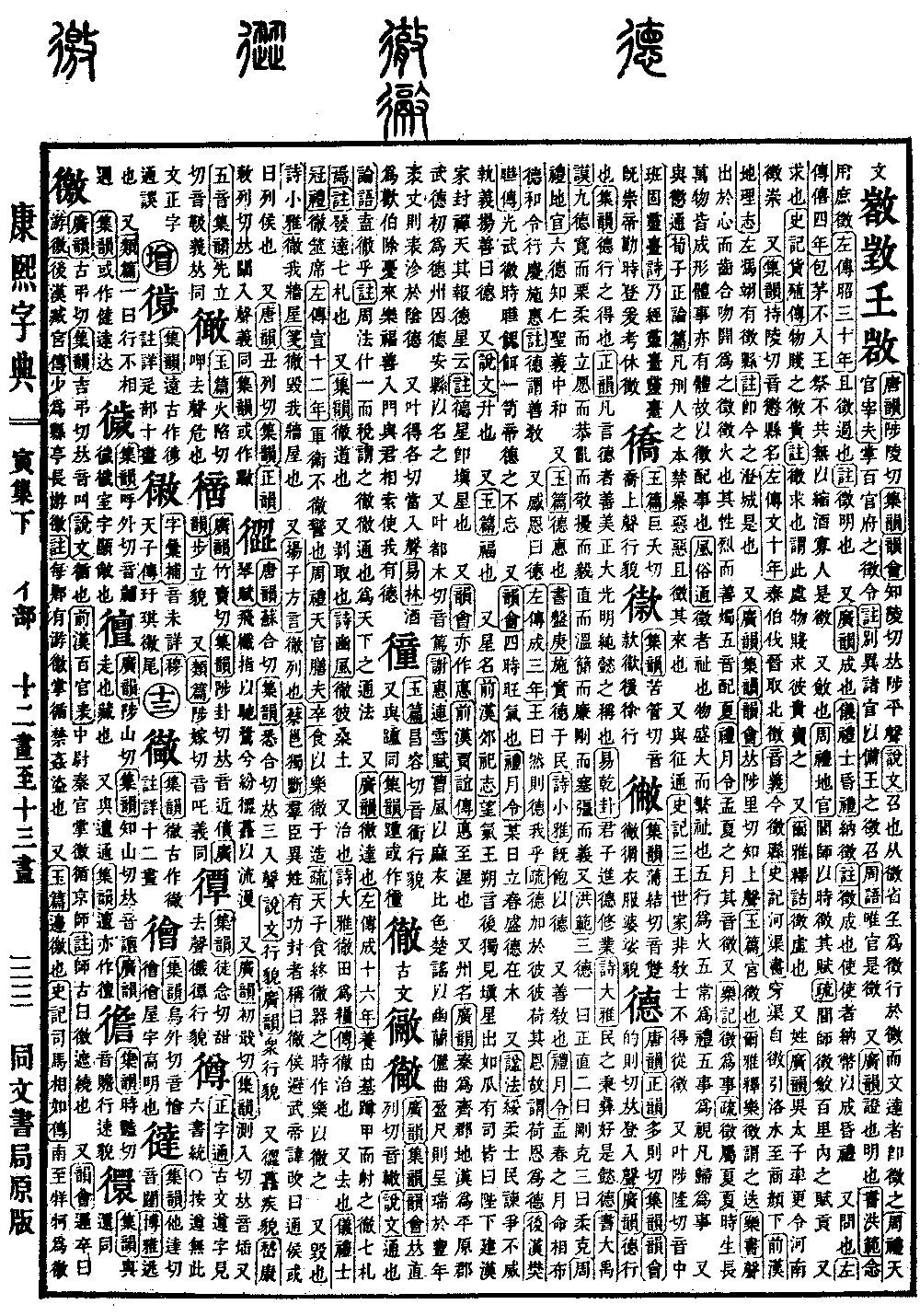
Yin Collection, Lower Volume, Radical: Step (chì), Kangxi Dictionary stroke count: 15, Page 371, Entry 08
Tangyun and Zhengyun pronounce it duo ze; Jiyun and Yunhui pronounce it di ze; it is pronounced as the entering tone of deng.
Guangyun explains it as moral conduct.
Jiyun explains it as that which is gained through moral conduct.
Zhengyun states that everything referred to as de signifies goodness, beauty, integrity, greatness, brilliance, purity, and a laudable designation.
Book of Changes (Yijing), Hexagram Qian: The superior person improves their moral character and cultivates their achievements.
Book of Odes (Shijing), Greater Odes: The people uphold their constant nature and love this virtue.
Book of Documents (Shangshu), Counsels of Gao Yao: The nine types of virtue: magnanimous yet dignified, gentle yet capable, honest yet respectful, talented in administration yet cautious, harmonious yet decisive, upright yet mild, simple yet clean, righteous yet substantial, and firm yet conforming to the Way.
Also, Book of Documents (Shangshu), Great Plan: The three virtues: first is uprightness, second is prevailing through firmness, and third is prevailing through gentleness.
Rites of Zhou (Zhouli), Offices of Earth: The six types of virtue: wisdom, benevolence, sagacity, righteousness, loyalty, and peace.
Also, Yupian: De means favor.
Book of Documents (Shangshu), Pan Geng: Bestow practical favors upon the people.
Book of Odes (Shijing), Lesser Odes: Already having received much favor.
Also refers to beneficial education.
Book of Rites (Liji), Monthly Ordinances: In the first month of spring, the prime minister is commanded to announce virtuous education, harmonize administrative decrees, perform celebrations and rewards, and distribute favors. Note: De refers to beneficial education.
Also, feeling gratitude is called de.
Zuo Commentary (Zuozhuan), Third Year of Duke Cheng: The King of Chu said: Then are you grateful to me? Commentary: Bestowing favor upon another, and the other receiving that favor; thus, receiving favor is called de.
History of the Later Han (Hou Hanshu), Biography of Fan Ye: Before Emperor Guangwu became prominent, Fan Ye once gifted him a bamboo chest of dried provisions. The Emperor was grateful and never forgot it.
Also, Yunhui: Refers to the flourishing energy of the four seasons.
Book of Rites (Liji), Monthly Ordinances: On a certain day, spring begins, and the flourishing virtuous energy resides in Wood (representing spring).
Also, Posthumous Titles Law: Pacifying the people, admonishing without relying on intimidation, upholding righteousness, and proclaiming good deeds is called de.
Also, Explaining Graphs and Analyzing Characters (Shuowen Jiezi): Explains it as rising.
Also, Yupian: Explains it as good fortune.
Also, the name of a star.
History of the Former Han (Qian Hanshu), Records of Suburban Sacrifices: Wang Shuo, who observed qi, said that later he alone saw the planet Saturn appear like a melon. The officials all said: Your Majesty has established the Fengshan sacrifices for the Han Dynasty; Heaven perhaps rewards this with the Virtue Star. Note: The Virtue Star is the planet Saturn.
Also, Yunhui: Also written in a variant form (de).
History of the Former Han (Qian Hanshu), Biography of Jia Yi: The favor and virtue are extremely deep.
Also, the name of a prefecture.
Guangyun: During the Qin Dynasty, it was the territory of Qi Commandery; during the Han, it was Pingyuan Commandery. In the early Wude era of the Tang, it was established as De Prefecture, named after De'an County.
Also, rhyming (ye), pronounced as du mu, with the same sound as du.
Xie Huilian, Ode to Snow: The Cao Odes use hempen robes to compare its color, and Chu songs use dark orchids to match its melody. Accumulated snow of one foot presents an omen for a good harvest, while spreading one zhang displays a calamity regarding hidden virtues.
Also, rhyming (ye), pronounced as de ge, belonging to the entering tone.
Yilin: Wine is the source of joy; it can dispel sorrow and bring happiness. Blessings and good deeds enter the house, mutually sought with you, allowing me to possess virtue.
Textual Verification: Book of Documents (Shangshu), Counsels of Great Yu, Nine Virtues, wide and trembling. Now corrected according to the original text as Counsels of Gao Yao.