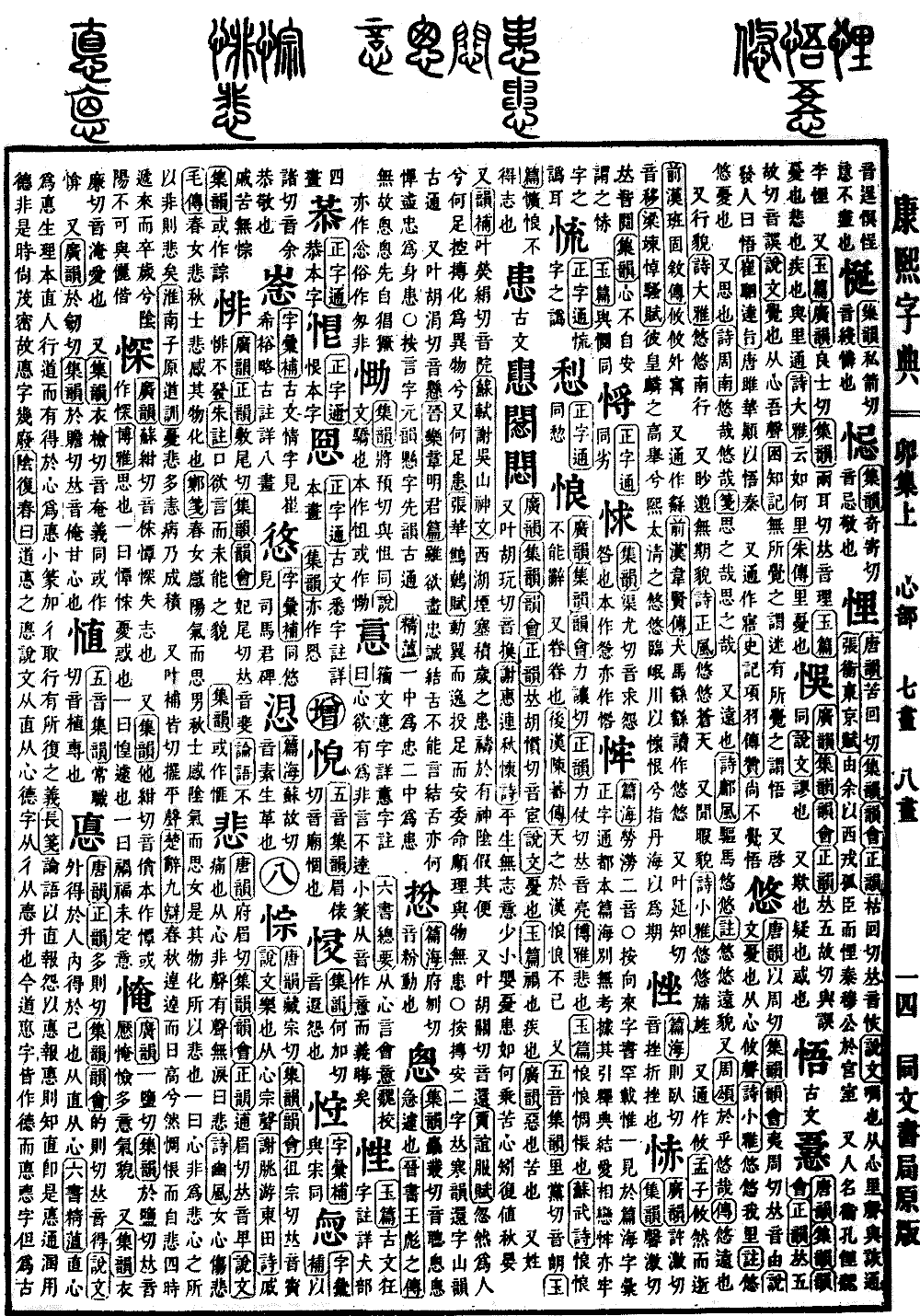
Mao Collection, Upper Volume
Radical: Heart (xīn)
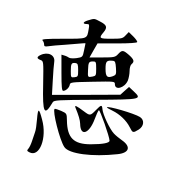
悳
Kangxi Stroke Count: 12
Page 388, Entry 01
Pronounced de (falling tone) from "duō zé" in the Guangyun (唐韵) and Zheng yun (正韵), and "dí zé" in the Jiyun (集韵) and Yun hui (韵会).
Shuowen (说文) defines it as benefiting others externally and gaining something internally. The character is composed of "zhí" (straight) and "xīn" (heart).
Jishu jingyun (六书精蕰) states that a straight heart is de. A person's original nature is upright; to practice the right way and gain inner understanding is de. The small seal script added the "chì" radical, signifying movement back and forth.
Chang jian (长笺) quotes the Analects (Lunyu): "Repay resentment with straightness, and repay kindness with de." From this, it is understood that "zhí" is "de." Later, the character "dé" (德) became commonly used, which is incorrect. Due to the prevalent dense writing style at the time, the character "dé" (悳) was almost abandoned.
Yin Fuchun (阴复春) states that the "de" (悳) in "dao de" (道悳) is explained in Shuowen jiezi (说文解字) as derived from "zhí" (直) and "xīn" (心). The character "dé" (德) is derived from "chì" (彳) and "shī" (示), indicating ascent. Currently, the "de" (悳) in "dao de" (道悳) is written as "dé" (德), and the character "dé" (悳) is only used in ancient texts. For detailed distinctions, please refer to the explanation of the character "dé" (德).