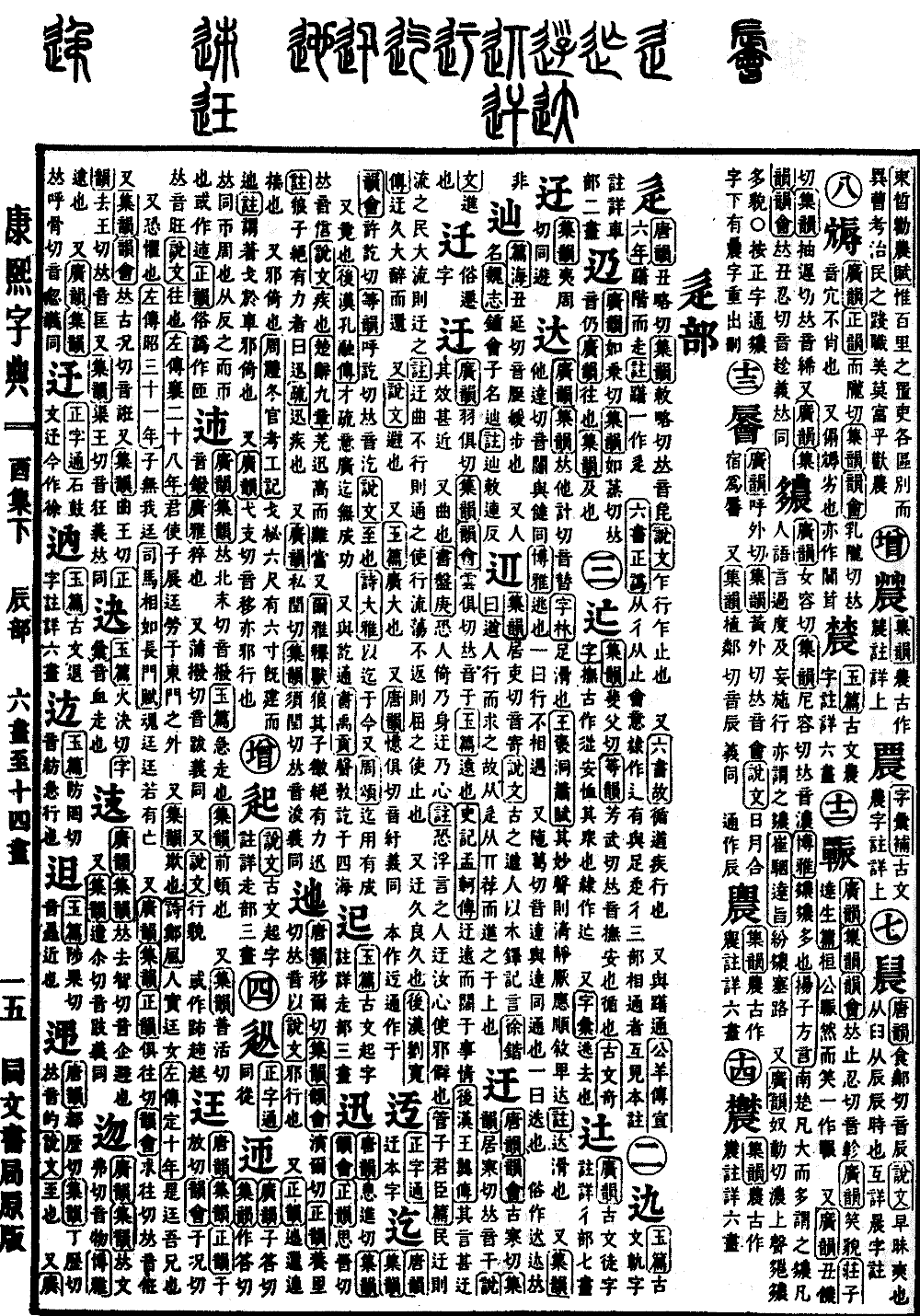
You Collection, Lower Volume
Radical: Walk (chuò)
Kangxi Strokes: 16
Page 1253, Entry 01
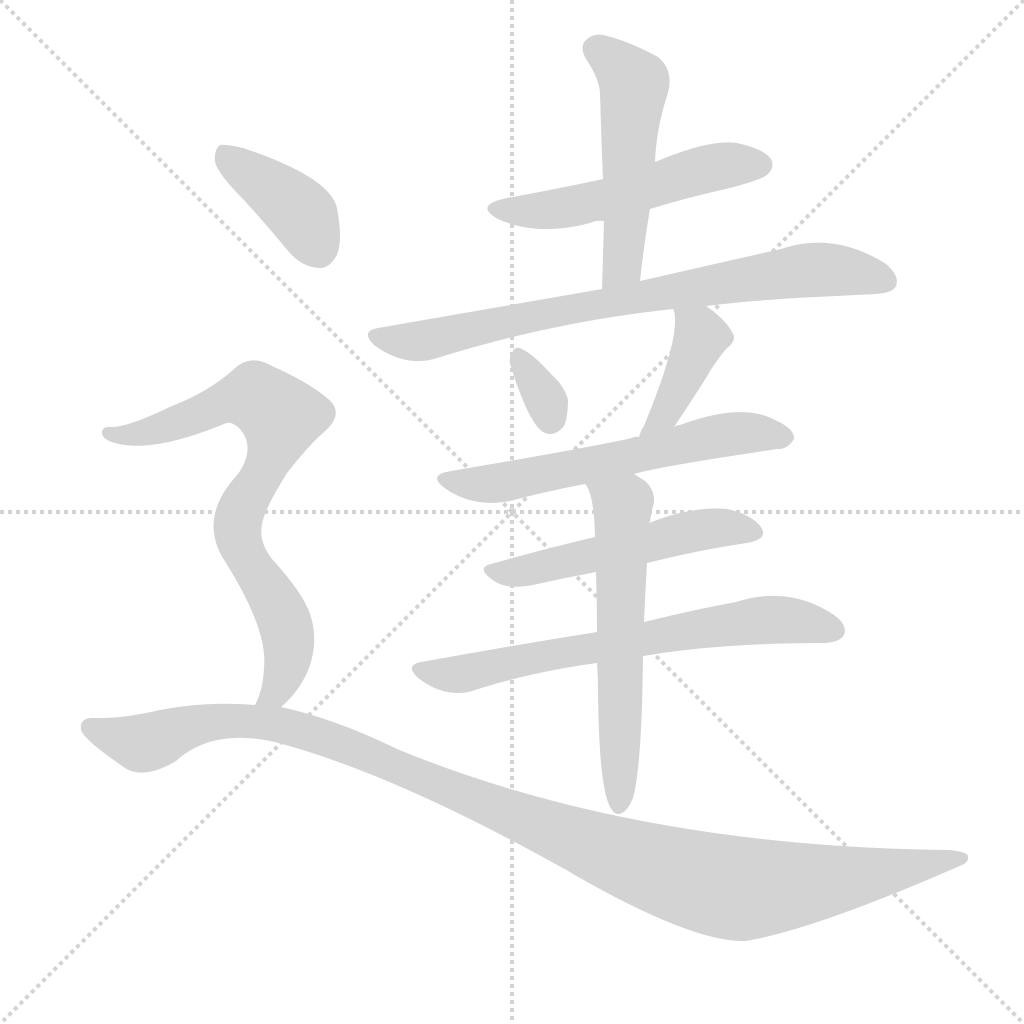
Pronounced da.
In the Comprehensive Rhymes (Guangyun) and Collected Rhymes (Jiyun), the pronunciation is noted as da.
In the Jade Chapters (Yupian), it means to penetrate or go through.
In the Book of Documents (Shangshu), Chapter of Yao, it says: "To reach to the four types of intelligence."
In the Book of Rites (Liji), Chapter on Ritual Vessels (Liqi), it says: "The gentleman is one who is penetrating."
In the Zuo Commentary (Zuozhuan), 7th Year of Duke Zhao, it says: "In the future, there will certainly be a person of great penetration." The commentary notes: "A person whose knowledge and ability can penetrate and reach."
It also means to be prominent or successful.
In the Mencius (Mengzi), it says: "When successful, one does not depart from the Way." It also says: "When successful, one extends one's goodness to the world."
It also means to recommend or advance someone.
In the Book of Rites (Liji), Chapter on the Conduct of Scholars (Ruxing), it says: "Recommend the worthy and advance them."
In the History of the Former Han (Qianhan), Biography of Huang Xiang, it says: "While in office, he often recommended and advanced others."
It also means to grow or to proceed.
In the Book of Odes (Shijing), Zhou Odes (Zhou Song), it says: "The sprouts grow vigorously." The commentary notes: "The sprouts emerging from the earth."
In the Book of Odes (Shijing), Shang Odes (Shang Song), it says: "Not proceeding, not growing."
It also means to be widespread or throughout.
In the Book of Documents (Shangshu), Announcement of Shao (Zhaogao), it says: "Then observe throughout the new city site." The commentary notes: "To view it in its entirety, meaning to be thorough."
It also means to be appropriate or fitting.
In the Book of Odes (Shijing), Shang Odes (Shang Song), it says: "Receiving a small state, it is fitting; receiving a large state, it is fitting." The commentary notes: "Meaning there is nowhere it is not appropriate."
It also means all or entirely.
In the Book of Rites (Liji), Chapter on Ritual Vessels (Liqi), it says: "The gentleman is earnest in all things." The commentary notes: "The word here means all."
To decide matters independently is called zhuan da.
In the Rites of Zhou (Zhouli), Offices of Heaven, Lesser Steward (Xiaozai), it says: "For major matters follow the senior, for minor matters act with independent authority."
To bring things along with one is called da.
In the Rites of Zhou (Zhouli), Offices of Summer, Huai Fang Shi, it says: "Bring them with a banner token." The commentary notes: "Bring the people with a banner token, bring the tribute goods with a seal token."
To follow or enter is called da.
In the Book of Documents (Shangshu), Tribute of Yu (Yugong), it says: "It reaches the Yellow River."
It also refers to a side chamber.
In the Book of Rites (Liji), Chapter on Internal Patterns (Neize), it says: "The pavilion of the Son of Heaven has five side chambers on the left and five on the right." The commentary notes: "These are side chambers, each having five cabinets for storing food."
It also refers to windows.
In the Book of Rites (Liji), Chapter on the Hall of Distinction (Mingtangwei), it says: "Scraped pillars and windows on all sides." The commentary notes: "Every room having eight windows is called four-way penetration; it is a decoration of the temple of the Son of Heaven."
A young lamb is called da.
In the Book of Odes (Shijing), Greater Odes (Daya), it says: "The first-born is like a lamb." The commentary notes: "The lamb is easily born without difficulty."
It is also the name of a prefecture.
In the Alphabetical Supplement (Zihui Bu), it is noted that during the Liang Dynasty, Wan Prefecture was renamed Tong Prefecture, and during the Song Dynasty, it was renamed Da Prefecture.
Pronounced ta.
In the Collected Rhymes (Jiyun), it refers to a situation where people walking do not encounter one another.
In the Orthography of Rhymes (Zhengyun), it refers to tiao da, the appearance of going back and forth to see others.
In the Book of Odes (Shijing), Odes of Zheng (Zhengfeng), it says: "Flitting and wandering." The commentary notes: "Tiao means light and frivolous, da means unrestrained."
In the Collected Rhymes (Jiyun), it is sometimes written as a variant form.