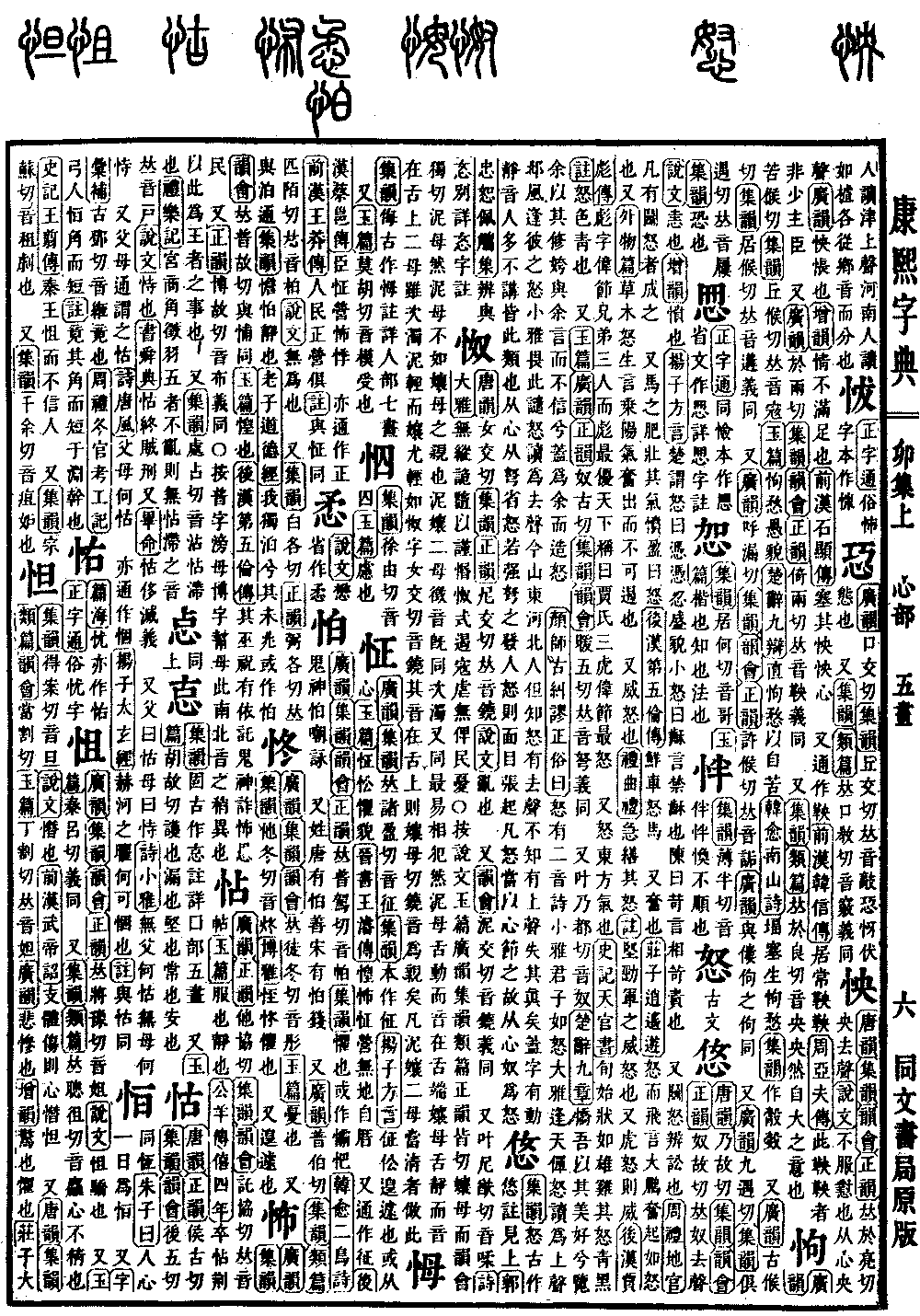
Mao Collection, Upper Volume
Radical: Heart (xīn)
Kangxi stroke count: 9
Page 380, Entry 26
Collected Rimes (Jiyun): Pronounced dan (falling tone).
Explanation of Characters (Shuowen): Deep pain.
Edict of Emperor Wu of the Former Han (Qianhan): If the limbs are injured, the heart is filled with deep pain and sorrow.
Also: Tang Rimes (Tangyun), Collected Rimes (Jiyun), Classified Anthology (Leipian), Dictionary of Rimes (Yunhui): Pronounced da (falling tone).
Jade Anthology (Yupian): Pronounced da.
Broad Rimes (Guangyun): Sorrowful and miserable.
Supplement to the Rimes (Zengyun): Fear and trepidation.
Zhuangzi (Zhuangzi): To not be fearful or sorrowful due to change.
Commentary on the Conduct of Scholars (Li Ruxing Zhu): To speak without haste.
Sub-commentary (Shu): The term bida refers to being hasty.
Explanation of Texts (Shiwen): Da means fear and sorrow.
Also: To labor.
Book of Odes (Shijing): An anxious heart.
Also: Sometimes written in a variant form.
Book of Odes (Shijing): The heart is sorrowful.
Biography of Wang Ji in the History of the Former Han (Qianhan): Quotes the Book of Odes using the variant form.
Also written as dan.
Entering tone.
Rites of Zhou (Zhouli): Even with strong winds, it cannot be made to fear.
Explanation of Texts (Shiwen): Pronounced da (entering tone).
Alternatively written as a variant form. Commonly used as dan.
According to the scholar Yin Fuchun: The Explanation of Characters (Shuowen) gives the pronunciation as dan (falling tone), and also as da (falling tone). It is also said that the character can be written with the heart radical below the character dan, but the pronunciation and meaning are the same. The departing tone should be considered the primary pronunciation, and the entering tone the secondary. Since the Jade Anthology (Yupian) separated the pronunciations of these two characters, this error has been long-standing; the Collection of Characters (Zihui) inherited this mistake, and the Comprehensive Dictionary (Zhengzitong) failed to clarify it. This entry now serves to analyze and correct these errors.