Wei Collection, Middle Volume
Radical: Silk (mì)
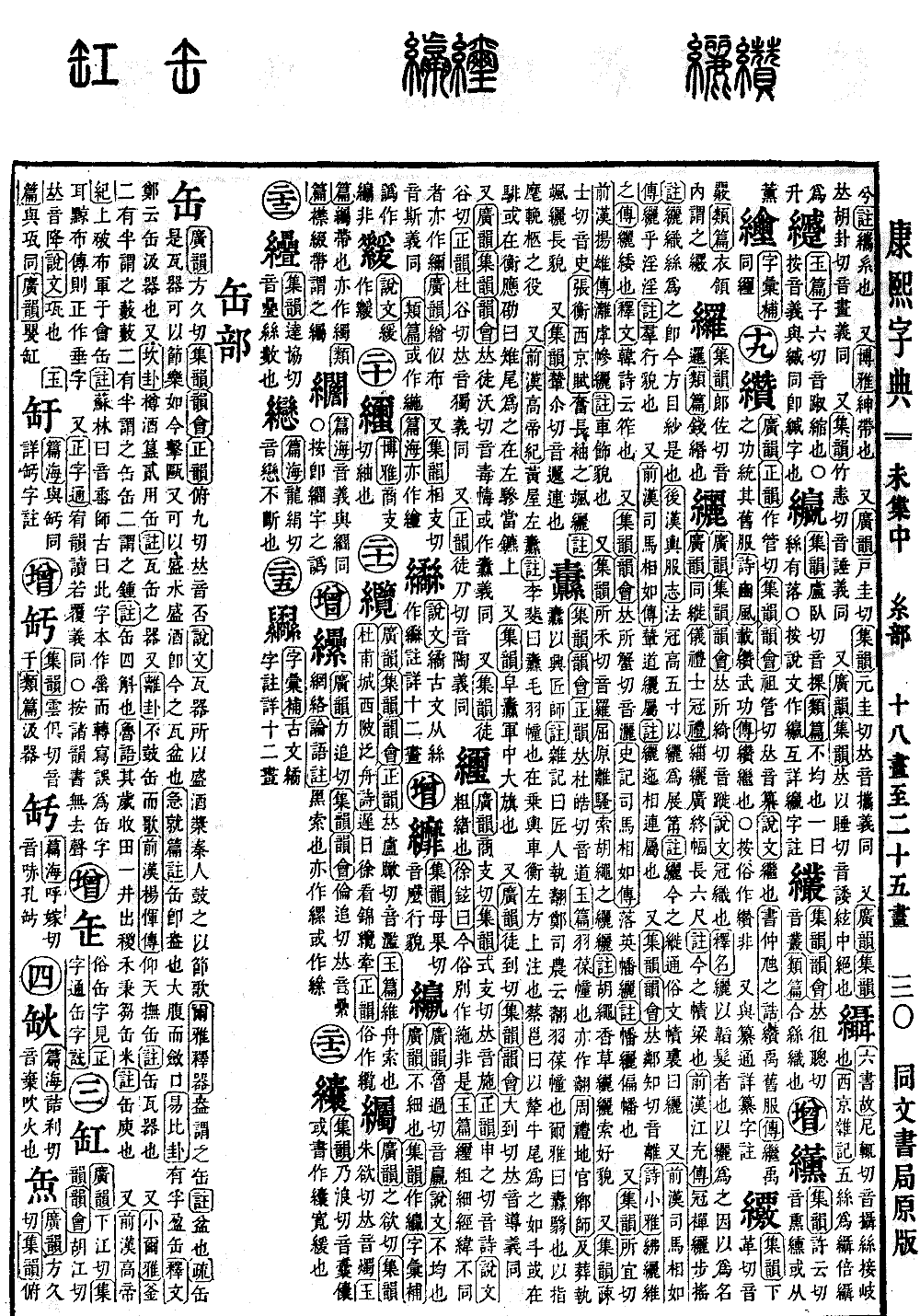
纛
Kangxi strokes: 25
Page 944, Entry 11
Pronounced dao.
Yupian (a dictionary of the Liang dynasty) states: A feather-adorned banner or standard. Also written as a variant form (dao).
Rites of Zhou (Zhouli), Earth Offices, Rural Officials: When attending a funeral, they hold the da-banner to direct the artisans.
Commentary: The Record of Miscellaneous Matters (Zaji) says: The artisan holds the da-banner. Zheng Sinong states: The da-banner is a feather-adorned banner. Erya (the earliest surviving Chinese dictionary) states: The da is a covering, used to signal and command those pulling the hearse.
Also, History of the Former Han (Hanshu), Annals of Emperor Gao: The yellow canopy and the left-side da-banner.
Commentary: Li Fei states: The da is a banner made of fur and feathers. It is attached to the left side of the chariot yoke. Cai Yong states: It is made from yak tails, shaped like a peck measure, sometimes attached to the outrigger horses or the yoke. Ying Shao states: It is made of pheasant tails, placed on the left side, aligned with the bit.
Also, according to Jiyun (a rhyming dictionary), the black da-banner is a large standard used by the military.
Also, pronounced dao. Meaning is the same.
Also, pronounced du. Sometimes written as a variant form. Meaning is the same.
Also, pronounced du. Meaning is the same.
Also, pronounced tao. Meaning is the same.
Textual Research: History of the Former Han (Hanshu), Annals of Emperor Gao: The yellow canopy and the left-side da-banner. Commentary: Li Fei states: The da is a banner made of fur and feathers. It is attached to the left side of the chariot yoke. Note: Adjusted according to the original text.