Wu Collection, Lower Volume
Radical: Grain (hé)
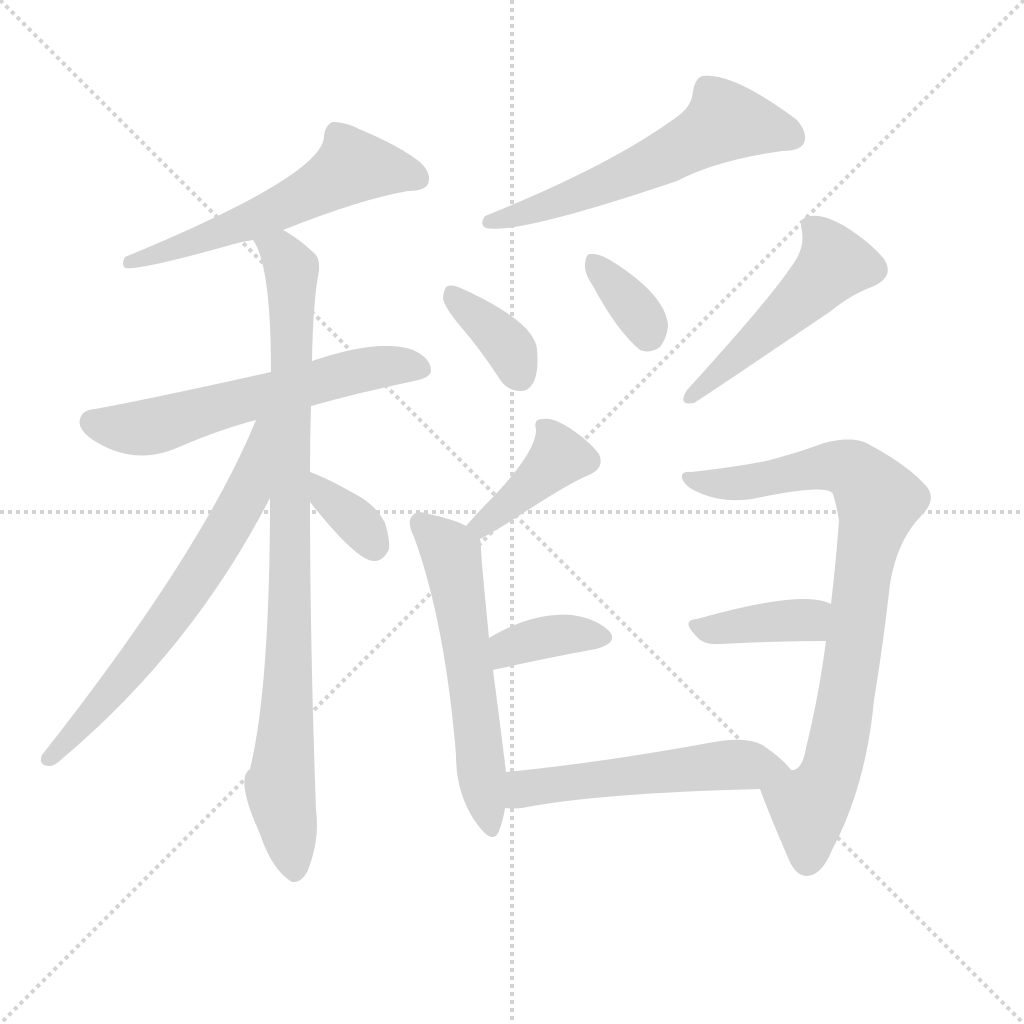
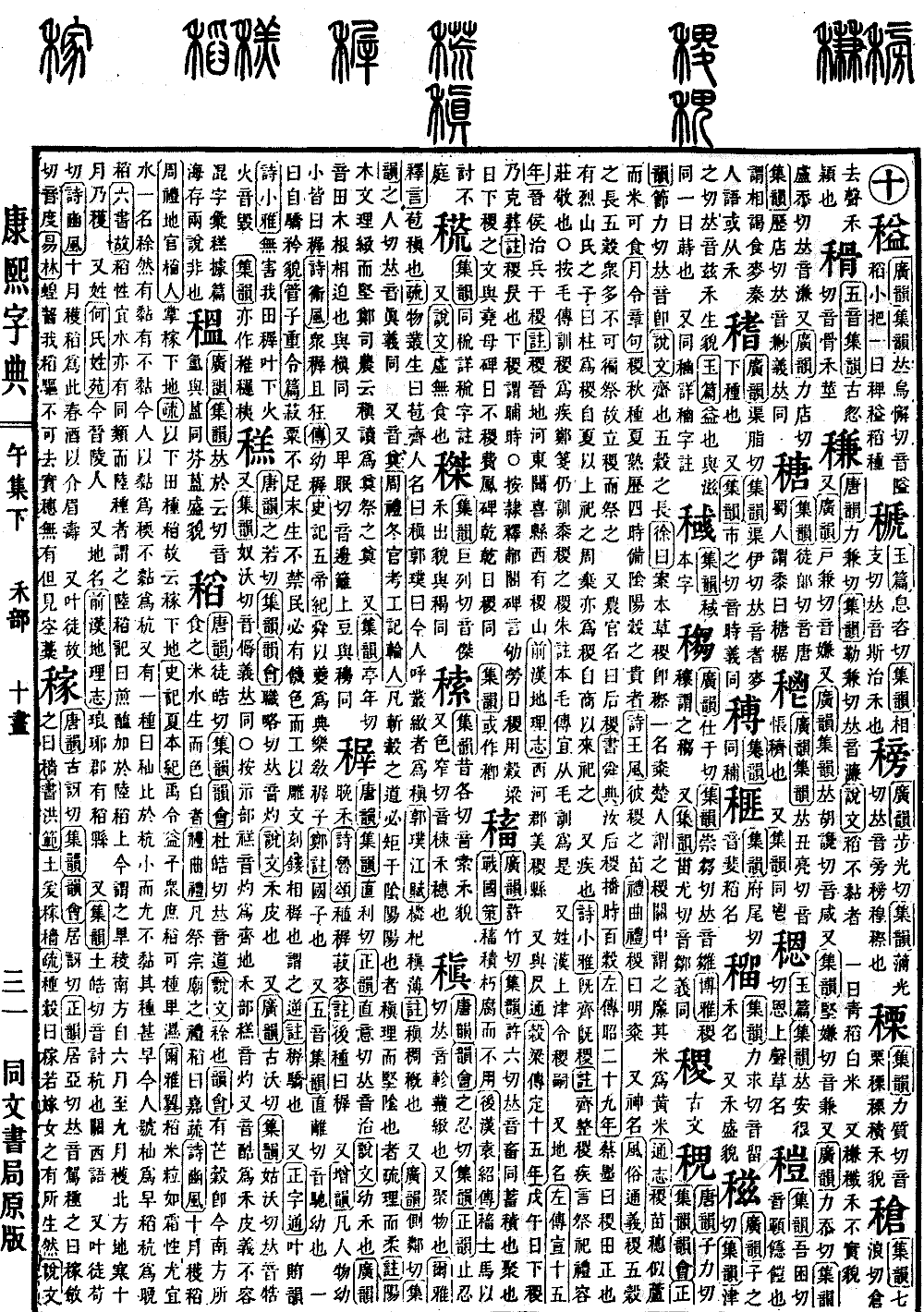
稻
Kangxi strokes: 15
Page 857, Entry 29
Pronounced dào.
Shuowen Jiezi says: It is a type of grain.
Yunhui says: A grain with awns, which is the rice eaten in the south today; it grows in water and is white in color.
Book of Rites (Liji): In the rites for ancestral temples, rice is called fine vegetable.
Book of Odes (Shijing): In the tenth month, we harvest the rice.
Rites of Zhou (Zhouli): The official in charge of rice governs the low-lying fields.
Commentary: Because rice is planted in low-lying fields, it is called grain of the low-lying lands.
Records of the Grand Historian (Shiji): Yu ordered Yi to give the people rice that can be planted in wet soil.
Erya Yi: Rice grains are like frost; its nature is particularly suited to water. Another name for it is tu. There are sticky varieties and non-sticky varieties. Today, people call the sticky variety glutinous rice and the non-sticky variety non-glutinous rice. There is also a variety called xian, which is smaller than non-glutinous rice and even less sticky. Its growth cycle is very early; today people call xian early rice and non-glutinous rice late rice.
Liushugu: Rice is suited to water, but there is a similar variety that grows on land, which is called upland rice. The Records say: Fried minced meat is added on top of upland rice; today it is called dry rice. In the south, it is harvested from the sixth to the ninth month, while in the north, the ground is cold, so it is harvested in the tenth month.
Also a surname.
He Shi Xing Yuan: Currently people from Jinling.
Also a place name.
Book of Han (Hanshu): There was a Rice County in Langya Commandery.
Also pronounced tão. Non-glutinous rice. This is a term used in the Guanzhong region.
Also rhyming with gou. Book of Odes (Shijing): In the tenth month, we harvest the rice, to make this spring wine, to grant longevity of eyebrows.
Also rhyming with gu, pronounced dù. Yilin: Locusts gnaw my rice, I drive them away but they will not leave. The ears of grain are gone, only empty stalks remain.