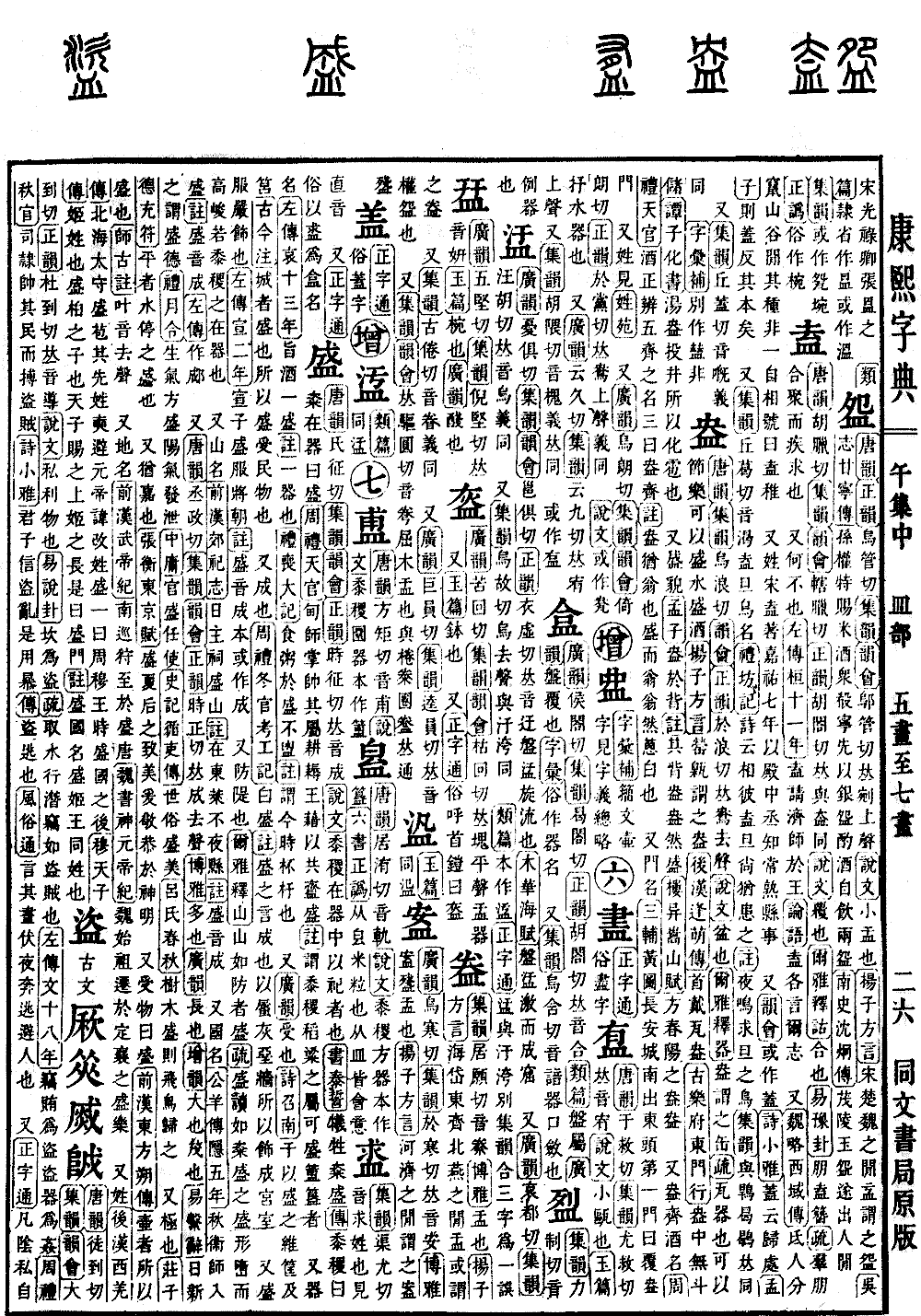
Wu Collection, Middle Volume
Radical: Vessel (mǐn)
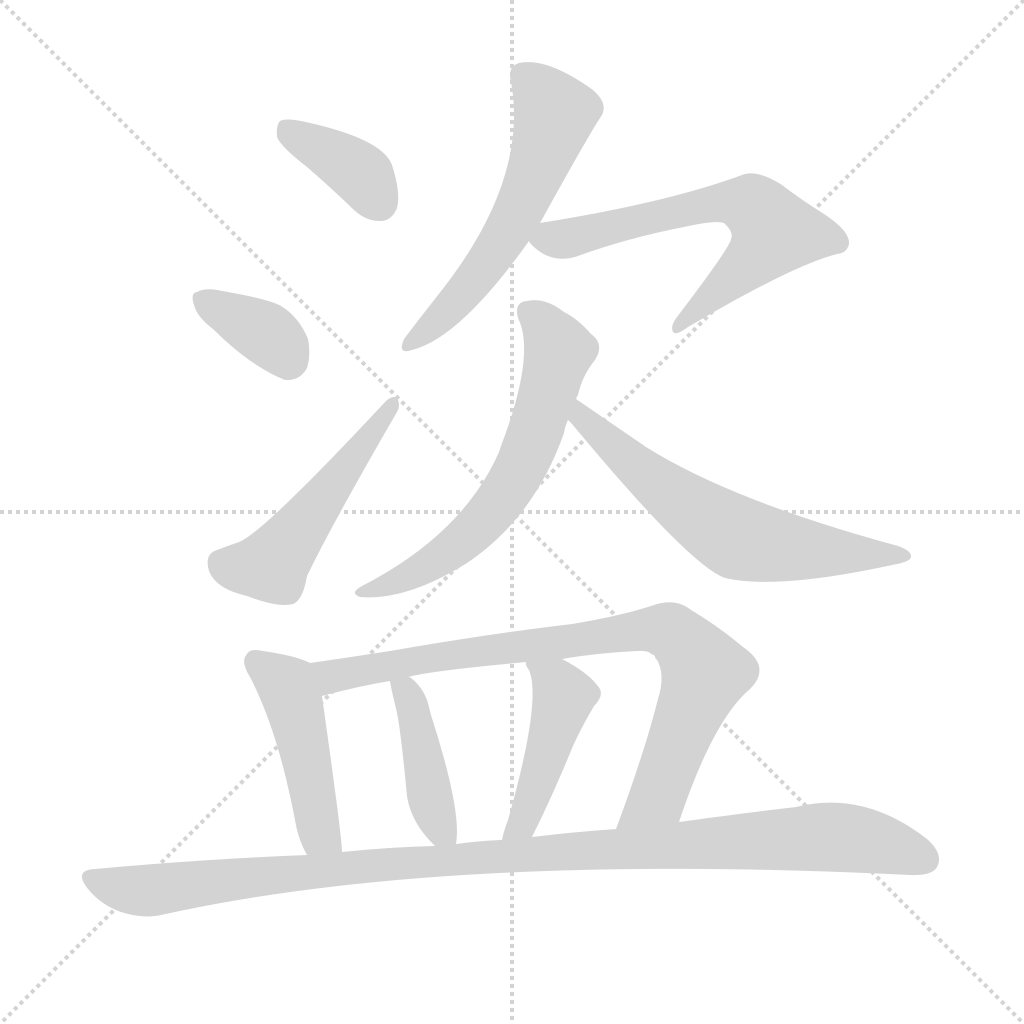
盜
Kangxi stroke count: 12
Page 794, Entry 21
Ancient form. Pronounced dào.
According to the Shuo Wen Jie Zi (Explanations of Simple and Compound Characters), it refers to the private appropriation of property. In the Book of Changes (Yijing), the section on the Discussion of Trigrams states that the Kan trigram represents a thief. The commentary explains that because water flows stealthily, stealing is compared to a thief. In the Zuo Tradition (Zuozhuan), under the eighteenth year of Duke Wen, it states that stealing property is called theft, and stealing ritual vessels is called treachery. In the Rites of Zhou (Zhouli), the section on the Autumn Official states that the Minister of Justice leads the people to arrest thieves and bandits. In the Book of Odes (Shijing), it says that when the superior man trusts thieves, disorder and violence follow. The commentary notes that theft implies escaping. According to the Comprehensive Customs (Fengsu Tong), it means to hide during the day and run at night, avoiding the sight of others.
Additionally, according to the Zheng Zi Tong (Correct Character Mastery), anyone who acts in a private, underhanded manner for their own benefit is called a thief. The Guliang Tradition (Guliangzhuan), under the fourth year of Duke Ai, states that there are three types of theft in the Spring and Autumn Annals: killing a high official covertly is theft; taking what is not one's own to take is theft; and deviating from the righteous path of the Middle Kingdom to seize profit is theft.
Also the name of a spring. According to the Book of Districts and States in the History of the Later Han (Hou Hanshu), there is a Thief Spring in Xuzhou. According to the Garden of Stories (Shuoyuan), Confucius would not drink from the water named Thief Spring because he found the name shameful.
Also the name of a star. According to the Astronomical Treatise in the History of the Song (Songshi), a guest star appearing in the southeast is called the Thief Star, which signifies major robbery.
Also the name of a legendary horse. In the Biography of King Mu (Mu Tianzi Zhuan), it is mentioned as the right-side horse, Daoli. According to the commentary on the Erya (Approaching the Correct), a fast horse with a slender neck is called a Daoli.
Also the name of a plant. According to the commentary on the Erya, the plant fu is also known as daogeng.
According to the Six Categories of Writing Corrected (Liushu Zheng’e), it is the same as the character for saliva, signifying desire; desiring the vessel is the meaning of the character. The common form using the character for next is an error.