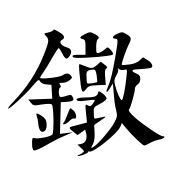
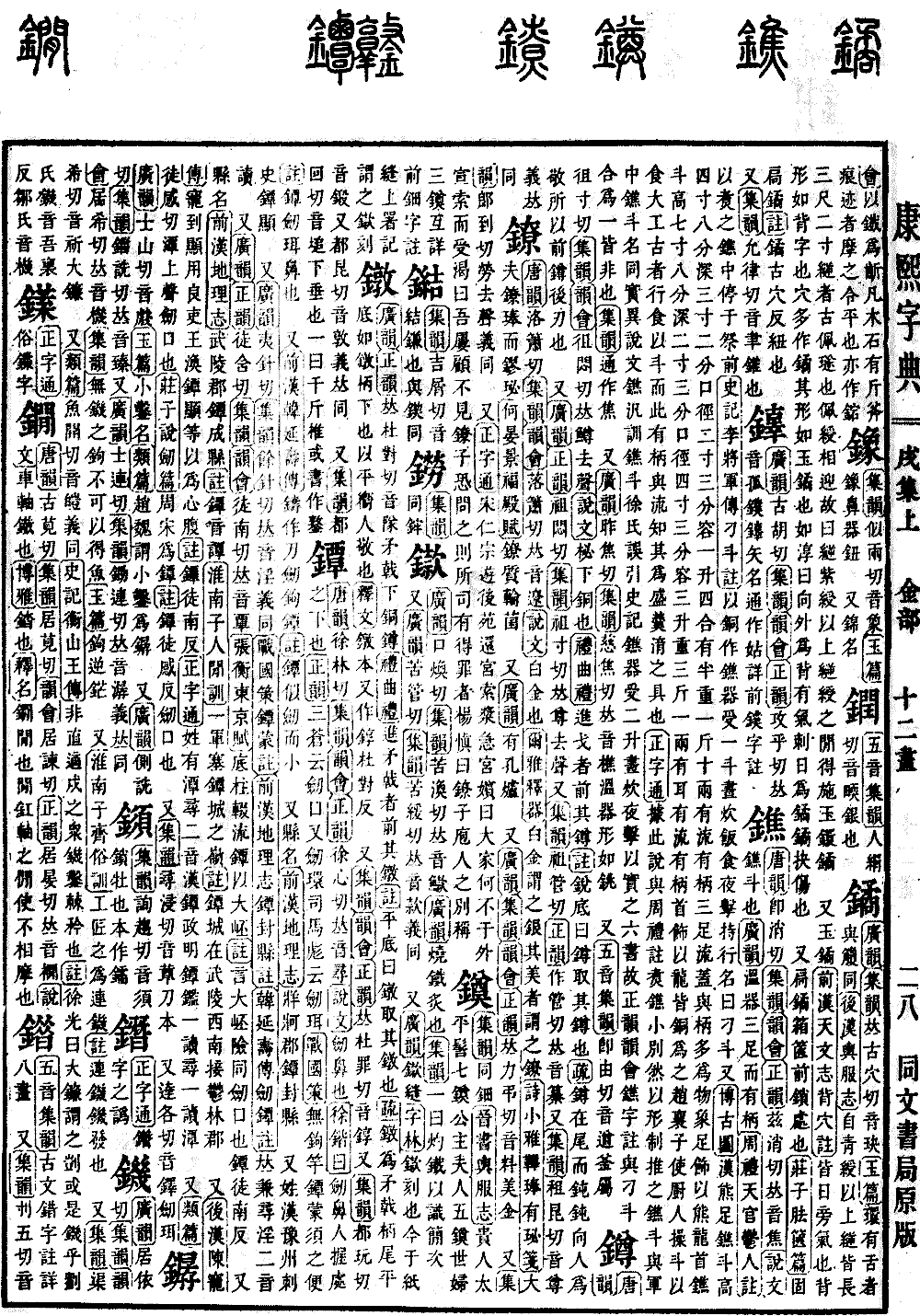
Xu Collection, Upper Volume
Radical: Metal (jīn)
Dui
Kangxi strokes: 20
Page 1322, Entry 12
Guangyun (Guangyun) and Zhengyun (Zhengyun): Pronounced dui (falling tone). A copper sleeve at the end of a spear or halberd handle.
Book of Rites (Liji), Qu Li: When presenting a spear or halberd, the person should keep the dui facing forward.
Commentary: A flat-bottomed object is called a dui. It takes its name from the concept of stability.
Sub-commentary: The dui is the end piece of a spear or halberd handle, with a flat bottom resembling a steelyard weight, located at the tip of the handle. Keeping the flat side facing the other person is a sign of respect.
Explanation of Text: The dui is sometimes written in a variant form (chún). Pronounced dui (falling tone).
Also, Jiyun (Jiyun), Yunhui (Yunhui), and Zhengyun (Zhengyun): Pronounced zui (falling tone), pronounced the same as chún.
Also, Jiyun (Jiyun): Pronounced wan (falling tone), pronounced the same as duan.
Also, pronounced kun. The meaning is the same.
Also, Jiyun (Jiyun): Pronounced hui (rising tone), pronounced the same as tui. It means to hang down. Another theory states it refers to a thousand-catty hammer. Sometimes also written in a variant form (dui).