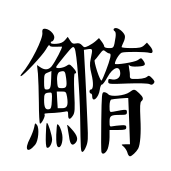
In "Guangyun" (Guangyun), the pronunciation is noted as ta-guo qie. In "Jiyun" (Jiyun), "Yunhui" (Yunhui), and "Zhengyun" (Zhengyun), the pronunciation is noted as tu-huo qie, with the same pronunciation as "tuo" (tuo). "Shuowen Jiezi" (Shuowen Jiezi) explains it as fish fry that have already hatched. In "Leipian" (Leipian), it is sometimes written as [character not provided]. In "Jiyun" (Jiyun), it is sometimes written as [character not provided].
Also, in "Tangyun" (Tangyun), the pronunciation is noted as tu-guo qie. In "Jiyun" (Jiyun), the pronunciation is noted as du-guo qie, with the same pronunciation as "duo" (duo).
Also, in "Jiyun" (Jiyun), the pronunciation is noted as xuan-gui qie, with the same pronunciation as "sui" (sui). It is also noted as tu-wo qie, with the same pronunciation as "duo" (duo). The meaning is the same.
Also, in "Guangyun" (Guangyun), the pronunciation is noted as yi-shui qie. In "Jiyun" (Jiyun), the pronunciation is noted as yu-shui qie, with the same pronunciation as "wei" (wei). It refers to crab roe.
Also, in "Jiyun" (Jiyun), the pronunciation is noted as tu-wo qie, with the same pronunciation as "tuo" (tuo). "Leipian" (Leipian) explains that removing fish scales is called [character not provided].