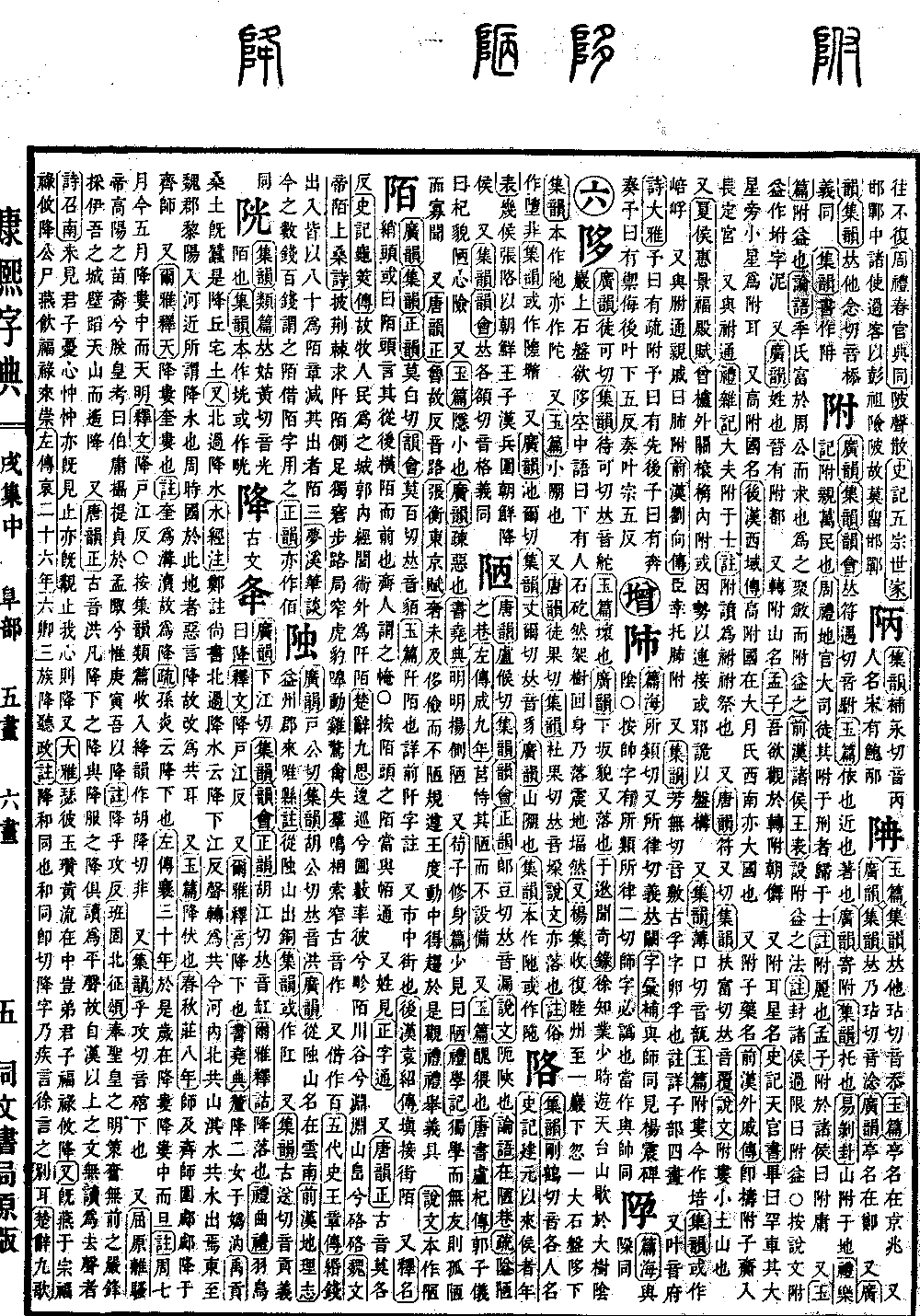
Xu Collection, Middle Volume, Radical: Mound (fù)
Stroke count: 14
Page 1349, Entry 06
Pronounced tuǒ (falling tone) according to Guangyun, and dāi (falling tone) according to Jiyun. Same pronunciation as "duò".
Explained in Yùpiān (Jade Letter) as "bad".
Guangyun describes it as the appearance of a mountain slope inclining downwards. It also means "to fall".
Yu Ti's "Wén Qí Lù" records: When Xu Zhiye was young, he visited Mount Tiantai and rested under the shade of a large tree. A stone slab on the mountainside was about to fall. A voice from the air said, "There are people below." The stone slab then became lodged in the tree and fell only after turning, shaking the ground with a roar.
Also recorded: When Yang Ji recaptured Muzhou, he reached the foot of a mountain cliff, and suddenly a large stone slab fell.
Jiyun states the original character was written as "shī", and also as "tuó".
Also explained in Yùpiān as "small".
Pronounced tuǒ (falling tone) according to Tangyun, and duǒ (falling tone) according to Jiyun. Same pronunciation as "duǒ".
Shuowen (Explaining Words) also explains it as "to fall".
Note: Commonly written as "duò", which is incorrect.
Jiyun sometimes writes it as "huì".
Pronounced chí (falling tone) according to Guangyun, and zhàng (falling tone) according to Jiyun. Same pronunciation as "zhì".
Guangyun explains it as "mountain".
Jiyun states the original character was written as "shī", and sometimes as "tuó".