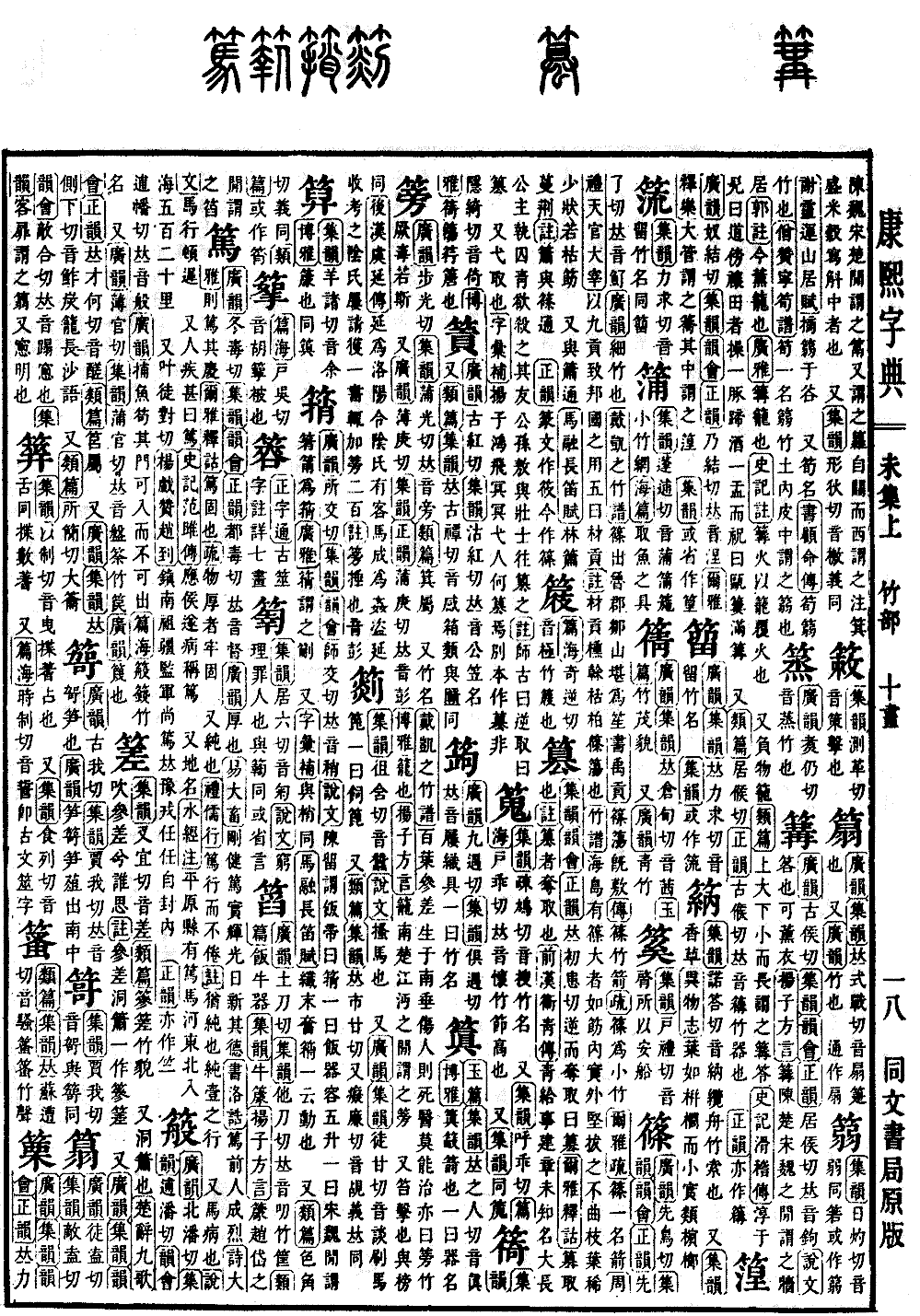
Wei Collection, Upper Volume
Radical: Bamboo (zhú)
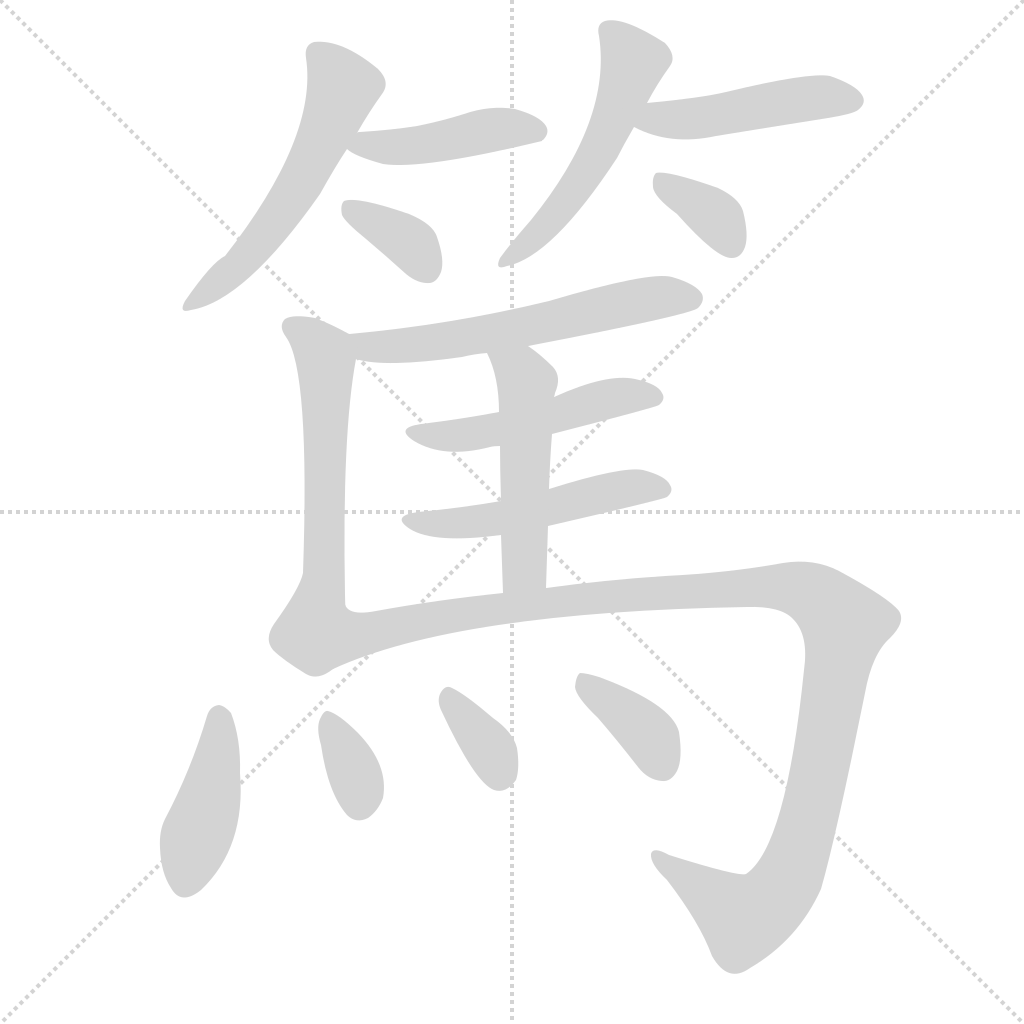
Du
Kangxi strokes: 16
Page 894, Entry 29
According to the Guangyun, pronounced du. According to the Jiyun, Yunhui, and Zhengyun, pronounced du.
Guangyun: Deep or thick.
Book of Changes (Yijing), Great Accumulation hexagram: Strong, healthy, sincere, and solid; brightness and light daily renew his virtue.
Book of Documents (Shangshu), Announcement of Luo: To solidify the glorious achievements of those before us.
Book of Odes (Shijing), Greater Odes: Then he made his blessing solid and secure.
Erya, Explanation of Words: Du means firm.
Commentary: Things that are thick are firm.
It also means pure.
Book of Rites (Liji), The Conduct of a Scholar: To practice pure conduct without wearying.
Note: This means pure, a single-minded, pure practice.
Also refers to a horse that is ill.
Shuowen Jiezi: A horse walking in a slow or sluggish manner.
When a person's illness is very severe, it is called du.
Records of the Grand Historian (Shiji), Biography of Fan Sui: The Marquis of Ying then became ill and declared his condition severe.
Also a place name.
Commentary on the Water Classic (Shuijingzhu): In Pingyuan County there is the Duma River, which flows northeast into the sea for five hundred and twenty li.
Also, following the rhyme, pronounced dui.
Yang Xi, Eulogy for Zhao Dao: Zhennan protected the border; the supervising officer was still steadfast. He undertook the military duties and took charge of affairs within the borders.
Zhengyun: Also written in a variant form (zhú).