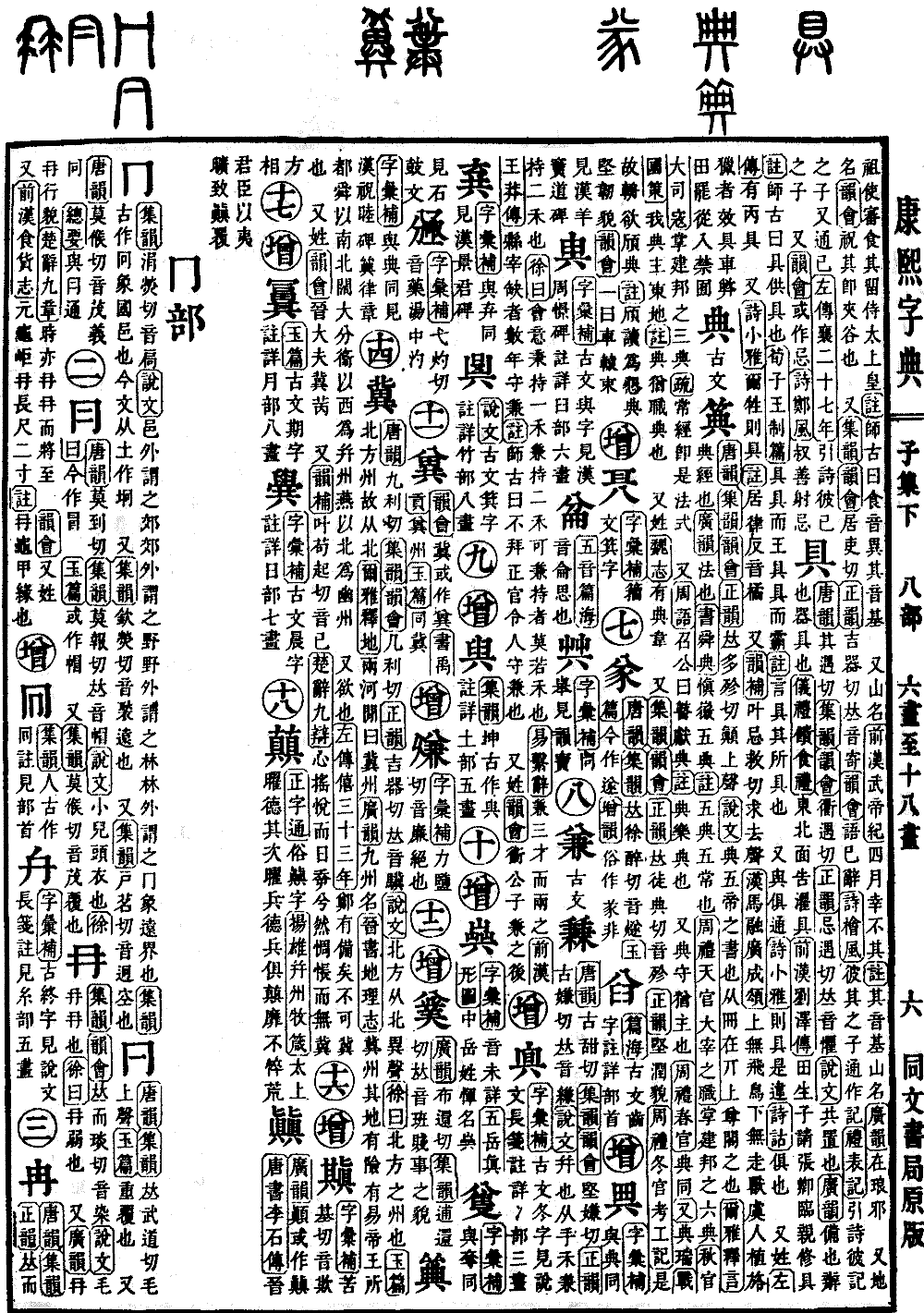
Zi Collection, Page Position: Lower. Radical: Eight (ba). Character: Dian. Kangxi Stroke Count: 8. Page 128, Number 02.
Ancient form. According to the Tang Rhymes (Tangyun), Collected Rhymes (Jiyun), Rhyme Assembly (Yunhui), and Correct Rhymes (Zhengyun), the phonetic notation is duo tian qie, pronounced as the rising tone of dian. Explaining Graphs and Analyzing Characters (Shuowen Jiezi) explains that dian refers to the books of the Five Emperors. The character form consists of a volume (ce) placed on a stand (ji), representing its being stored with honor. Approaching the Refined (Erya) states that dian means a classic or scripture. Expanded Rhymes (Guangyun) explains it as a law or standard. The Book of Documents (Shangshu) mentions carefully observing the five canons. The commentary explains that the five canons are the five constants of benevolence, righteousness, propriety, wisdom, and trustworthiness. The Rites of Zhou (Zhouli) records the duty of establishing the six canons of the state. It also mentions the duty of establishing the three canons of the state. The sub-commentary explains that constant classics serve as laws and models.
In the Discourses of the States (Guoyu), Duke Zhao says that the blind musicians present the musical canons. The commentary explains that dian refers to musical canons.
It also means to be in charge of or to manage. The Rites of Zhou mentions the office of Diantong and the office of Dianrui. The Strategies of the Warring States (Zhan Guo Ce) records a statement about being in charge of the eastern lands. The commentary explains that dian means to hold office or to manage.
It is also a surname. The Records of the Three Kingdoms (Weizhi) mentions a person named Dian Wei.
Additionally, in the Collected Rhymes, Rhyme Assembly, and Correct Rhymes, the phonetic notation is tu tian qie, pronounced as tian. The Correct Rhymes explains it as appearing firm and lustrous. The Rites of Zhou records that for this reason, the carriage pole should be long and firm. The commentary says that qi is pronounced as ken, and dian refers to a firm and resilient appearance. The Rhyme Assembly adds that another explanation is the binding strap of a carriage pole.