Chen Collection, Lower Volume
Radical: Weapon (shū)
Page 586, Entry 09
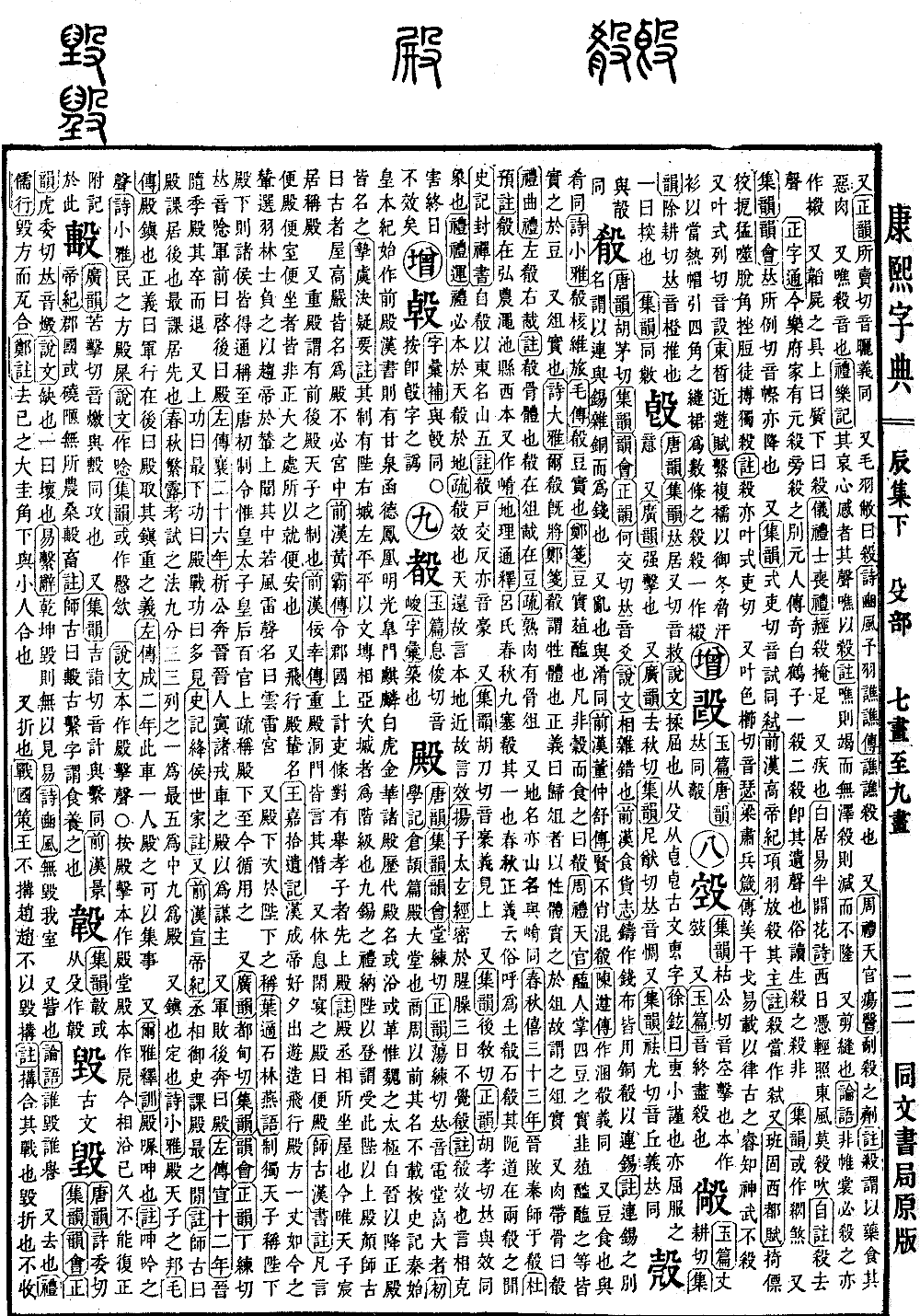
Pronounced dian (falling tone). Refers to a tall, large hall. Initial Learning Record (Chuxueji), citing the Cangsang Pian, states that a dian is a grand hall; there are no records of this term appearing before the Shang and Zhou dynasties. According to the Records of the Grand Historian (Shiji), Qin Shi Huang began the construction of the Front Hall. The Book of Han (Hanshu) mentions numerous hall names such as Ganquan, Hande, Fenghuang, Mingguang, Gaomen, Qilin, Baihu, and Jinhua. Some hall names were passed down through dynasties, while others changed; only the Taiji Hall of the Wei state remained the standard name for the main hall from the Jin dynasty onwards. Zhi Yu’s Commentary on Deciding Doubts (Jueyi Yaozhu) notes its structure features steps: the right side has steps (ce), while the left side is a smooth, sloped ramp (ping). The smooth section consists of patterned bricks laid in sequence, while the stepped section consists of tiered stairs. In the Nine Bestowals (jiuxi) ritual, there is an item called na bi, meaning to be permitted to use the steps to ascend the hall. Yan Shigu states that in ancient times, all tall, large houses were called dian, not necessarily only those within a palace. In the Biography of Huang Ba from the Former Book of Han (Qian Hanshu), it is ordered that officials from various commanderies reporting conditions should answer line by line, and those who recommended filial sons were permitted to ascend the hall first. The commentary notes that dian here refers to the office building of the Chancellor. Nowadays, only the residence of the Emperor is called a dian. There is also the term heavy hall, referring to the configuration of having both a front and back hall; this was the regulated standard for the Son of Heaven. The Biography of Favorites in the Former Book of Han mentions heavy halls and recessed gates, which refer to individuals violating the prescribed ritual standards. Halls provided for rest and banquets are called bian dian (casual hall). Shi Gu’s commentary on the Book of Han states that any mention of bian dian, bian shi (casual room), or bian zuo (casual seat) refers to non-formal or solemn places, established for convenience and comfort. There is also the flying hall, a type of carriage. In Wang Jia’s Records of Lost Matters (Shiyiji), it is noted that Emperor Cheng of Han, fond of nighttime excursions, built a flying hall, one zhang square, resembling a modern carriage, and selected elite guards to carry it at a run; the Emperor, while inside, heard what sounded like wind and thunder, and thus named it the Cloud-Thunder Palace. There is also the term Dianxia (Under the Hall), a form of address secondary to Bixia (Under the Imperial Steps/Your Majesty). Ye Shi’s Notes from the Stone Forest (Shilin Yanyu) states that ritual regulations permitted only the Son of Heaven to be addressed as Bixia, while Dianxia was generally applicable to feudal lords. By the beginning of the Tang dynasty, regulations specified that only the Crown Prince and the Empress were to be addressed as Dianxia by officials in memorials, a rule that persists to this day.
Pronounced nian (falling tone). The front of an army is called qi, and the rear is called dian. In the Zuo Tradition (Zuozhuan), Year 26 of Duke Xiang, when Xi Gong fled to the state of Jin, the people of Jin placed him at the rear of the war chariots, making him a primary advisor. When an army retreats, protecting the rear is called dian. In the Zuo Tradition, Year 12 of Duke Xuan, Sui Ji (Sui Wuzi) covered his troops as they retreated. Regarding the assessment of merit, the highest grade is called zui, the lowest is called dian, and significant achievement is called duo. Refer to the commentary on the Biography of Marquis of Jiang in the Records of the Grand Historian. In the Former Book of Han, Annals of Emperor Xuan, there is mention of the Chancellor and Censor-in-Chief evaluating the political performance of officials using the dian and zui grading system. The commentary by Shigu states that dian refers to an evaluation ranking at the bottom, while zui refers to a ranking at the top. The Spring and Autumn Annals of Luxuriant Dew (Chunqiu Fanlu) describes an examination method divided into nine grades arranged in groups of three: the first grade is zui, the fifth is middle, and the ninth is dian. It also carries the meaning of guarding or pacifying. The Classic of Poetry (Shijing) mentions pacifying the states of the Son of Heaven. Mao’s commentary defines dian as guarding. The orthodox interpretation states that in military marches, the rear guard is called dian, drawing on the sense of acting as a steady, stabilizing force. In the Zuo Tradition, Year 2 of Duke Cheng, a single person guarding the rear of the chariot was sufficient to ensure success. According to the Erya, Explaining Customs (Erya Shixun), dian is the sound of groaning. The commentary defines this as the sound of lamentation. The Classic of Poetry mentions the common people groaning in pain. In the Analytical Dictionary of Characters (Shuowen Jiezi), it is written as nian. The Jiji Rhyme Dictionary (Jiyun) notes it may be written as a character composed of heart. The original meaning in the Analytical Dictionary of Characters is the sound of a strike, originally written with a different structure. The character for a palace hall was originally a different form. Since the character dian has been used in this context for so long, it cannot be corrected now, and this note is appended here. The etymology of dian is composed of mouth and excrement. Dian is sometimes also written with an alternative radical.