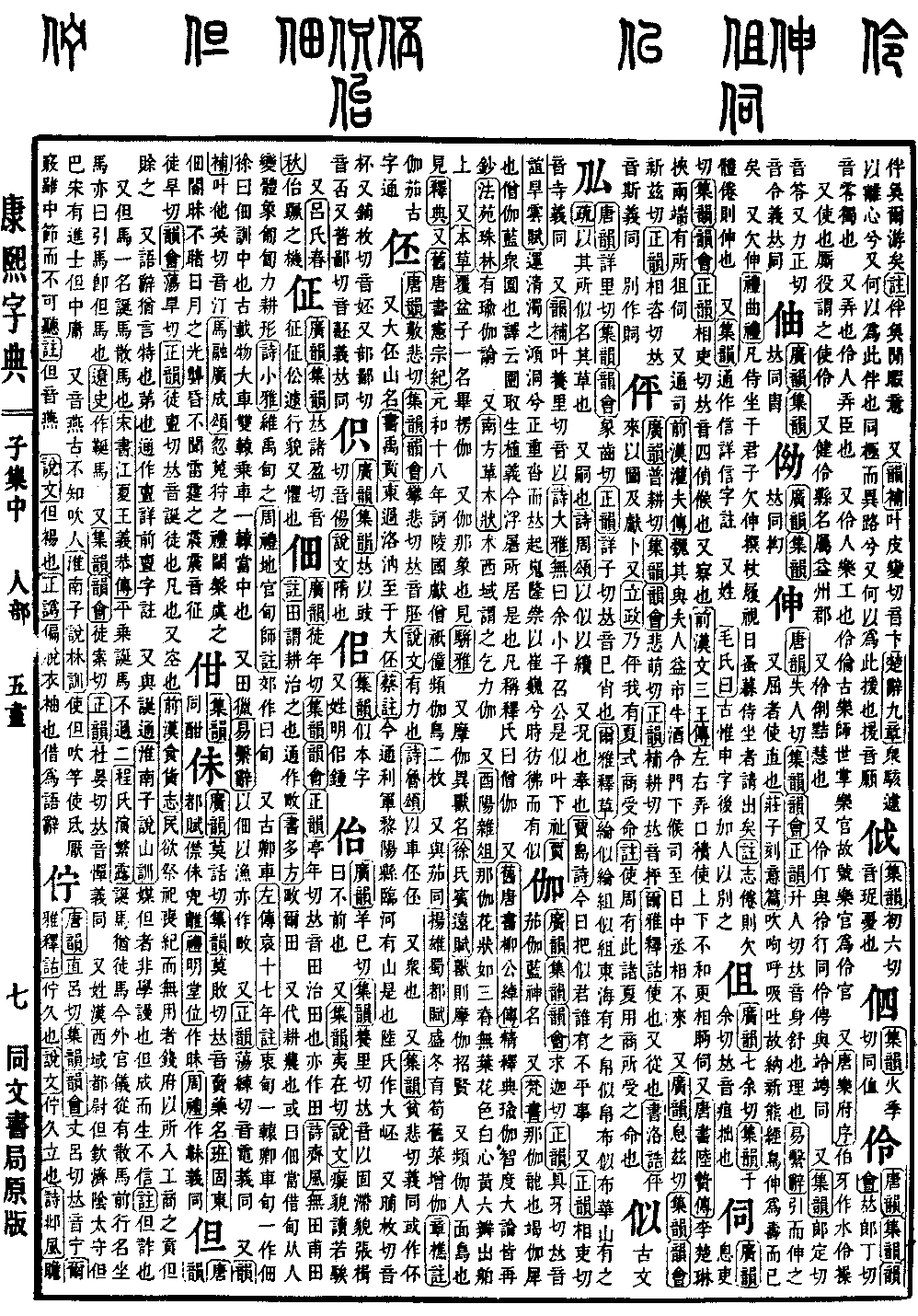
Zi Collection, Middle Volume. Radical: Person (rén). Stroke count: 7. Page 97, number 18. According to the Broad Rhymes (Guangyun), Collected Rhymes (Jiyun), Rhyme Assembly (Yunhui), and Correct Rhymes (Zhengyun), the character is pronounced tián. It means to till the fields. It is also written using the character for field, tián. The Book of Odes (Shijing) in the Qi Odes states, Do not till the large fields. The commentary explains that field here means the act of tilling and managing. It is also used interchangeably with the character for hunting, tián. The Book of Documents (Shangshu) in the Numerous Regions states, Till your fields. It also refers to the farmers who till the soil. Some suggest that this character should be a phonetic loan for the word for suburbs, diàn, and that its form is derived from the radical for person, resembling a person crawling and exerting effort to cultivate the land. The Book of Odes in the Lesser Odes states, It was the Great Yu who regulated it. The Rites of Zhou (Zhouli) in the Ministry of State (Tianguan) notes for the Manager of the Royal Domains (Dianshi) that the outskirts are called suburbs, diàn. It also refers to the carriage used by high officials in ancient times. The Commentary on the Zuo Tradition (Zuozhuan) in the notes for the 17th Year of Duke Ai states that a middle-pole carriage refers to a carriage with a single shaft used by high officials. The Shuowen Jiezi (Shuowen Jiezi) writes the character and explains it as middle. Xu Kai explained that in ancient times, large carts used for carrying goods had double shafts, whereas carriages for passengers had a single shaft positioned in the middle. It also means to hunt. The Classic of Changes (Yijing) in the Appended Phrases (Xici) states, Used for hunting and for fishing. It is also written using the character for hunting, tián. According to the Correct Rhymes, it is also pronounced as diàn with the same meaning. According to the Rhyme Supplement (Yunbu), it rhymes as tīng. Ma Rong’s Ode to Guangcheng states, Neglecting the rites of the seasonal hunts, lacking the cultivation of the royal parks. In darkness and ignorance, one sees not the light of the sun and moon; deaf and muddled, one hears not the roar of the thunder. In this context, the word for thunder is pronounced as zhēng to rhyme.