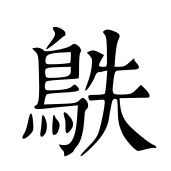
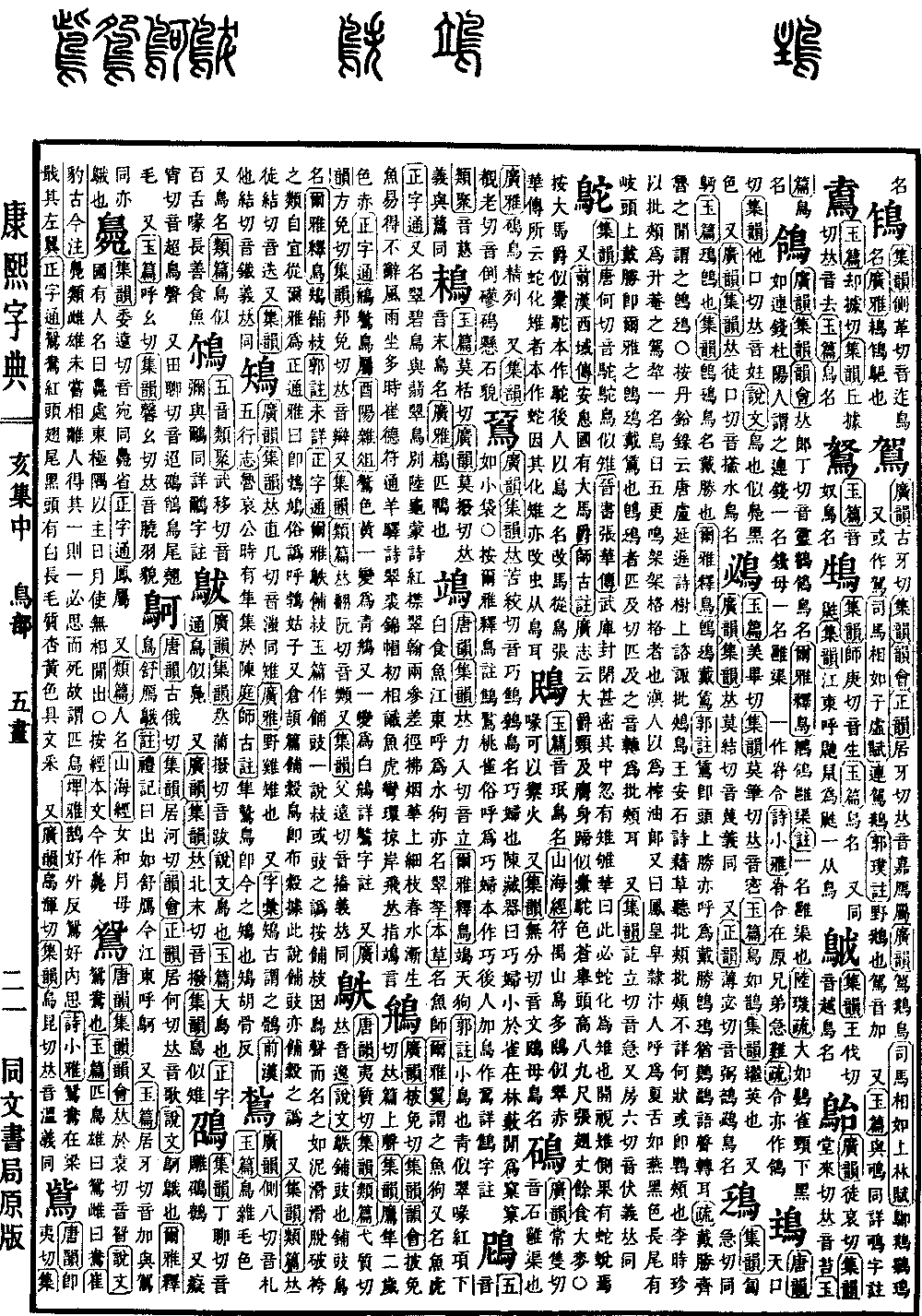
The rhyme dictionary "Tang Yun" (Tang Yun) uses the characters 夷 (yi) and 质 (zhi) for fanqie to indicate pronunciation, which is the same as "yi" (逸). The rhyme dictionaries "Ji Yun" (Ji Yun) and "Lei Pian" (Lei Pian) use the characters 弋 (yi) and 质 (zhi) for fanqie, also pronounced the same as "yi" (逸).
The "Shuowen Jiezi" (Shuowen Jiezi) explains that "䳀" (yi) is "铺豉" (pushi), which is the name of a bird.
The "Erya" (Erya), in its "Shi Niao" (Shi Niao) section, records that "鴩" (yi) is "餔" (bu). Guo Pu's commentary states that the details are unclear.
The "Zhengzitong" (Zhengzitong) mentions that "䳀餔" (yi bu) in the "Erya" is written as "铺豉" (pushi) in the "Yupian" (Yupian), and there is a theory that it might be an erroneous transcription of the character "豉" (chi).
Note: "餔" (bu) is named after the bird's call, similar to names like "ni huahua" and "tuo ku." Therefore, the record in the "Erya" should naturally be considered the correct basis.
The "Tongya" (Tongya) states that it is the "鹁鸠" (bo jiu), which is popularly mispronounced as "鹁姑子" (bo gu zi). Furthermore, the "Cangjie Pian" (Cangjie Pian) records that "餔谷鸟" (bu gu niao) is the cuckoo. According to this statement, "餔豉" (bu shi) is also an erroneous form of "餔谷" (bu gu).
Additionally, the rhyme dictionaries "Ji Yun" (Ji Yun) and "Lei Pian" (Lei Pian) use the characters 徒 (tu) and 结 (jie) for fanqie, pronounced the same as "die" (迭).
Furthermore, the rhyme dictionary "Ji Yun" (Ji Yun) uses the characters 他 (ta) and 结 (jie) for fanqie, pronounced the same as "tie" (铁), with the same meaning.