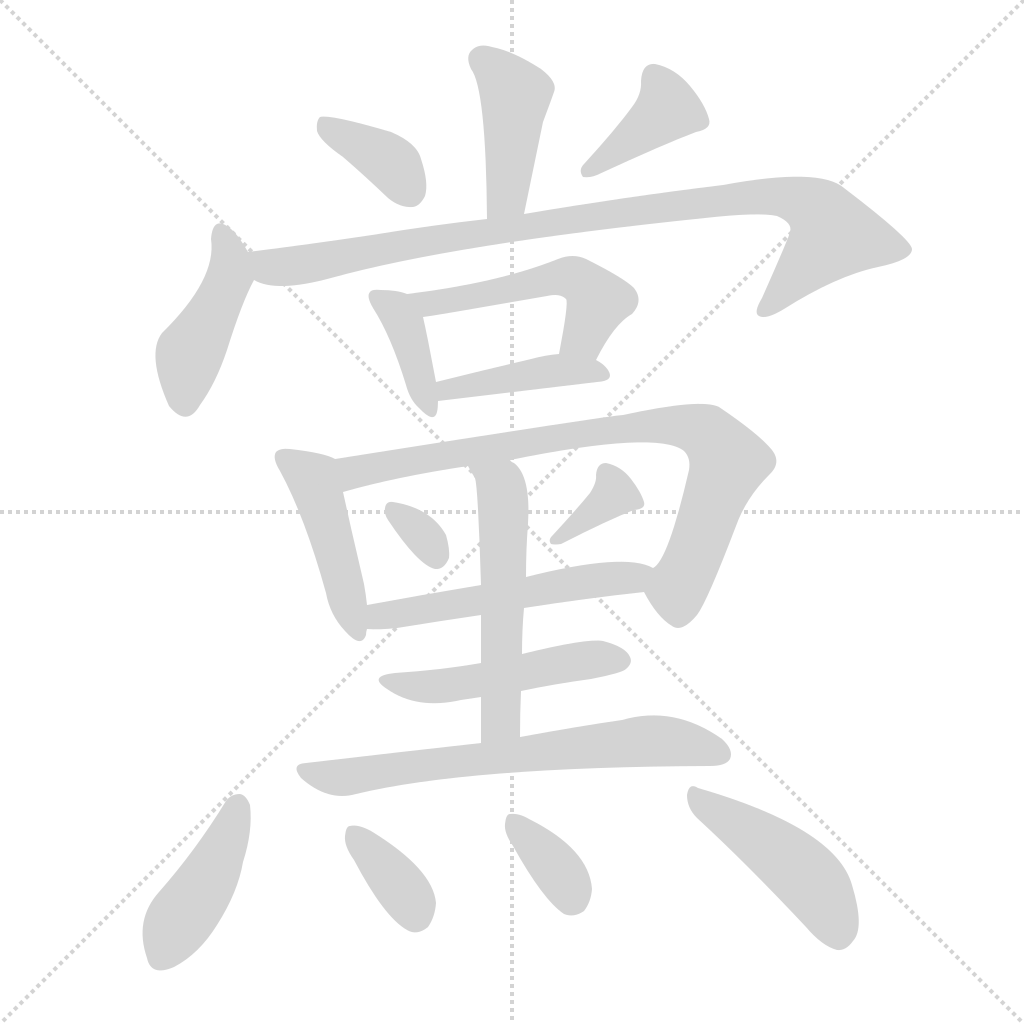
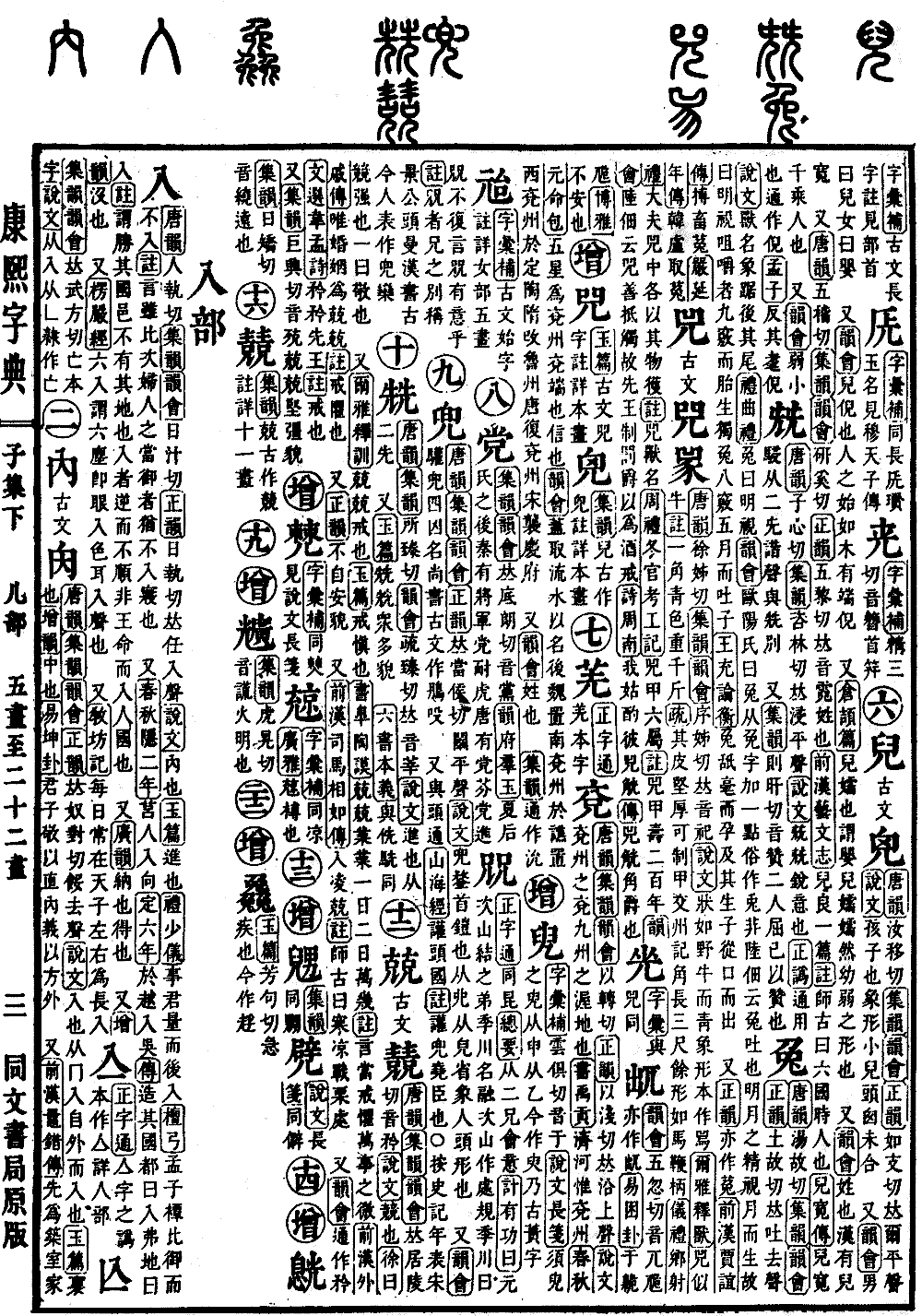
Hai Collection, Lower Volume
Radical: Black (hēi)
Kangxi stroke count: 20
Page 125, Entry 01
Pronounced dang (falling tone).
Shuowen (Explaining Graphs and Analyzing Characters): Not bright or clear.
Also: In the Rites of Zhou (Zhouli), Office of Earth, Grand Minister of Instruction: Five families make a bi, five bi make a lü, four lü make a zu, and five zu make a dang.
Interpretation of Names (Shiming): Five hundred families make a dang. Dang means leader. Refers to the headman respected by those living in a gathering place. Also refers to associates or partners.
Xunzi, Power of the State chapter: Do not form cliques to pursue private interests, do not form factions.
Also refers to shielding or favoring. Mutually covering up mistakes is called dang.
Analects (Lunyu): The superior person is not partial.
Also refers to bias.
Book of Documents (Shangshu), Great Plan (Hongfan): Without bias and without forming cliques, the kingly way can be broad.
Also refers to being close or intimate.
Xunzi, Against Physiognomy chapter: Follow ritual and righteousness, and draw close to the learned. Commentary: Dang means to be close to.
Also refers to frequency.
Xunzi, Discourse on Heaven chapter: Strange stars appear frequently.
Also refers to knowing or understanding.
Yangzi, Dialects (Fangyan): Dang, xiao, and zhe all mean to know. In the region of Chu it is called dang, or sometimes xiao, while in the regions of Qi and Song it is called zhe. Guo commentary: Dang means bright or clear. The appearance of understanding clearly.
Also, Guangyun (Broad Rhymes): Beautiful.
Guangya (Broad Refinements): Dang means good.
Also refers to a place or a time.
Gongyang Commentary (Gongyangzhuan), 13th Year of Duke Wen: Going to the place. Commentary: Dang means place. Place is like time, which is a dialect of the Qi region.
Zuo Commentary (Zuozhuan), 5th Year of Duke Ai: The song of the Lai people says: Troops, oh troops, where are you going? Commentary: Dang means place.
Also, Yupian (Jade Chapters): To connect.
Also, Guangyun (Broad Rhymes): To accumulate.
Also, a place name.
History of the Former Han (Qianhan), Treatise on Geography: The Qin dynasty established Shangdang Commandery, belonging to Bing Province, which is the ancient Shangdang Pass.
Also, Jiyun (Collected Rhymes): Pronounced zhang (rising tone). A surname.
Zuo Commentary (Zuozhuan), 32nd Year of Duke Zhuang: Duke Zhuang of Lu built a high terrace near the house of the Dang family. Commentary: The Dang family were grand masters of the State of Lu. Explication of Text: Dang is pronounced zhang.
Also, 11th Year of Duke Ai: Jisun allowed his followers to wait at court, waiting at the Dang family ditch. Commentary: Dang family ditch, a place name within the court.
Also, Jiyun (Collected Rhymes): Pronounced tang (rising tone). Same as the character tang. Means to hope or perhaps.
History of the Former Han (Qianhan), Biography of Dong Zhongshu: Perhaps it can be seen.
Also, Biography of Wu Bei: Perhaps one can be lucky and succeed. Shigu commentary: Dang is pronounced the same as tang.
Also the same as the character dang (upright/frank).
Xunzi, Against Physiognomy chapter: Broad learning and upright speech. Commentary: Refers to frank speech. Also written as dang.
Critical Analysis: Rites of Zhou, Office of Earth, Lüxu commentary: Five families make a bi, five bi make a lü, five lü make a zu. Note: This text does not appear in the Lüxu commentary, it is verified as text from the Grand Minister of Instruction. We have corrected the text by changing Lüxu commentary to Grand Minister of Instruction and changing five lü make a zu to four lü make a zu.
Xunzi, Against Physiognomy chapter: Knowledge is broad and the dang is upright. Note: The original text is polished and substantial, broad and dang is upright, with four characters per phrase; one cannot quote the character substantial by itself. The character substantial has been deleted.