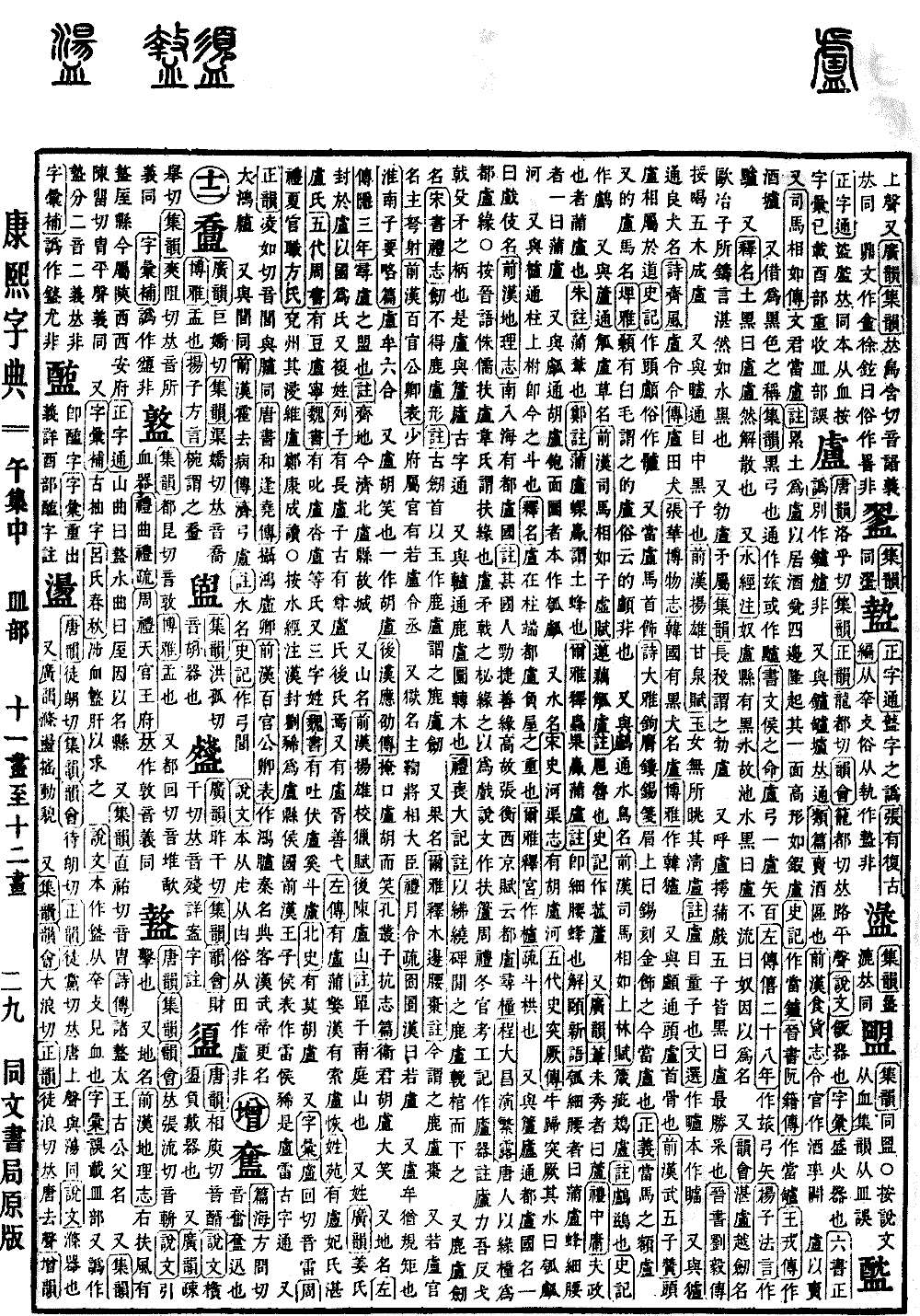
Wu Collection, Middle Volume
Radical: Vessel (mǐn)
盪
Kangxi strokes: 17
Page 797, Entry 15
Pronounced lang (rising tone). Matches the character dang. In the Explanation of Script (Shuowen Jiezi), it means to wash vessels. Also, in the Extensive Rhymes (Guangyun), it refers to the appearance of washing and shaking.
Pronounced dang (falling tone). Refers to pushing and shaking. In the Book of Changes (Yijing), section on Appended Remarks (Xici), it says the eight trigrams shake each other. The commentary explains this as movement and displacement. In the Textual Explanation (Shiwen), all scholars write it as dang, with the exception of Wang Su, who provides the phonetic reading as tang (rising tone).
Also, according to the Classified Chapters (Leipian), it means to move. In the Zuo Tradition (Zuo Zhuan), under the twenty-sixth year of Duke Zhao, it refers to shaking and moving, spreading and scattering. In the Records of the Grand Historian (Shiji), Book of Music (Yueshu), it states that music is used to stir the blood and pulse.
Also means to wash. One interpretation is to be unrestrained. In the Book of Han (Qianhan), Treatise on Literature and Arts (Yiwenzhi), it refers to a calm mind and unrestrained intent. Also, in the Biography of Bing Ji (Bingji Zhuan), it mentions serving Hu Zu and Guo Zhengqing, not allowing them to leave the imperial grandson morning or night to become unrestrained. The commentary explains this as the meaning of being loose.
In the Erya, section on Explanation of Teachings (Shixun), it says dangdang refers to being heterodox and biased. The sub-commentary explains this as lacking deep thought and being heterodox. In the Book of Han (Qianhan), Treatise on Suburban Sacrifices (Jiaosizhizhi), it describes seeking something in a state of emptiness, like tying the wind and catching a shadow.
Also, it refers to the appearance of vastness. In the Rhapsody on Hedong (Hedong Fu) by Yang Xiong, it describes standing independently alongside heaven and earth, vast and incomparable.
Also, Zhi Dang, an official title; see the Book of Sui (Suishu), Treatise on Officials (Baiguanzhi).
Also, Zhi Dang, a flag name; see the History of Song (Songshi), Treatise on Ceremonial Guards (Yiweizhi).
Also, Tiao Dang, a military unit name. In the Book of Tang (Tangshu), Treatise on Officials (Baiguanzhi), it refers to those who charge into battle and break through enemy lines, defeating many before arrows and stones have even met, thereby achieving victory.
Also, a Han dynasty palace name. According to the Yellow Map of the Three Prefectures (Sanfu Huangtu), there was the Daidang Palace. It is also written as daidang, describing the slow and gentle ripples of the spring scenery. The commentary notes that this dang is the same as the character盪.
Also, in the Minor Supplement to the Rhyme Collection (Yunhui Xiaobu), it is used interchangeably with tang. In the Book of Han (Qianhan), Treatise on Astronomy (Tianwenzhi), it refers to four stars appearing to align, which is called a great tang. The commentary notes this is similar to washing clean.
Also, a surname; see the Garden of Surnames (Xingyuan).
Also, pronounced dang (falling tone). Also means to move.
Also, pronounced tang. In dangtu, it is also written with the character for tang, and is used interchangeably with tangtu (clashing or offensive).
Also, pronounced tang. Also refers to dangtu.
Also, a nursery rhyme from the end of the Daye era of the Sui dynasty: "Going up the mountain to eat deer and muntjac, going down the mountain to eat cattle and sheep. Suddenly hearing the imperial army has arrived, raising a sword and rushing forward."
Also, in the Panyu Records (Panyu Ji) by Zheng Xiong, it mentions that according to Guangdong custom, when a son-in-law has not yet met his wife's parents, he first drinks a large cup, which is called dangfeng. Modern folk customs include the expression "dangfeng maoxue," meaning to brave the wind and snow.
Also, pronounced tang (falling tone). Also means to wash vessels.
Also, means to walk. In the Analects (Lunyu), it mentions Ao moving a boat. The commentary notes this refers to sailing a boat on dry land.