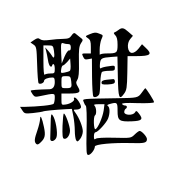
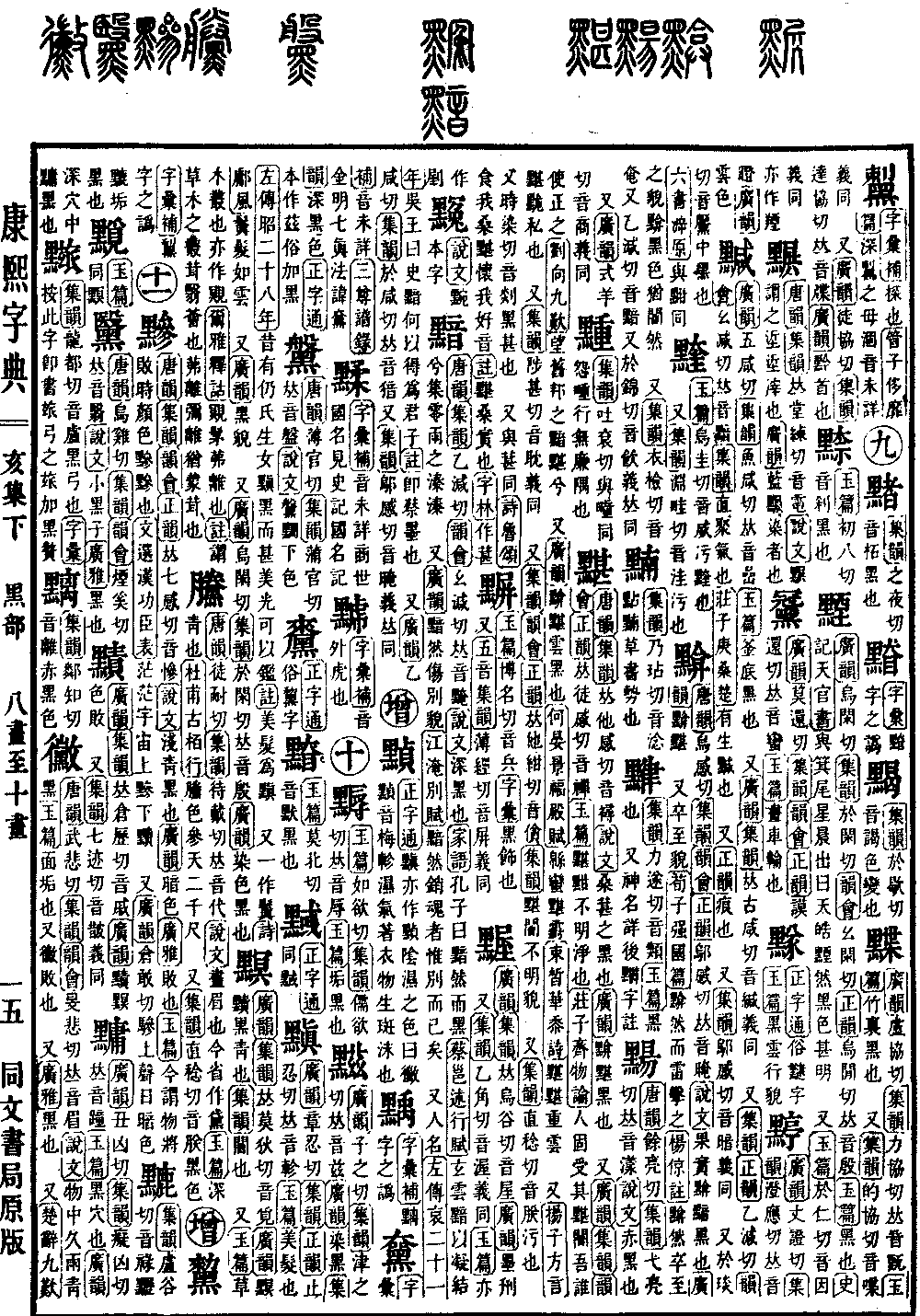
Hai Collection, Lower Volume
Radical: Black (hēi)
Kangxi Strokes: 21
Page 1521, Entry 19
According to Tang Rhymes (Tangyun) and Collection of Rhymes (Jiyun), it is pronounced tan (falling tone), with the same sound as the character tan.
According to Explaining Graphs and Analyzing Characters (Shuowen Jiezi), it refers to the black color of mulberry fruit.
According to Extensive Rhymes (Guangyun), the combination tan-tan denotes the color black.
Also, according to Extensive Rhymes (Guangyun), Collection of Rhymes (Jiyun), Rhyme Compendium (Yunhui), and Correct Rhymes (Zhengyun), it is pronounced tu (falling tone), with the same sound as the character tan.
According to Jade Chapter (Yupian), the combination tan-qian refers to something unclean or impure.
In Zhuangzi: Discussion on Making All Things Equal (Zhuangzi Qiwulun), it is written: People are inherently troubled by such ignorance, so who can I ask to correct it?
In Liu Xiang's Nine Laments (Jiutan), it is written: Gazing at the darkened and obscured state of my homeland.
Also, according to Extensive Rhymes (Guangyun), the combination tan-tan refers to thick, black clouds.
In He Yan's Rhapsody on the Jingfu Hall (Jingfu Dian Fu), it is written: A continuous and profound blackness.
In Shu Xi's Poem on the Grain of China (Hua Shu Shi), it is written: Dense and heavy dark clouds.
Also, according to Yang's Dialects (Fangyan), the character tan implies secrecy.
Also, according to Collection of Rhymes (Jiyun), it is pronounced zhen (falling tone), with the same sound as the character dan. The meaning is the same.
Also, according to Collection of Rhymes (Jiyun), Rhyme Compendium (Yunhui), and Correct Rhymes (Zhengyun), it is pronounced gan (falling tone), with the same sound as the character dian.
According to Collection of Rhymes (Jiyun), the combination tan-an refers to an appearance of dimness or lack of clarity.
Also, according to Collection of Rhymes (Jiyun), it is pronounced zhen (rising tone), with the same sound as the character zhen, referring to impurity.
Also, it is pronounced yan (falling tone), with the same sound as the character yan, meaning extremely black.
It is also the same as the character for mulberry fruit. In Book of Odes (Shijing), Lu Eulogy (Lusong), it is written: Eating the fruit of my mulberry tree, mindful of my good voice. The commentary states that tan refers to the fruit of the mulberry tree.
According to Dictionary of Characters (Zilin), it is written as the character for mulberry fruit.