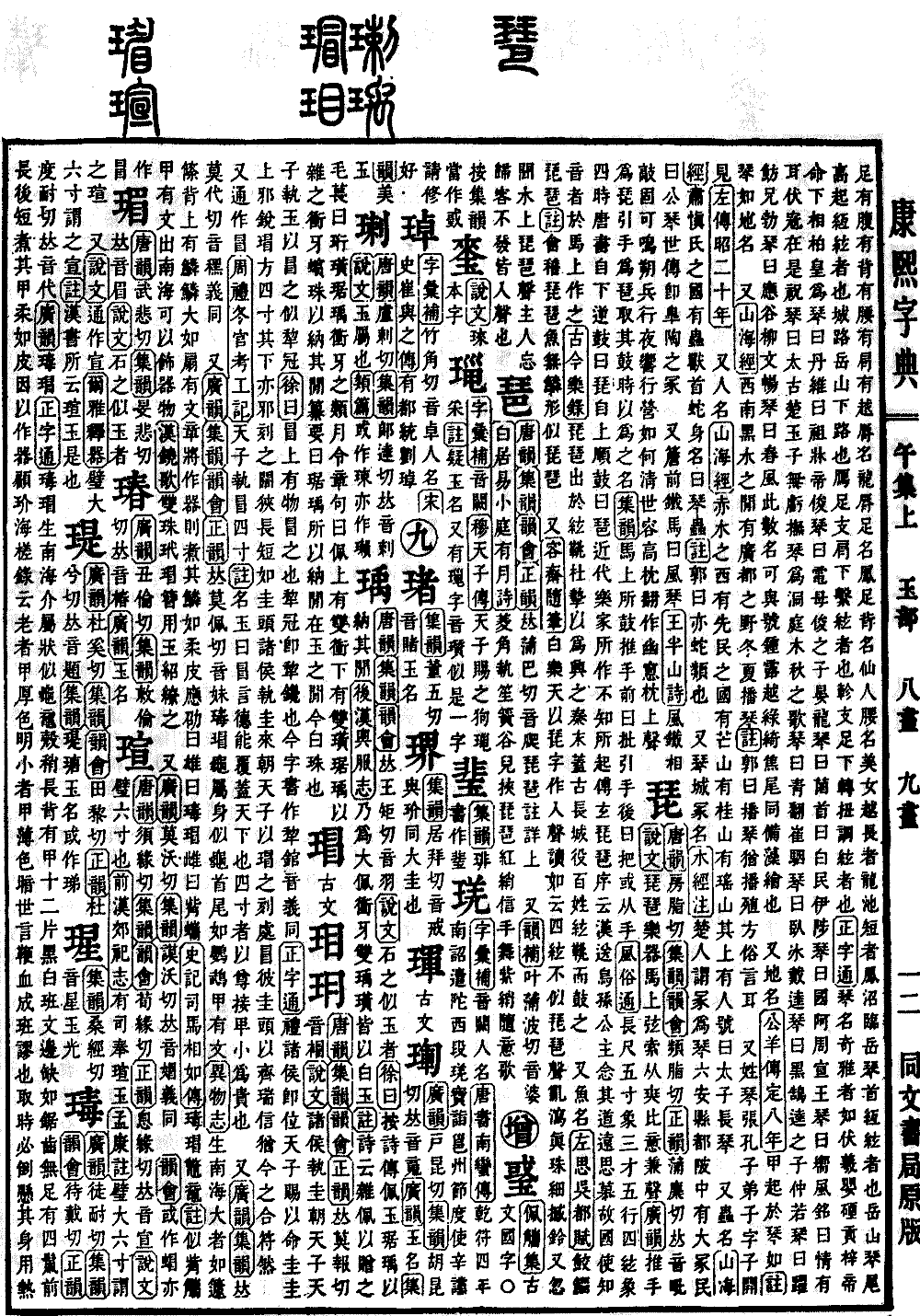
Wu Collection, Upper Volume
Radical: Jade (yù)
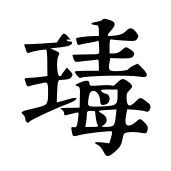
Dai
Kangxi strokes: 14
Page 736, Entry 23
Pronounced dai (falling tone). As cited in the Wide Rhymes (Guangyun), Collection of Rhymes (Jiyun), and Rhyme Meeting (Yunhui), and Correct Rhymes (Zhengyun).
According to the Wide Rhymes (Guangyun), this refers to the hawksbill turtle.
According to the Compilation of Correct Characters (Zhengzitong), the hawksbill turtle grows in the South China Sea and belongs to the crustacean family. It is shaped like a tortoise or a soft-shelled turtle, but its shell is slightly elongated. On its back are twelve plates with black and white mottled patterns, and its edges have notches like a saw. It has no feet but possesses four whiskers, the front two being long and the rear two short. If the shell is boiled, it becomes as soft as leather, which is why it is used to craft objects. In the Record of Sea Rafts (Haichalu) by Gu Jie, it is said that an old hawksbill has a thick, bright shell, while a young one has a thin, dull shell. People commonly say that the patterns on its back are formed by blood from being whipped, but this is incorrect. To obtain the plates, the creature must be hung upside down and splashed with hot vinegar, causing the plates to peel off one by one. Lu Dian stated that the hawksbill does not mate a second time and that it hatches its young by watching the shadow of its eggs; this is called protecting the eggs. Ying Shao stated that the male is called hawksbill and the female is called zixi. Another source claims that the hawksbill has six plates that are thick and yellow. Counterfeit hawksbill is made by applying lime, lead powder, and lye onto ox horn. Furthermore, the semen left by the hawksbill, when swallowed and then regurgitated by the crocodile fish, hardens over many years into lumps called sabaer, which are as valuable as gold. This is mentioned in the Western Regions Record (Xiyuji) by Liu Yu. For further details, refer to the entry for the character mao.
Also pronounced du (entering tone). As cited in the Wide Rhymes (Guangyun), Collection of Rhymes (Jiyun), and Correct Rhymes (Zhengyun). The meaning is the same.
According to the Compilation of Correct Characters (Zhengzitong), dai is the common form of the character. In the Selections of Refined Literature (Wenxuan), it is written with the insect radical as du mao. Ouyang Xun’s feibai calligraphy, as well as the Explanations of Characters (Zigu) and Cui Xiyu’s Brief Account of Antiquity (Cui Xiyu Luegu), all use the shell radical. In the Biography of Wang Mang, it is simplified to du mao.