Hai Collection, Upper Volume
Radical: Horse (mǎ)
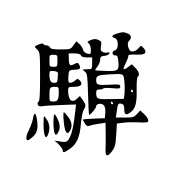
Entry: cāo
Kangxi stroke count: 20
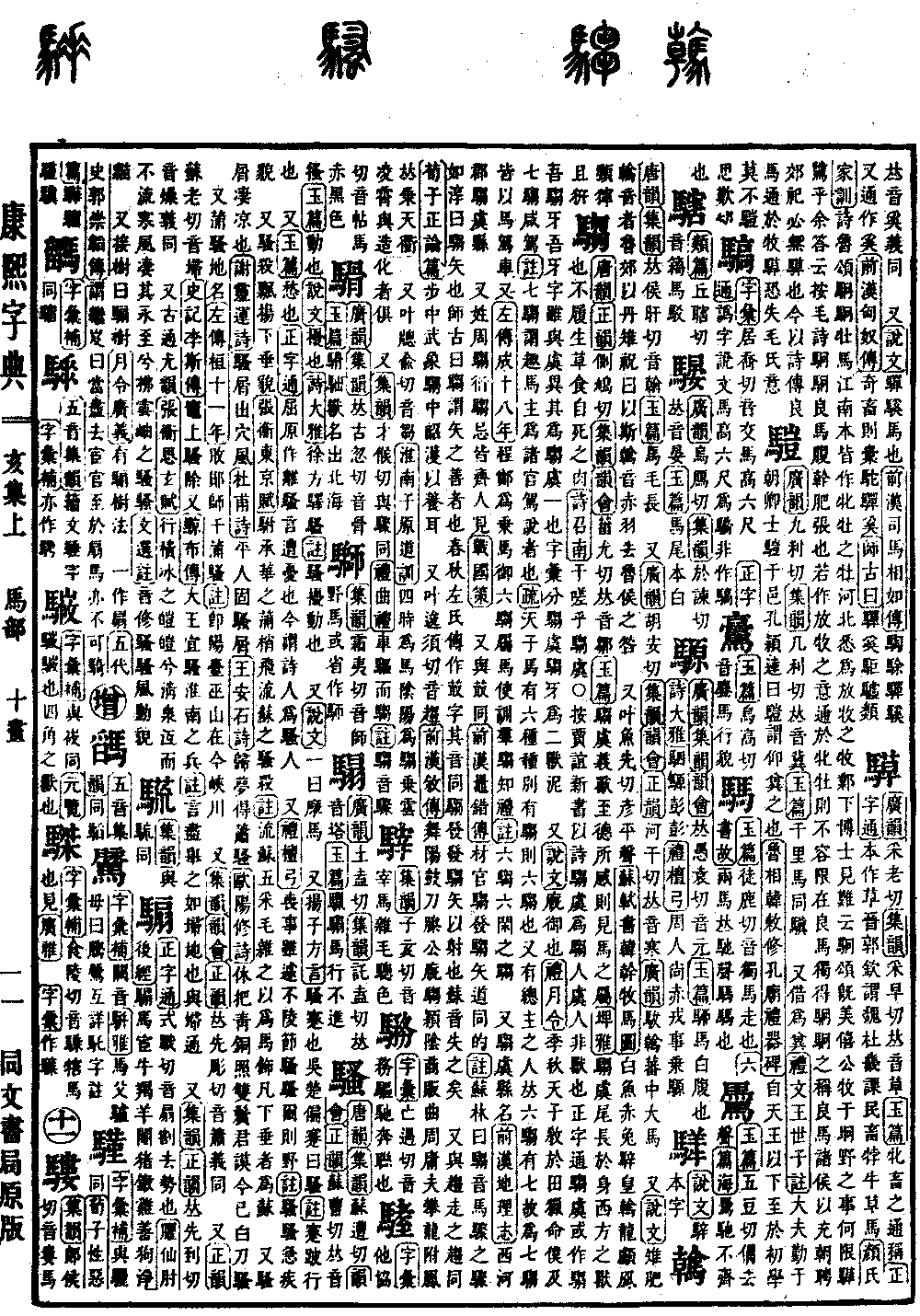
Page 1443, Entry 01
Broad Rhymes (Guangyun): Pronounced cǎo.
Collected Rhymes (Jiyun): Pronounced cǎo.
Pronounced cǎo.
Comprehensive Collection of Characters (Yupien): A general term for female livestock.
Correct Interpretation of Characters (Zhengzitong): Originally written as the character for grass. In the Jin dynasty, Guo Qin stated that Du Ji of the Wei state urged the people to raise cows and female horses.
Family Instructions of Mr. Yan (Yanshi Jiaxun): The Book of Odes (Shijing), in the Lu Odes section, contains the phrase "The stallions are fat and sleek." In the versions from the south, it is written with the character denoting a stallion. In the versions from Hebei, it is written with the character denoting pasturing. The scholars in Ye posed a question: Since this ode describes Duke Xi pasturing horses in the suburbs, why limit it to the gender of the horses? I answered: According to the Mao Commentary on the Book of Odes (Mao Shi), the term describes superior horses that are robust and plump. If it is interpreted as pasturing, covering both genders, it would not be limited to superior horses, nor would it uniquely fit the description of being robust. Superior horses were used by feudal lords for official visits and suburban sacrifices, and they would certainly not use female horses. Now, based on the commentaries of the Book of Odes, to equate the meaning of superior horses with pasturing and female horses, I fear, does not align with the original intention of the Mao school.
Textual Research: Correct Interpretation of Characters (Zhengzitong) states: Originally written as the character for grass. In the Jin dynasty, Guo Qin stated that Du Ji of the Wei state urged the people to raise cows and female horses. Note: Following the original text, the term for cow has been corrected to the character denoting a female cow. This has been corrected in the original edition.