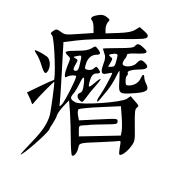
Pronounced qi ran (falling tone), according to the "Guangyun" (Guangyun), and qin ran (falling tone), according to the "Jiyun" (Jiyun), with the same pronunciation as "qian" (qian). It means pain or suffering. The "Book of Han" (Qian Hanshu), in the biography of Gu Yong (Gu Yong), records: "Furthermore, the prison of the Imperial Garden was turned into a great chaotic trap, and the pain of whipping was more severe than the torture of burning." In the commentary, Shigu (Shigu) says: "㿊, means pain."
Additionally, according to the "Jiyun" (Jiyun), pronounced zi zhen (rising tone), with the same pronunciation as "䤐" (䤐). It refers to painful diseases.
Furthermore, according to the "Jiyun" (Jiyun), "Yunhui" (Yunhui), and "Zhengyun" (Zhengyun), pronounced qi gan (falling tone). It means the same as "can" (can). The "Book of Han" (Qian Hanshu), in the Table of Kings of Vassal States of Different Surnames (Yixing Zhuhou Wang Biao), records: "The danger of responding is more severe than slander." In the commentary, Fuqian (Fuqian) says: "㿊, pronounced the same as can (can)." Ying Shao (Ying Shao) says: "Under Qin law, those who slandered were exterminated. Now Chen Sheng raises his arms and shouts, and everyone in the world responds. The danger of responding is more severe than slander." Shigu (Shigu) says: "㿊, means suffering."