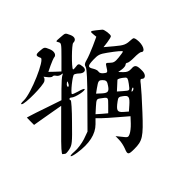
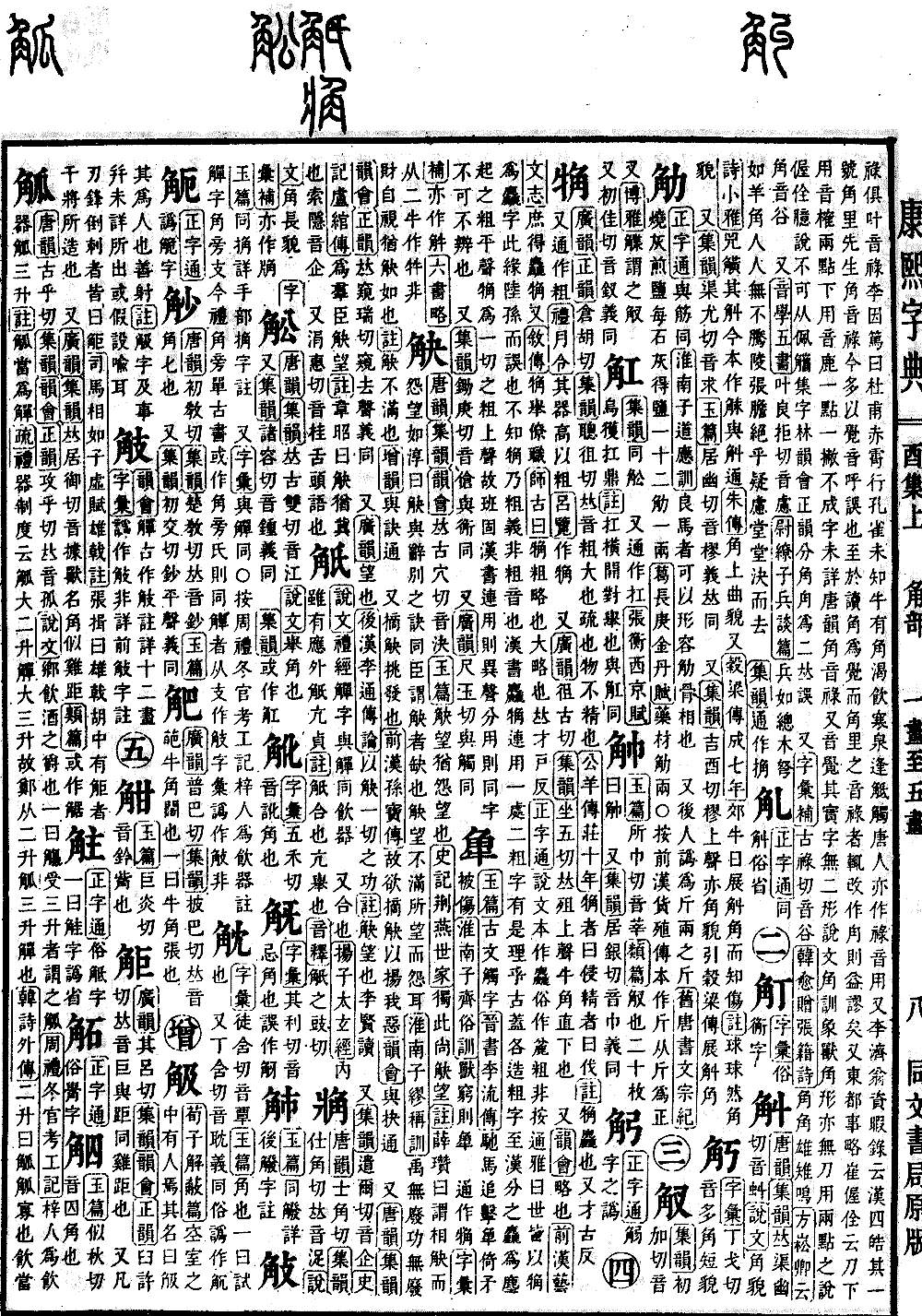
You Collection, Upper Volume
Radical: Horn (jiǎo)
Kangxi Strokes: 11
Page 1140, Entry 10
Pronounced cu. Meaning coarse, rough, or unrefined.
Gongyang Commentary (Gongyang Zhuan) on the tenth year of Duke Zhuang: To attack in a crude or rough manner is called an incursion (qin). To attack in a meticulous manner is called a campaign (fa). Commentary: This character means coarse.
Also pronounced cai and gu (rising tone).
Also written as a variant form for coarse (cu).
Book of Rites (Liji), Monthly Ordinances (Yueling): Ritual sacrificial vessels should be tall and coarse.
Master Lu’s Spring and Autumn Annals (Lüshi Chunqiu): Written as this character.
Pronounced cu and gu (rising tone), also pronounced zuo and wu (rising tone). Refers to ox horns pointing straight downward.
Rhyme Collection (Yunhui): Meaning brief or rough.
History of the Former Han (Qian Hanshu), Treatise on Literature (Yiwenzhi): Hoping to obtain an outline.
Same work, Preface (Xuzhuan): To list official positions in a rough or summary fashion.
Shigu says: This character means rough or summary, an outline. Pronounced cai and hu (rising tone).
Corrected Characters (Zhengzitong): The Explaining Graphs and Analyzing Characters (Shuowen Jiezi) originally wrote this as the character meaning deer-like. Common usage writes it as various forms, but these are incorrect. According to the Comprehensive Refinement (Tongya): The world treats this character as equivalent to the deer-like character, but this follows the errors of Lu Deming and Sun Mian. They do not realize that while this character means coarse, it is not the same pronunciation as the common word for coarse. In the History of the Former Han (Qian Hanshu), the two forms are used together; how could there be a logic to using two synonyms in one place? Anciently, the character for coarse was likely created separately; by the Han dynasty, they were distinguished. The deer-like form refers to the coarseness of dust rising and is pronounced with a level tone. This character refers to the coarseness of all things and is pronounced with a rising tone. Thus, when Ban Gu used them together in the History of the Former Han (Qian Hanshu), they were pronounced differently, but when used separately, they are the same word; one cannot fail to distinguish them clearly.
Also pronounced chu and geng (rising tone). Equivalent to another character for rough.
Also pronounced chi and yu (rising tone). Equivalent to the character for touch or collide (chu).