Hai Collection, Upper Volume
Radical: Bone (gǔ)
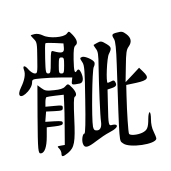
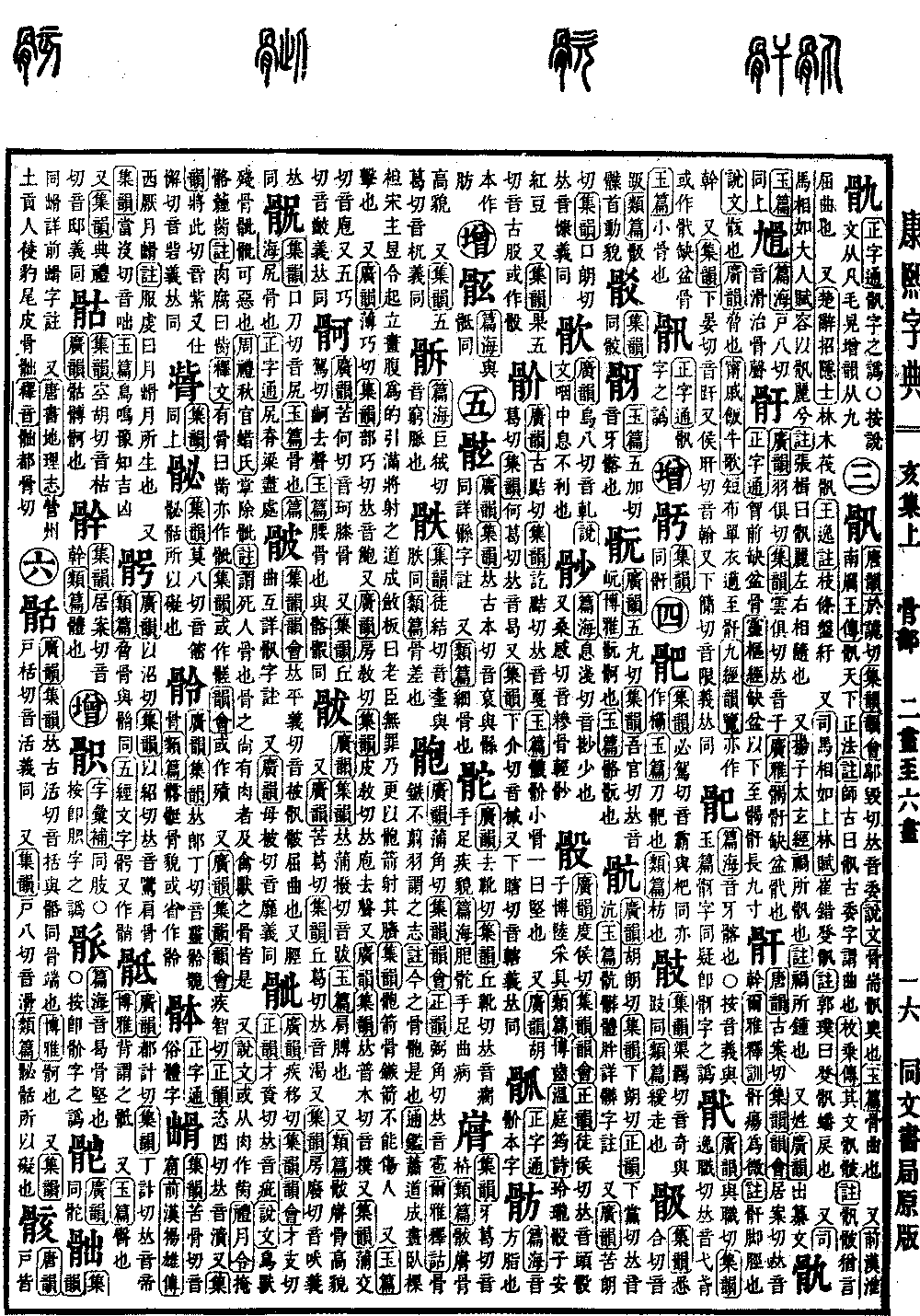
Character: 骴
Kangxi Stroke Count: 15
Page 1448, Entry 35
Pronounced ci.
According to the Explanation of Words and Phrases (Shuowen Jiezi), it refers to the residual bones of birds and beasts. It denotes something loathsome.
In the Rites of Zhou (Zhouli), under the Office of Autumn, the Official of Sacrificial Offerings (Lashi) is responsible for the removal of such remains. The commentary explains this as human bones, including bones that still have flesh attached, as well as the bones of birds and beasts.
Also, the Explanation of Words and Phrases (Shuowen Jiezi) notes that it is sometimes written with the flesh radical as variant form (zì). In the Book of Rites (Liji), in the Monthly Ordinances (Yueling), it mentions covering skeletal remains and burying such flesh. The commentary states that putrefied flesh is called zì. The Explication of Text (Shiwen) states that remains with bone are called zì. It is also written as the primary form mentioned above.
The Compendium of Rhymes (Jiyun) notes it is also written in a variant form (chú). The Collection of Rhymes (Yunhui) notes it is also written in another variant form.
Additionally, pronounced zi (falling tone).
Also, according to the Compendium of Rhymes (Jiyun), pronounced zi (rising tone).
Also, pronounced zhai (falling tone). The meanings are the same.