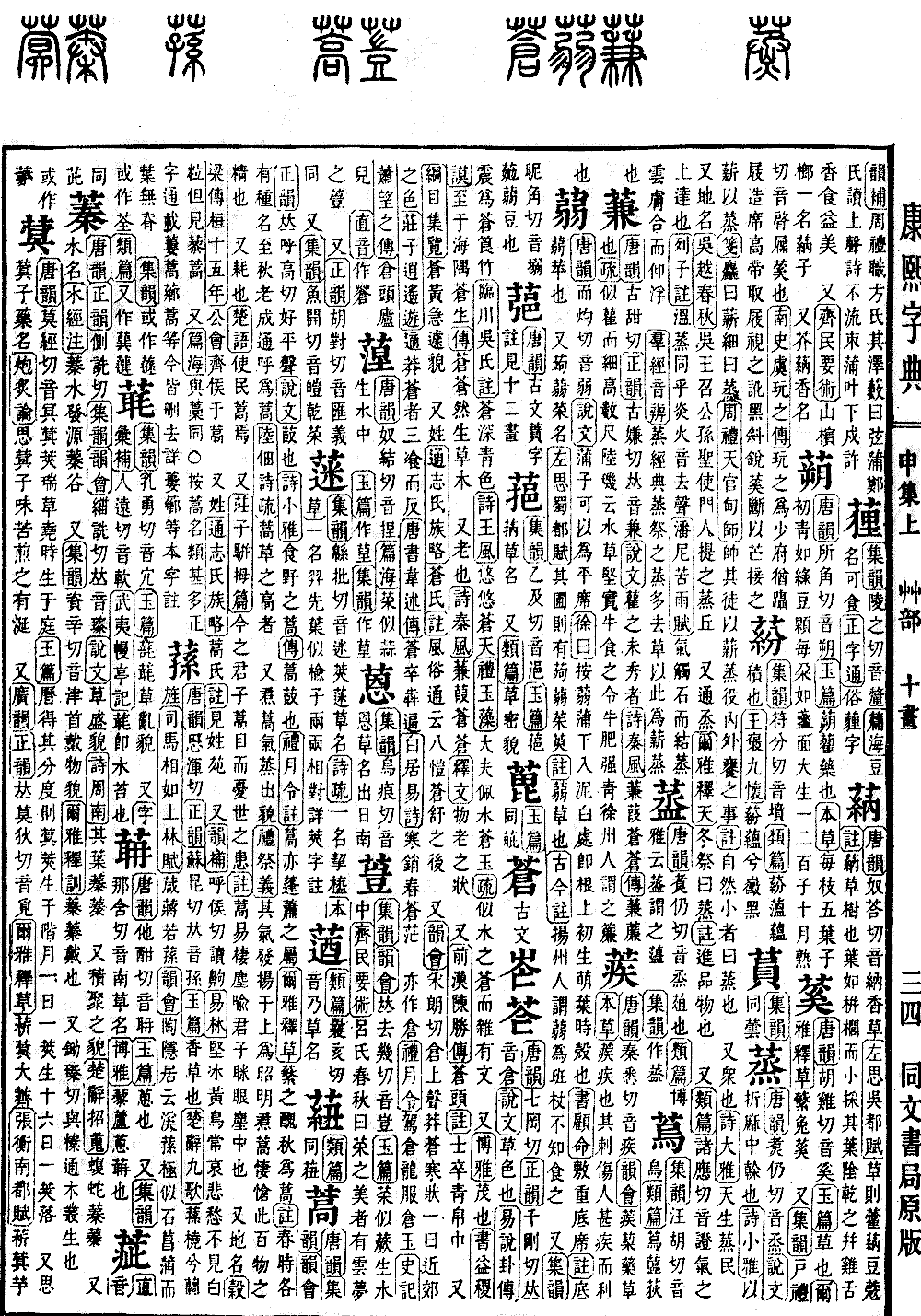
Shen Collection, Upper Volume
Radical: Grass (cǎo)
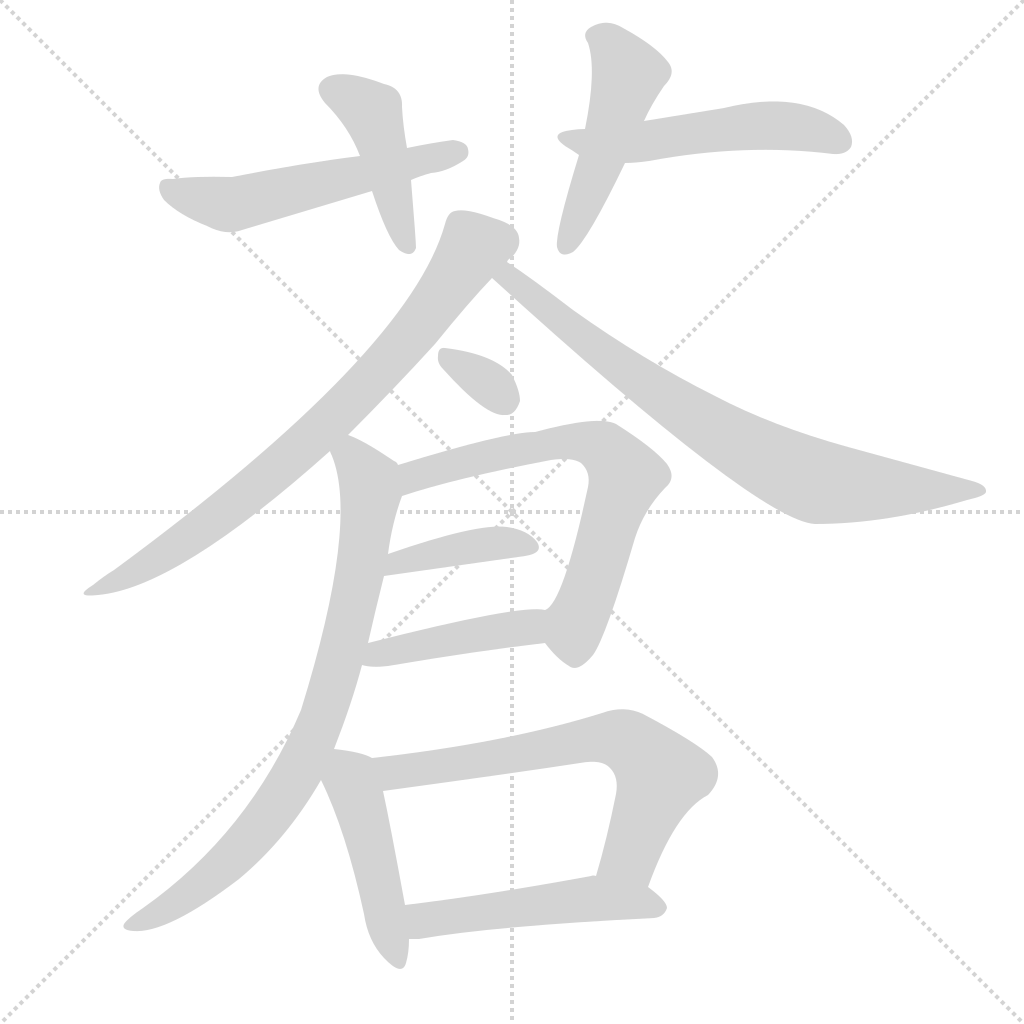
苍; Kangxi stroke count: 16; Page 1050, Entry 16
Ancient forms. Pronounced cang. According to the Shuowen Jiezi (Explanation of Graphs and Analysis of Characters), it refers to the color of grass. In the Book of Changes (Yijing), section on the Explanation of the Trigrams, it is stated that the trigram for thunder represents green bamboo. A commentary by Wu of Linchuan states that this term describes a deep blue-green color. In the Book of Odes (Shijing), it is used in the phrase "the vast, dark blue heaven." In the Book of Rites (Liji), it states that officials wear water-blue jade; the commentary notes this refers to the appearance of water-colored blue-green with patterns. It also denotes lush growth, as seen in the Book of Documents (Shujing), section on the Benefits of Social Order, which refers to the living creatures at the edge of the sea, with the commentary noting this describes the flourishing growth of plants. It also means old or aged, as in the Book of Odes (Shijing), where it describes the appearance of aged reeds. The explanatory text notes this describes the state of something aged. In the History of the Former Han (Qian Hanshu), in the Biography of Chen Sheng, it refers to soldiers who wore blue-cloth headbands. According to the Comprehensive Summary of History (Gangmu Jilan), it describes a state of haste or panic. It is also a surname. According to the Record of Clans (Tongzhi Shizulu), it originates from the descendants of Cang Shu, one of the Eight Virtuous Men mentioned in the Record of Customs (Fengsutong). Pronounced cang (rising tone). It refers to the appearance of cold, or alternatively, the color of the outskirts of a city. In the Zhuangzi, it is used to describe those traveling to the wild outskirts who return after three meals. In the History of the Tang (Tangshu), it describes a hurried and pressing situation. In the poetry of Bai Juyi, it describes the cold melting into the vastness of spring. It is also written as a variant form. In the Book of Rites (Liji), it refers to driving a green dragon and wearing green jade. In the Records of the Grand Historian (Shiji), it appears in the Biography of Xiao Wangzhi. The dictionary directs this character to be written under the radical for grass. Textual verification: In the Book of Documents, section on the Benefits of Social Order, the original text used the word treatise, which has been corrected to chapter to match the source.