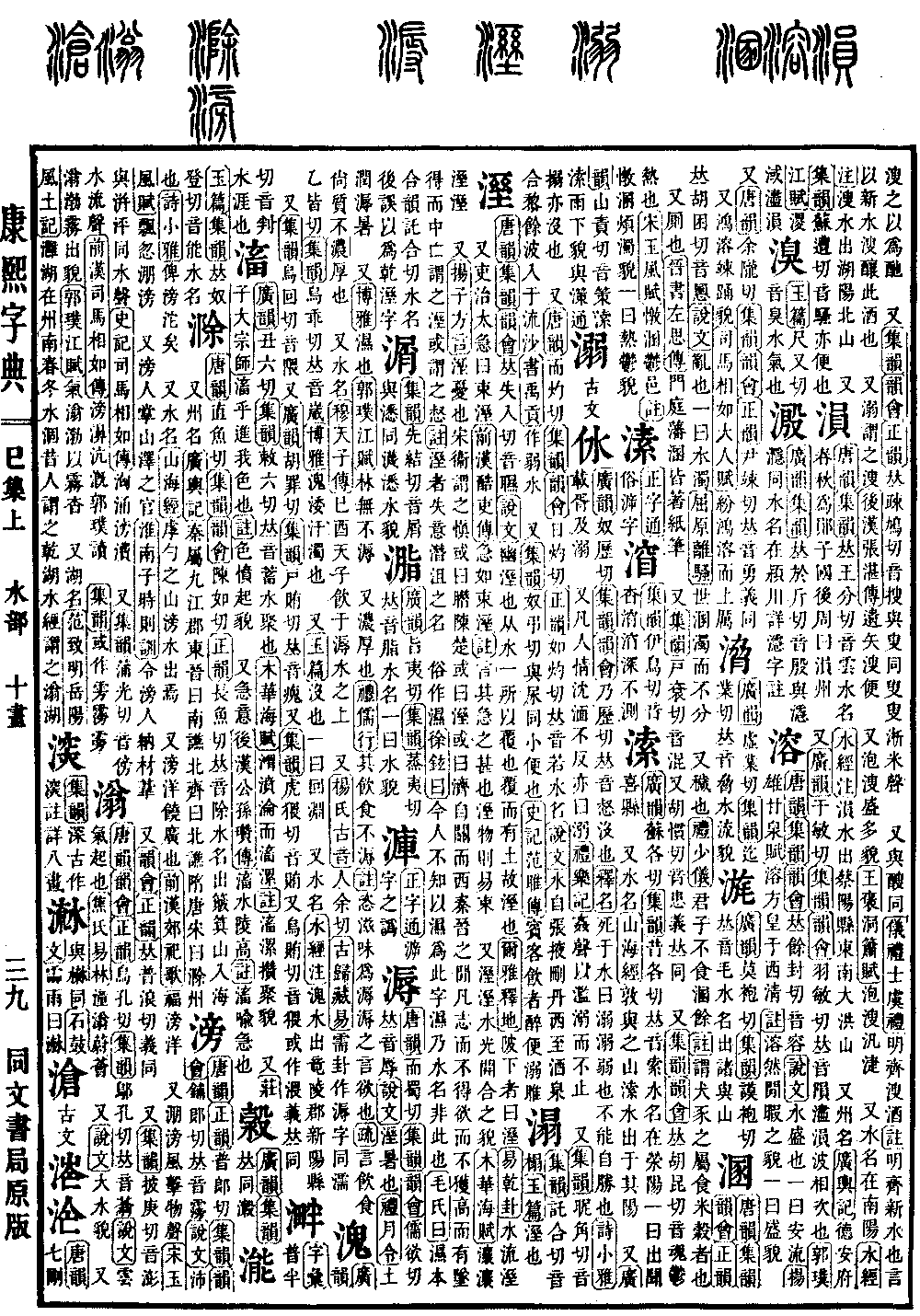
Si Collection, Upper Volume
Radical: Water (shuǐ)
Character: Cang
Kangxi stroke count: 14
Page 641, Entry 29
Ancient script form. According to the Tang Rhyme (Tangyun), pronounced cang. According to the Collection of Rhymes (Jiyun) and the Compendium of Rhymes (Yunhui), pronounced cang. Pronounced the same as the character for granary.
A name of a river. In the Book of Documents (Shujing), specifically the Tribute of Yu (Yugong) chapter, it is noted that Mount Bozhong directs the Yang River, which flows east to become the Han River. Further east, it becomes the Canglang River.
Also a river name. According to the Commentary on the Water Classic (Shuijingzhu), the Shi River merges on the left with the Qingyi River, also known as the Cang River.
Also a lake name. According to the Comprehensive Geography of the Empire (Guangyuji), it is located in Lechang County, Shaozhou Prefecture.
Also a prefecture name. According to the Expanded Rhyme Dictionary (Guangyun), it was established during the Later Wei dynasty, presumably named after the Azure Sea.
Also, according to the Explanation of Script (Shuowen), it means cold. In the Lost Book of Zhou (Yizhoushu), it is written that the way of heaven and earth involves cold and heat. It is also written as the character for granary.
In the Sweet Spring Rhapsody (Ganquan Fu) by Yang Xiong, it is written: The sun shines east onto the Azure Sea.
Also, according to the Collection of Rhymes (Jiyun), pronounced chuang. Identical to the character for cold.