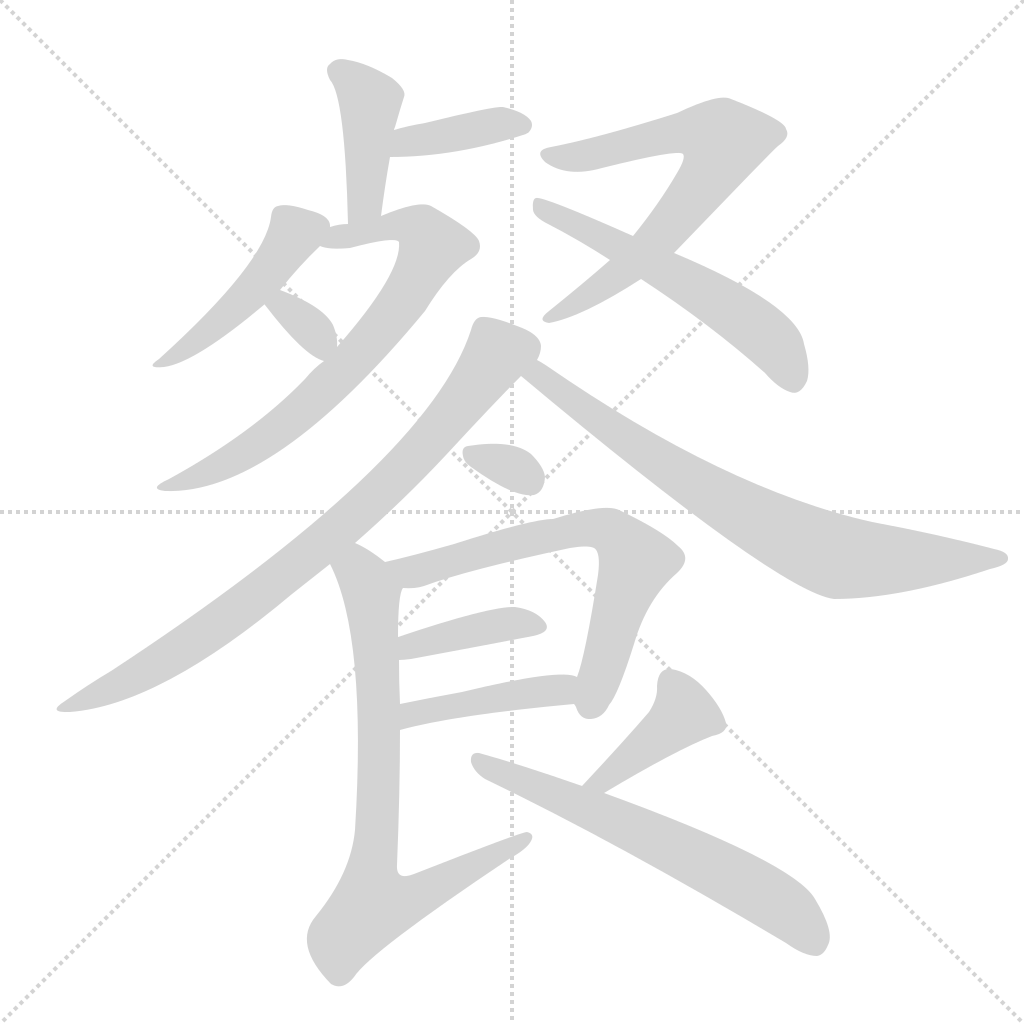
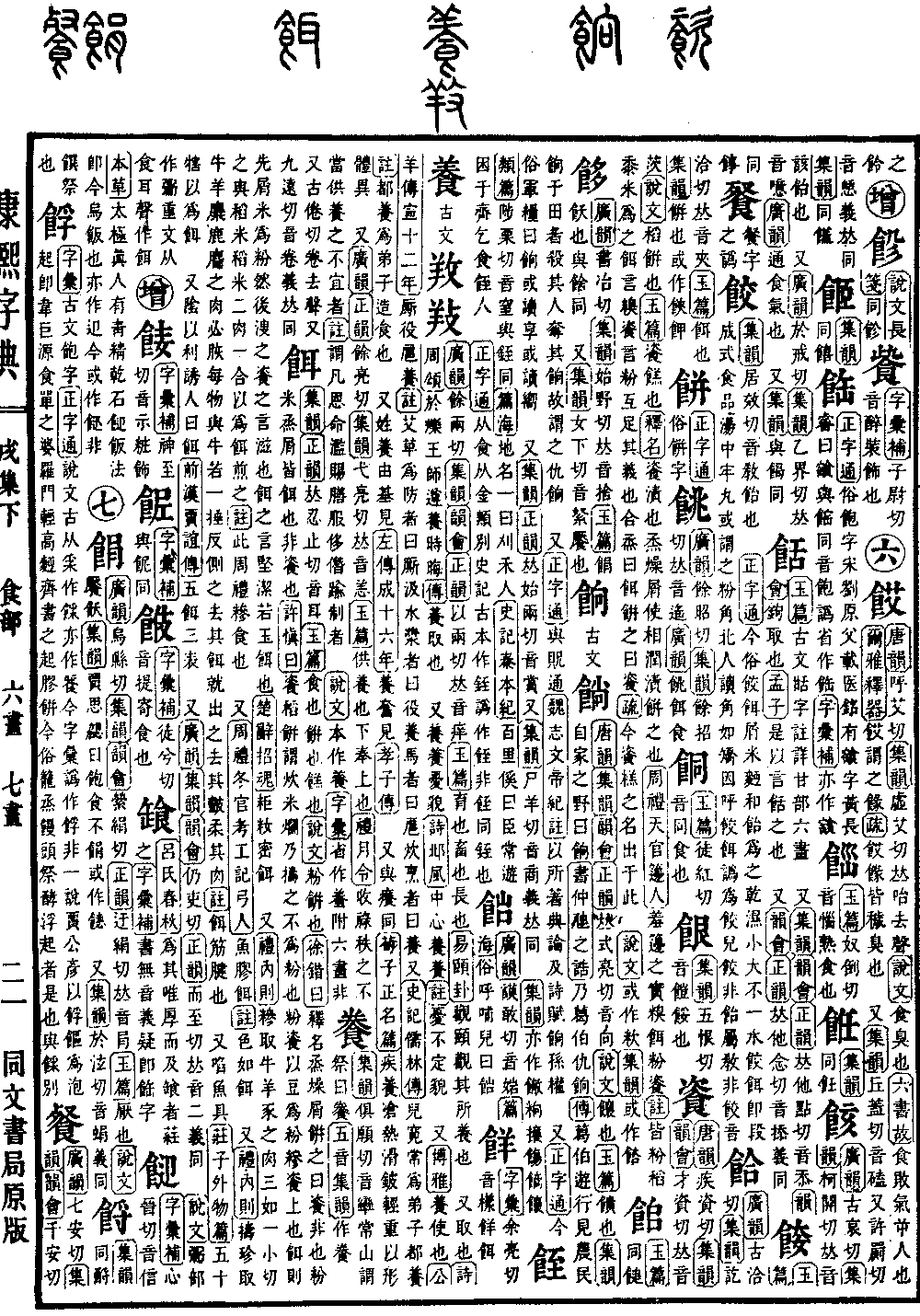
Xu Collection, Lower Volume
Radical: Food (shí)
Kangxi strokes: 16
Page 1419, Entry 39
Pronounced can.
According to the Explaining Graphs and Analyzing Characters (Shuowen Jiezi), it means to swallow.
In the Book of Odes (Shijing), it is written: Do not eat the bread of idleness. The commentary notes that it is pronounced like the character for bright (can).
The Explaining Graphs and Analyzing Characters (Shuowen Jiezi) also notes a variant form written with the water radical.
The Rhyme Anthology (Yunhui) notes a common variant form written with the food radical.
It also refers to food and drink. In the History of the Former Han (Qianhan Shu), the Annals of Empress Gao mentions the bestowal of meal money, with the commentary explaining this as kitchen and pantry funds.
In the Biography of Han Xin, it mentions ordering his lieutenant to deliver meal rations. The commentary by Fu Qian suggests this refers to delivering meals while mounted on horseback. Ru Chun notes that a small meal is called a meal. Yan Shigu comments that this character is an ancient form of the character for food, pronounced can.
It also means to gather. In the writings of Wang Jian and Chu Yuan, it refers to gathering public opinion in the village and looking up to his elegant praise in the capital. The commentary notes that gathering public opinion refers to praising his virtuous conduct.
In ancient times, it was interchangeable with the word for first (xian). In the Ancient Music Bureau (Gu Yuefu) poems, specifically the Gentleman's Conduct (Junzi Xing), it describes how the Duke of Zhou would lower himself to visit commoners, spitting out the food in his mouth and leaving his bath three times to grasp his hair in order to welcome them; later generations called him a sage.
Also, according to the Collected Rhymes (Jiyun), pronounced sun. It is the same as the character for supper (sun). The Erya: Explanations of Words (Erya Shiyan) states that the character for bright (can) is a meal. The commentary notes that it is pronounced like the character for supper (sun).
Also, according to the Collected Rhymes (Jiyun), pronounced can (falling-rising tone). It refers to a type of cake. The Orthography of Rhymes (Zhengyun) records this form. The Compendium of Characters (Zihui) states that writing it as this character is incorrect.