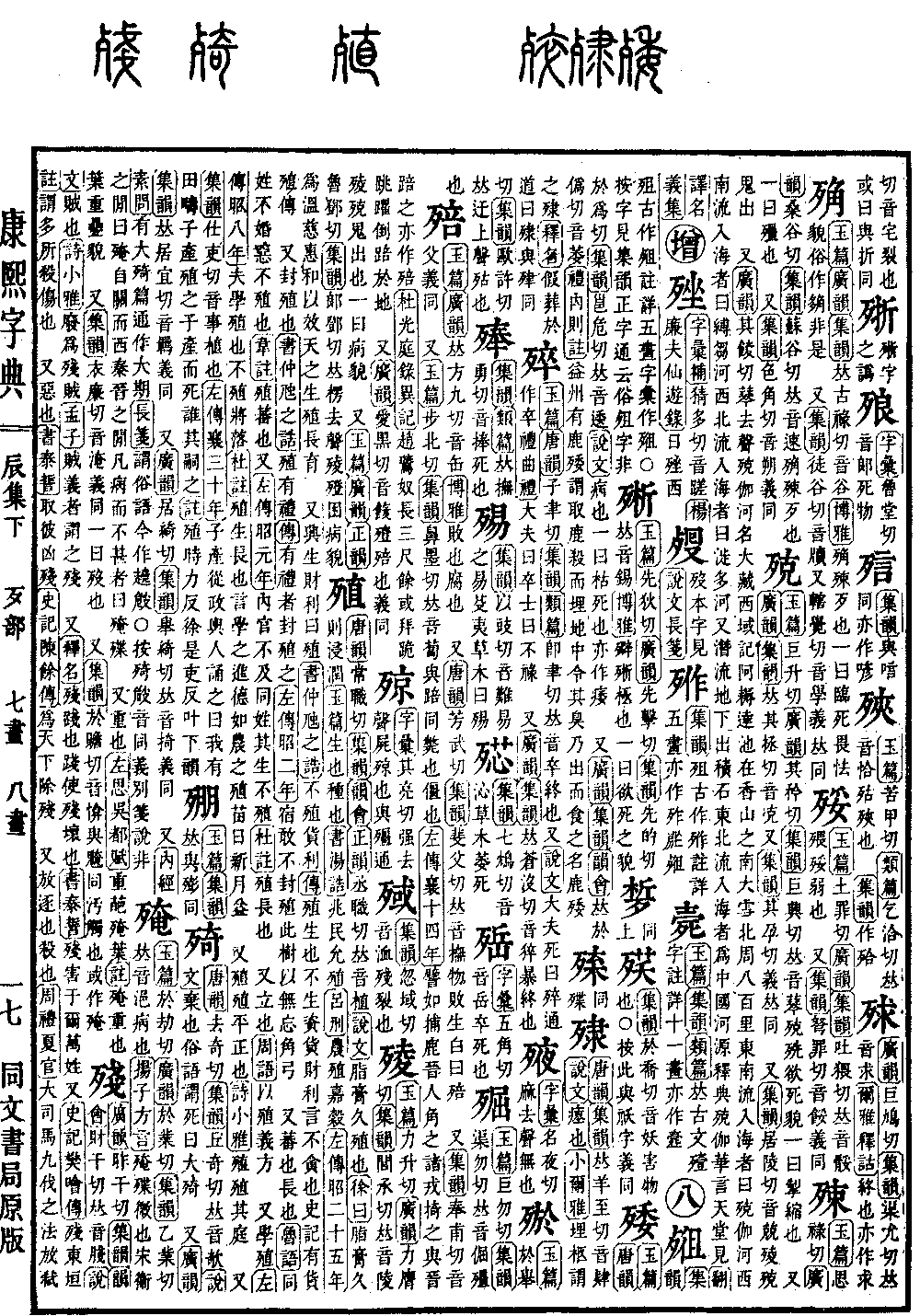
Chen Collection, Lower Volume
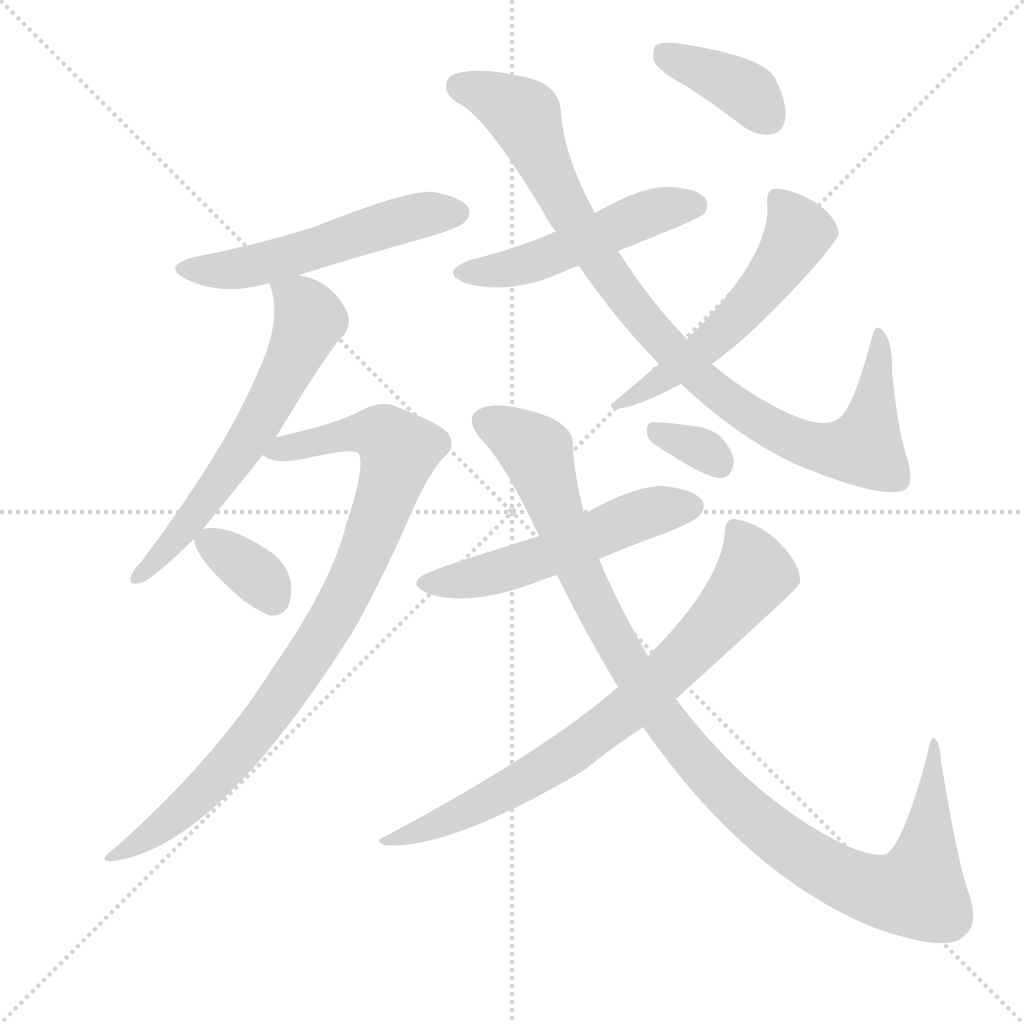
Radical: Evil (dǎi)
Kangxi Strokes: 12
Page 581, Entry 37
Guangyun (Dictionary of Broad Rimes): Pronounced can
Jiyun (Collection of Rimes) and Yunhui (Compendium of Rimes): Pronounced can
Shuowen (Explaining Graphs and Analyzing Characters): To injure.
Book of Odes (Shijing), Lesser Odes: Cast aside and become a cruel, injurious person.
Mencius: Those who violate righteousness are called cruel.
Also, Explanations of Names (Shiming): Cruel means to trample. Trampling causes destruction and ruin.
Book of Documents (Shujing), Great Declaration: To inflict harm upon your myriad people.
Also, Records of the Grand Historian (Shiji), Biography of Fan Kuai: To ravage Dongyuan.
Commentary: This refers to causing many deaths and injuries.
Also, evil.
Book of Documents (Shujing), Great Declaration: Eliminate those who are violent and cruel.
Records of the Grand Historian (Shiji), Biography of Chen Yu: To eliminate the cruel from the world.
Also, to banish, to kill.
Rites of Zhou (Zhouli), Summer Offices, The Grand Minister of War: Among the nine methods of punitive expeditions, if they depose or murder their ruler, then one must destroy them.
Yangzi's Dialects (Fangyan): To kill. In the regions north of the He river in the Jin and Wei states, it is called can. Pronounced lin. Sometimes pronounced lan.
Also, leftover food.
Du Fu's Poetry: Leftover cups and cold meat.
Also, a name for boiled meat.
Zhang Xie, Seven Commands: Swallow lips of orangutans, yak meat, and elephant trunk.
Commentary: Mao is the yak. Canbai is likely a specific name for a type of boiled meat.
Cui Yin, Treatise on Gamblers: Boiled mutton.
Also, incomplete or defective.
Liu Xin, Letter to the Doctoral Scholars of the Imperial Academy: Clinging stubbornly to incomplete knowledge.
Commentary: Shigu stated: To be obsessed with one's own biased view and stubbornly cling to incomplete texts.
Also, to interpret things in a far-fetched or forced manner is called zuican.
Wang Chong, Balanced Discourses (Lunheng): A cart full of insignificant scraps does not make a path; a chest full of jade dust does not make a treasure.
Also, abusive swearing is called canma.
Yangzi's Dialects (Fangyan): In Southern Chu, when people swear abusively, it is called qian.
Also, greedy and violent officials are called canli.
Book of the Later Han (Hou Hanshu), Annals of Emperor Ming: Corrupt officials let go.
Also, Wucan, name of a star.
Records of the Grand Historian (Shiji), Treatise on the Celestial Offices: The Wucan star appears in the fields of the far east; its shape resembles the Mercury star.
Correct Meaning (Zhengyi): Wucan is also known as Wufeng.
Book of the Former Han (Qian Hanshu), Treatise on Arts and Literature: Contains twenty-one scrolls of the Wucan miscellaneous changing stars.
Also, interchangeable with jian.
Classic of Changes (Yijing), Fen Hexagram: Bundles of silk, meagerly.
Commentary: Cites the Classic of Changes (Yijing) by Zixia: Bundles of silk, meagerly.
Also, Book of Wei (Weizhi): The Chenhan people called the people of Lelang A-can. Eastern people called us A, saying that the Lelang people are the remnants of their original people.
Also, kuai-can, name of a fish.
Pi Rixiu's Poetry: Clearly able to count the kuai-can fish.
Also, Biographies of Eminent Monks (Gaoseng Zhuan): Chan Master Mingzan was lazy by nature and ate leftovers, so he was called Lazy Can.
Also, Rhyme Supplement (Yunbu): Rhymes with qian.
Ban Biao, Northern Expedition Rhapsody: With body and head separated, I do not wake, still counting merit while resigning from trouble. Why do those masters speak so foolishly, claiming that the earth's veins produce death and ruin?
Also, Record of Brush Talks from Dream Stream (Mengxi Bitan): Wang Shengmei studied orthography, extending its meaning to create the Right-Phonetic category. Whenever a character belongs to a category, it is on the left, and its meaning is on the right. For example, the wood category all follow wood on the left. The so-called Right-Phonetic principle suggests that jian means few; a small amount of water is called shallow; a small amount of gold is called coin; evil and small is called cruel; a small amount of shells is called cheap; these examples all use jian to define meaning. Note: The meaning of can originally combines the concepts of large and small; I append this note here.
Correction: Cui Yin, Treatise on Gamblers: Boiled mutton. Carefully corrected from the original text's faulty character to the character meaning boiled meat.