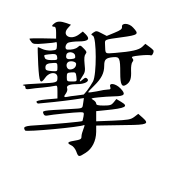
Zi Collection, Page Position: Upper, Radical: Cliff (hǎn), Page 24, Entry 03
In the "Tang Yun" (Tang Yun), it is pronounced zuó gān, and in the "Ji Yun" (Ji Yun), it is pronounced cái gān, with the same pronunciation as "cán". "Shuowen Jiezi" (Shuowen Jiezi) explains it as meaning brief.
Also, in the "Ji Yun" (Ji Yun), "Yun Hui" (Yun Hui), and "Zheng Yun" (Zheng Yun), it is pronounced suǒ zhǎn, read as the rising tone of "cán". "Boyao" (Boyao) explains it as meaning secondary. Another explanation is the meaning of to cut off.
Also, in the "Ji Yun" (Ji Yun), it is pronounced zài gǎn, with the same pronunciation as "qiàn". It means to strike.
Also pronounced zǔ gàn. It means to lift.
Also, in the "Tang Yun" (Tang Yun) and "Ji Yun" (Ji Yun), it is pronounced shān kǎn, also meaning to take.
Also, in the "Ji Yun" (Ji Yun), it is pronounced jí rǎn, with the same pronunciation as "jiàn". It is also pronounced shì jiǎn, read as the rising tone of "chán". The meaning is the same. One explanation is a variant of the character "nán".