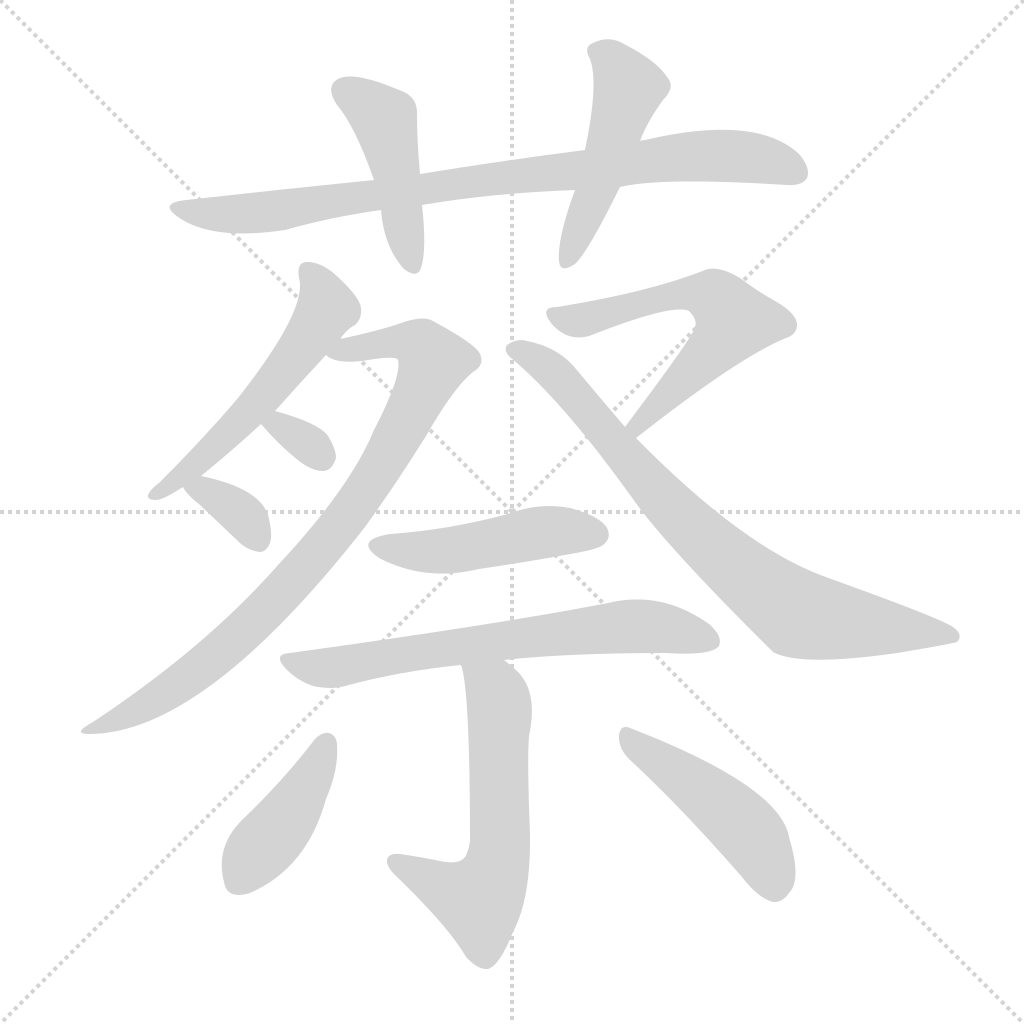
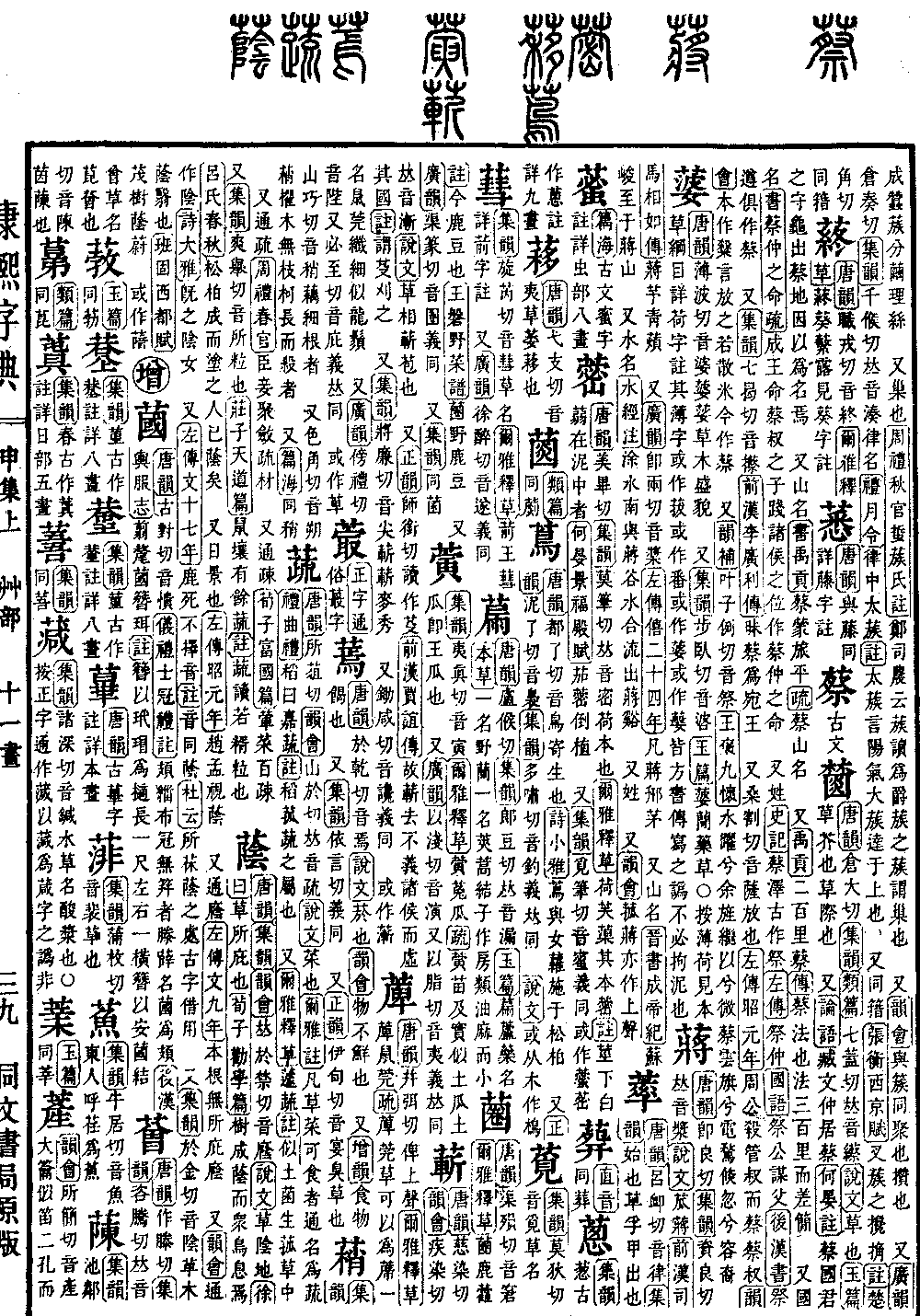
Shen Collection, Upper Volume
Radical: Grass (cǎo)
Kangxi Strokes: 17
Page 1055, Entry 03
Ancient form. Pronounced cai.
According to the Explaining Graphs and Analyzing Characters (Shuowen Jiezi), it refers to grass.
According to the Jade Chapters (Yupian), it refers to grass or small plants, or the edge of grass.
Also, in the Analects of Confucius (Lunyu), Zang Wenzhong kept a tortoise. He Yan states: Cai is the divination tortoise kept by a feudal lord, originating from the region of Cai, and thus named after it.
Also, the name of a mountain. According to the Book of Documents (Shujing), specifically the Tribute of Yu (Yu Gong), it is mentioned as Mount Caimeng. The commentary explains: Cai is the name of a mountain.
Also, in the Tribute of Yu, it mentions a distance of two hundred li being a cai. The commentary explains: Cai means a law or standard, used here to distinguish the gradations of three hundred li.
Also, a state name. According to the commentary on the Mandate of Cai Zhong (Cai Zhong zhi Ming) in the Book of Documents, King Cheng ordered the son of Cai Shu to ascend to the position of a feudal lord, and the chapter titled The Mandate of Cai Zhong was composed.
Also, a surname. According to the Records of the Grand Historian (Shiji), Cai Ze was originally written with the character pronounced ji. In the Zuo Tradition (Zuo Zhuan), Ji Zhong is mentioned; in the Discourses of the States (Guoyu), Ji Gong Moufu is mentioned; and in the History of the Later Han (Hou Hanshu), Ji Zun is mentioned, all of which are written with the character for cai.
Also, pronounced ca. According to the History of the Former Han (Qian Hanshu), in the biography of Li Guangli, Mei Cai became the King of Wan.
Also, pronounced sa. It means to banish or cast away. In the Zuo Tradition, in the first year of Duke Zhao, it is written that the Duke of Zhou killed Guan Shu and banished Cai Shu. According to the Rhyme Compendium (Yunhui), it was originally written as a character meaning to scatter or banish like spreading rice; it is now written as cai.
Also, pronounced ji. As seen in Nine Yearnings (Jiu Huai) by Wang Bao: Water splashes and dampens my banner, followed by fine water grasses. My cloud-like flags fly as fast as lightning, in the blink of an eye, I have drifted away.