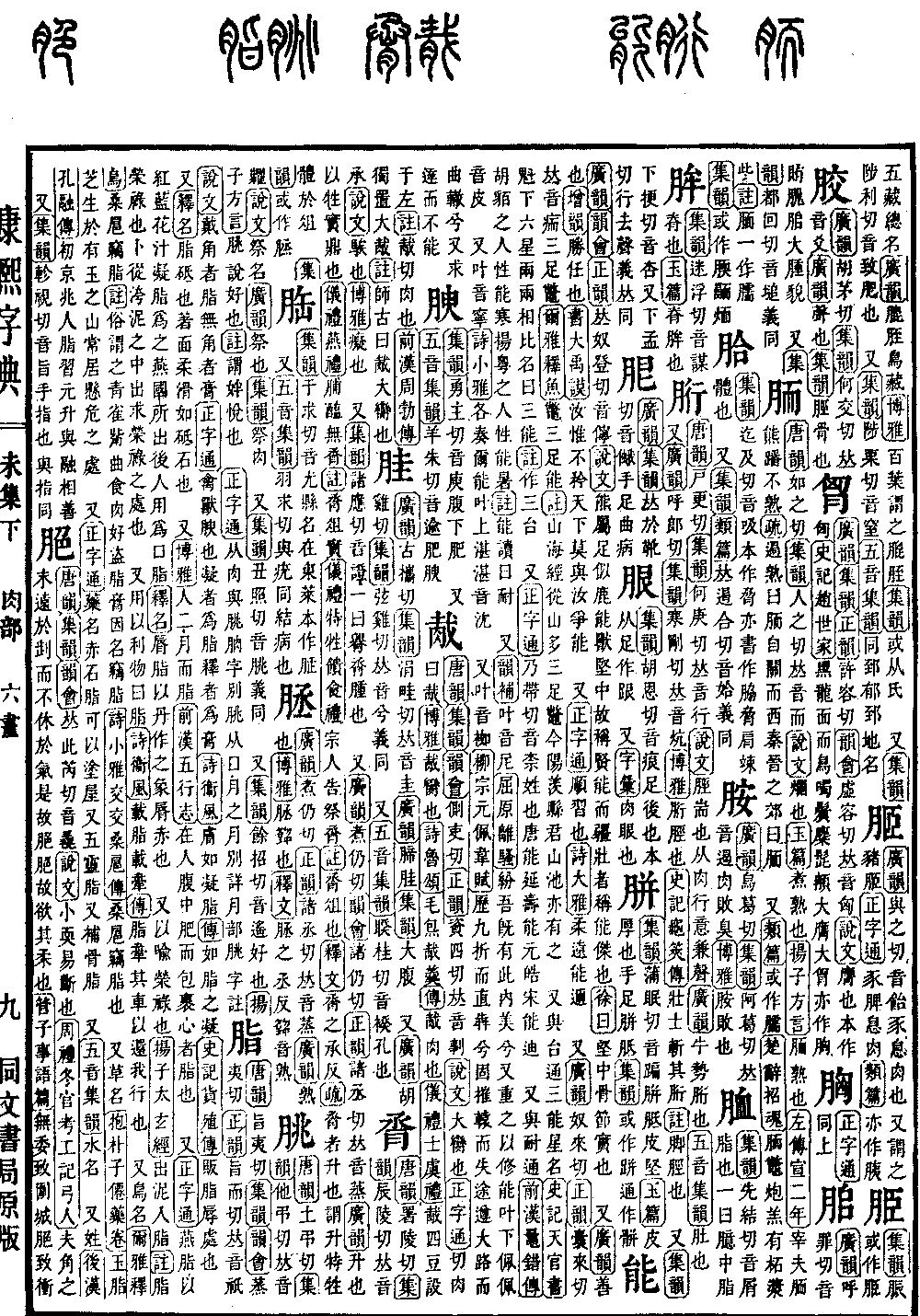
Wei Collection, Lower Volume
Radical: Meat (ròu)
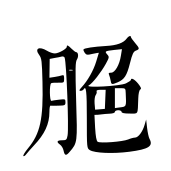
Cui
Kangxi strokes: 12
Page 981, Entry 25
Tang Rhyme (Tangyun), Collected Rhymes (Jiyun), and Dictionary of Rhymes (Yunhui): Pronounced cui (falling tone).
Shuowen Jiezi: Refers to something thin, small, and soft that is easily broken.
Book of Rites (Liji), Winter Officials, Artificers Record: At the end of the horn, the part farthest from the bow tip does not receive the nourishment of blood and energy, therefore it is easily brittle; because it is easily brittle, one hopes it will be soft and pliable.
Guanzi, Discourse on Affairs: Lacking stores leads to being besieged; walls that are not firm lead to being breached.
Note: Cui means not firm.
Also, Guangya: Cui means desire.
Also, Zhengzitong: Means light and superficial.
Book of the Later Han (Houhan shu), Biography of Xu Jing: The commanderies and counties are near the south, where customs are light, superficial, and lacking in sincerity.
Also, Collected Rhymes (Jiyun): Pronounced cui (falling tone).
Also, Pronounced cu (falling tone).
The meaning is the same.
Also, Rhyme Supplement (Yunbu): Rhymes with chuo (entering tone).
Zuo Si, Rhapsody on the Capital of Wei (Wei du fu): Appearance is ugly, nature is impulsive and fragile. In the streets and alleys, there are no outstanding talents; in the villages, there are few long-lived elders.
Guangyun: Commonly written as cui (brittle).