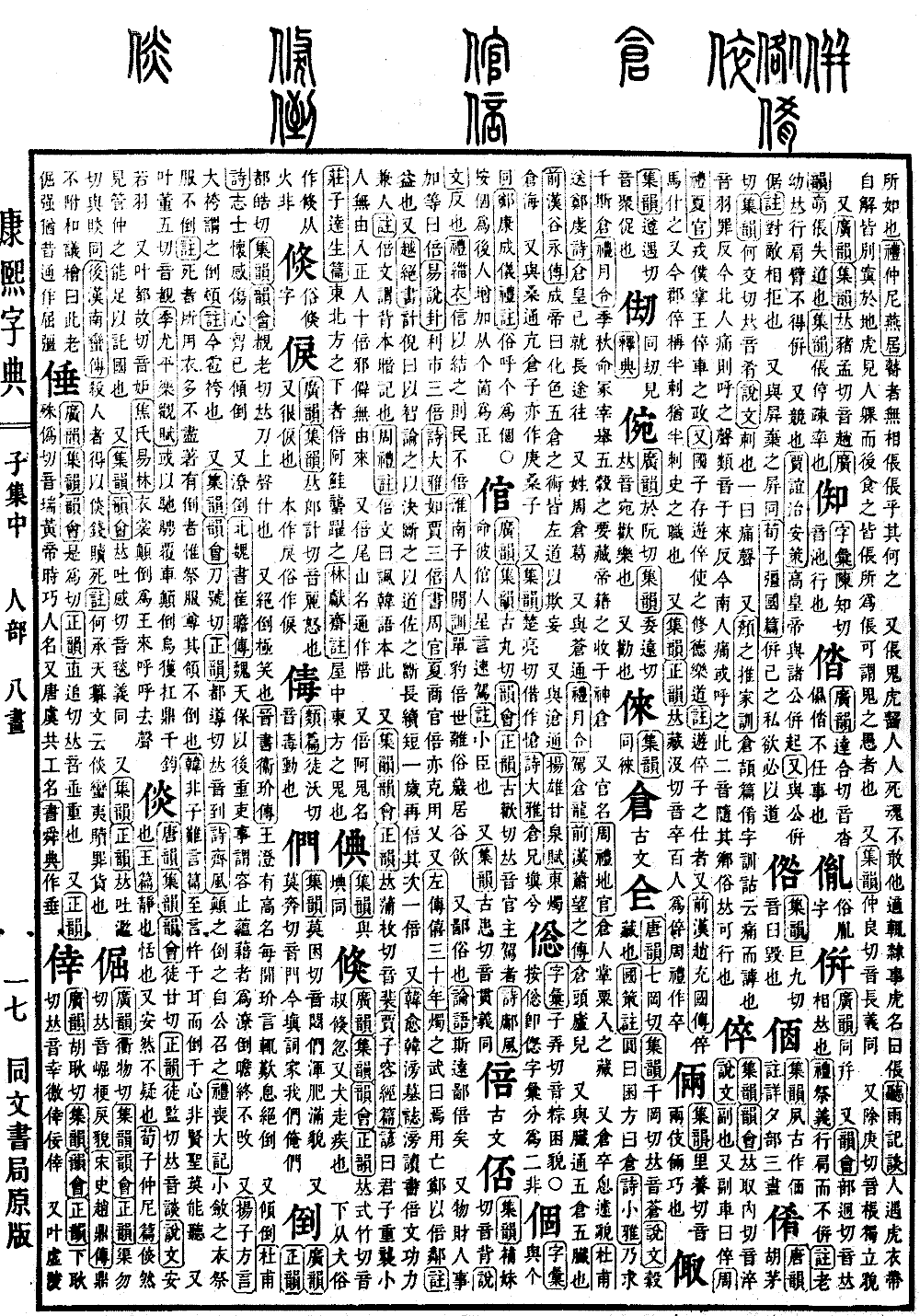
Zi Collection, Middle Volume
Radical: Person (rén)
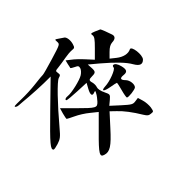
Cui
Kangxi strokes: 10
Page 107, Entry 08
According to the Compilation of Rhymes (Jiyun) and the Collection of Rhymes (Yunhui), the pronunciation is cui.
According to the Explaining Graphs and Analyzing Characters (Shuowen), it means secondary or assistant. Additionally, an assistant vehicle is called a cui.
In the Rites of Zhou (Zhouli), Summer Offices, it is stated: The military attendants oversee the administration of the King’s assistant vehicles. Also: For the sons of the nobility and the sons of the state, retain those in the assistant ranks and have them cultivate virtue and study the Way. The commentary states: Assistant ranks refer to those who have not yet entered official service.
Also, in the History of the Former Han (Qianhan Shu), Biography of Zhao Chongguo, it refers to the supplementary horses for the groups of ten.
Furthermore, current regional assistant officials are called semi-prefects, which is similar to the duties of a deputy governor.
According to the Compilation of Rhymes (Jiyun) and the Correct Rhymes (Zhengyun), the pronunciation is zu. It refers to a unit of one hundred men. In the Rites of Zhou (Zhouli), it is written as zu.
Textual verification: In the Rites of Zhou (Zhouli), Summer Offices, it is stated: The military attendants oversee the administration of the King’s assistant vehicles. Also: For the sons of the nobility and the sons of the state, retain those in the assistant ranks and have them cultivate virtue and study the Way. The commentary states: Assistant ranks refer to those who have not yet entered official service. Regarding the original text, the two characters for sons of the nobility were added before sons of the state; study the Way was corrected from cultivate the Way; and those who have not yet entered official service was corrected from those who are in official service.