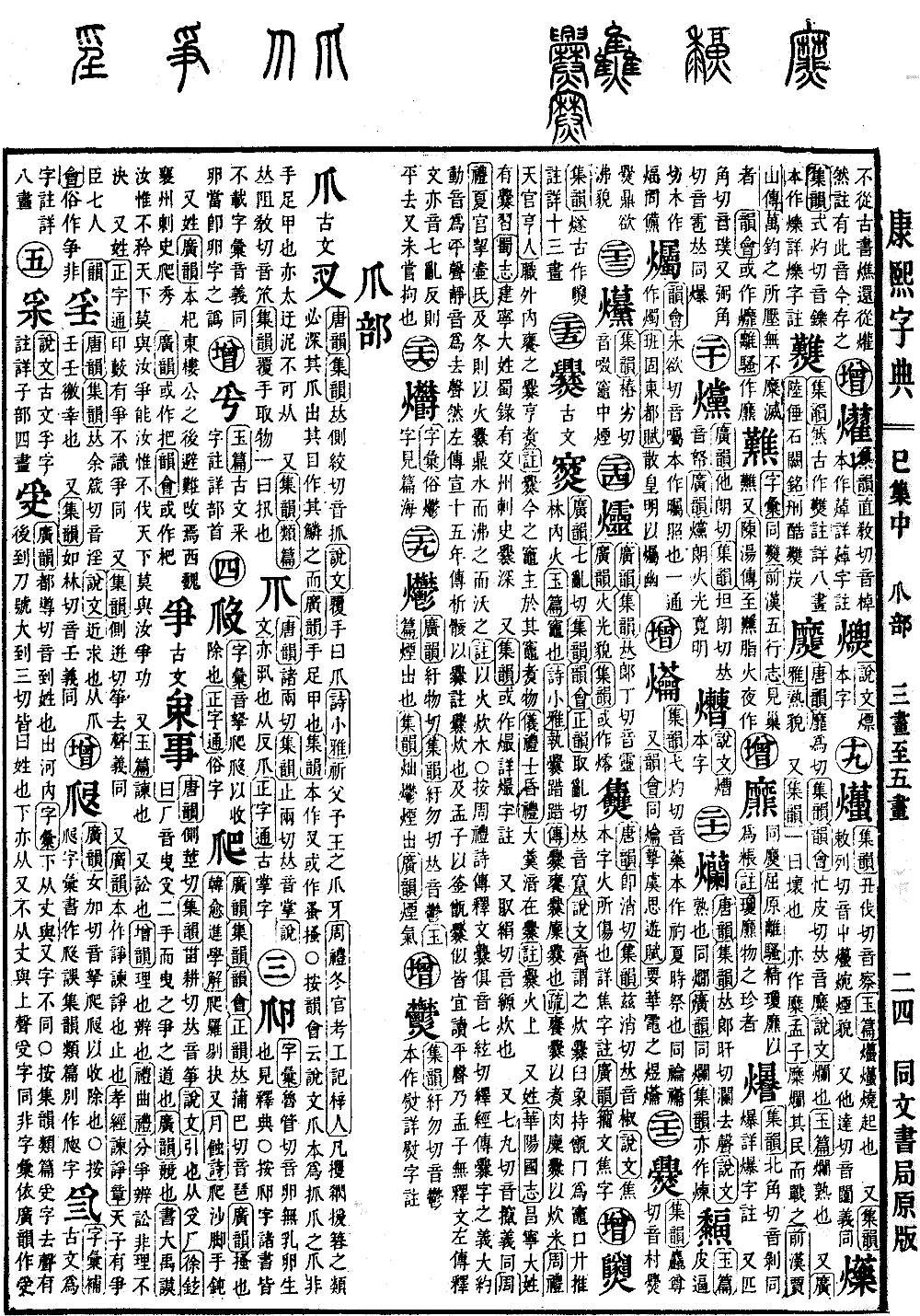
Si Collection, Lower Volume
Radical: Fire (huǒ)
Kangxi Strokes: 29
Page 688, Entry 21
According to the General Rhymes (Guangyun), it is pronounced luan (falling tone). According to the Collection of Rhymes (Jiyun), Rhyme Anthology (Yunhui), and Orthodox Rhymes (Zhengyun), it is pronounced cuan (falling tone), same as the character for fleeing.
The Explanation of Script and Elucidation of Characters (Shuowen Jiezi) defines it as the Qi region term for burning fire to cook meals. The glyph depicts hands holding a steamer, with a symbol representing the stove opening and a symbol representing two hands pushing wood into the fire.
The Jade Chapters (Yupian) defines it as a stove.
The Book of Odes (Shijing), Small Odes section, contains the phrase, "Holding the cooking stove with quick, respectful steps." The Commentary explains that the character refers to stoves used for cooking meat and preparing meals. The Sub-commentary further clarifies that the stove for meat is for boiling, and the stove for rice is for steaming.
The Rites of Zhou (Zhouli), Office of Heaven, Officials of Cooking, manages the work of heating food on the stoves within the royal palace. The Note explains that the character refers to the modern stove, focusing on the act of cooking food over fire.
The Book of Etiquette and Ceremonial (Yili), Rites of Marriage for Gentlemen, records that meat broth is placed upon the stove. The Note explains that this refers to the space above the stove fire.
It is also a surname. Chronicles of Huayang (Huayang Guozhi) records that among the major clans of Changning was the Cuan family. Records of Shu (Shuzhi) states it is a prominent clan of Jianning. The Records of Shu lists Cuan Shen as the Inspector of Jiaozhou.
Additionally, the Collection of Rhymes (Jiyun) notes that it is sometimes written in a variant form (zuan). See the entry for that character for details.
It has another pronunciation of quan (falling tone), same as the character for red silk. The meaning remains burning fire to cook meals. It has a third pronunciation of cuan (level tone), with the same meaning.
The Rites of Zhou, Office of Summer, Master of the Clepsydra, records: in winter, fire is used to heat the water in the tripod until it boils for pouring. The Note explains this as using fire to heat water.
According to the commentaries and glosses on the Rites of Zhou and the Book of Odes, the character is generally pronounced xian (rising tone). In the interpretation of the classics, the character is generally pronounced with a level tone when used as a verb and a falling tone when used as a noun. However, the commentary on the Zuo Tradition (Zuo Zhuan), Year 15 of Duke Xuan, records: splitting bones as firewood for cooking. The note explains this as burning fire to cook meals. Furthermore, the Book of Mencius (Mengzi) contains the phrase "to cook with a steamer." In these instances, it seems it should be read with a level tone. The Book of Mencius contains no gloss, and the Zuo Tradition gloss gives the pronunciation as luan (falling tone). Thus, the distinction between level and falling tones is not absolute.