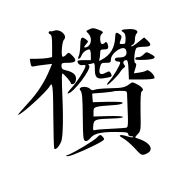
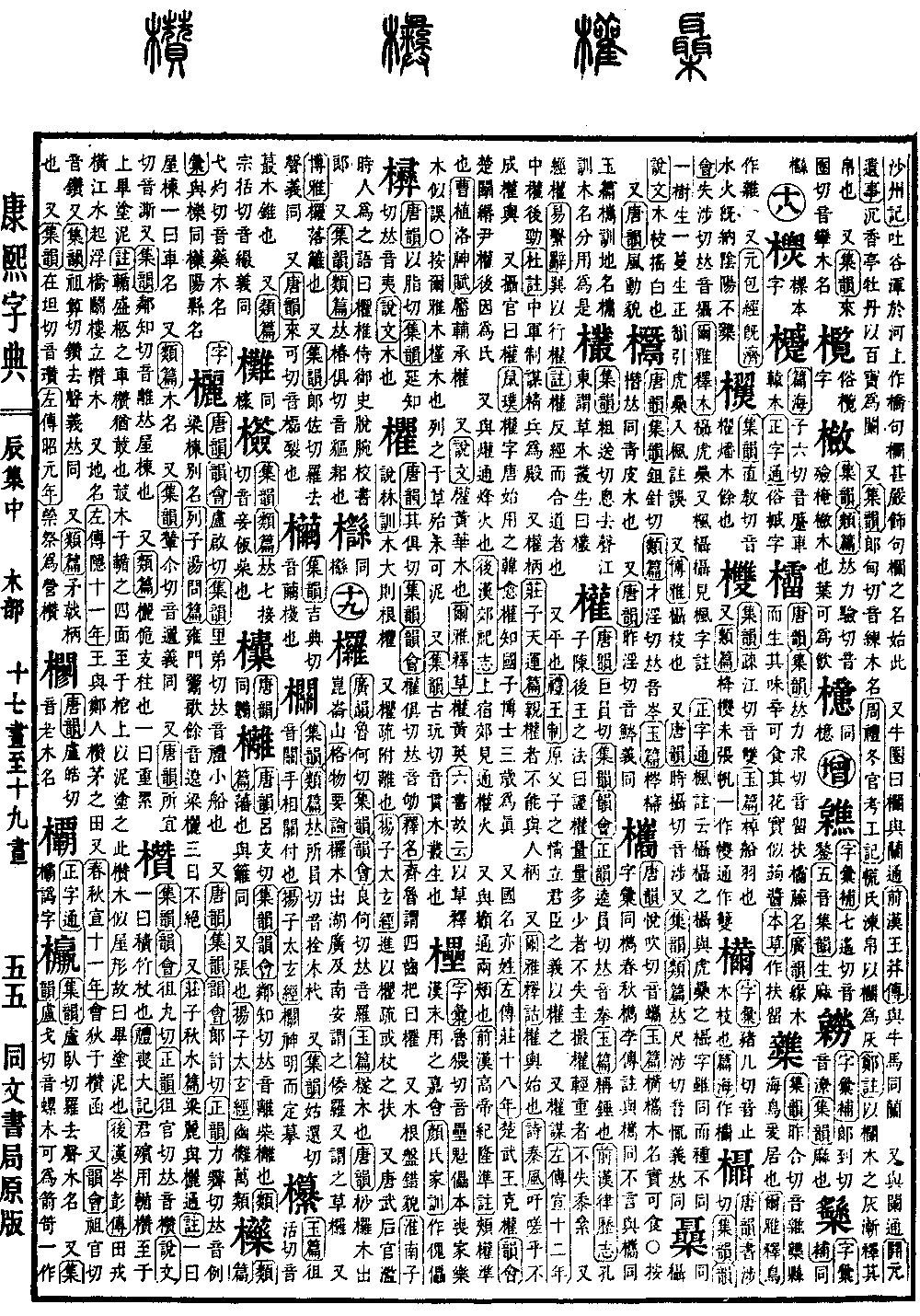
Chen Collection, Middle Volume. Radical: Tree (mù). 23 Kangxi strokes. Page 563, Entry 34.
According to Collected Rhymes (Jiyun) and Rhyme Anthology (Yunhui), pronounced cuan (rising tone). According to Correct Rhymes (Zhengyun), pronounced cuan. According to Explaining Graphs (Shuowen), one definition is a staff made of bundled bamboo.
Book of Rites (Liji), Record of Mourning (Sangdaji): The funeral carriage of a feudal lord is called a chun; upon the chun, wooden bundles (cuan) are arranged over the coffin and covered entirely with mud. Commentary: The chun is the carriage used to transport a coffin. Cuan means to gather, similar to the word for gathering (zou). Wood is gathered on the four sides of the chun and built up over the coffin, then sealed with mud. The shape of this wooden structure resembles a house, hence the statement that it is entirely covered in mud.
History of the Later Han (Hou Hanshu), Biography of Cen Peng: Tian Rong blocked the Yangtze River, building a floating bridge and watchtowers, and erected wooden pillars (cuan).
Also a place name. Zuo Commentary (Zuozhuan), Eleventh Year of Duke Yin: The King of Zhou granted the people of Zheng the land of Cuanmao. Also Spring and Autumn Annals (Chunqiu), Eleventh Year of Duke Xuan: The Marquis of Jin met with the Di people at Cuanhan.
According to Rhyme Anthology (Yunhui), pronounced zuan. According to Collected Rhymes (Jiyun), pronounced zuan (falling tone). The meanings are the same.
Also, handles for spears or halberds.
According to Categorized Compilation (Leipian), pronounced zan. Zuo Commentary (Zuozhuan), First Year of Duke Zhao, Commentary: A sacrifice of purification (yong) involves building a sacrificial altar (cuan).
Textual verification: In the entry for Zuo Commentary, Eleventh Year of Duke Yin, the text originally read the land of Cuanmao; the characters for the field of have been omitted here. In the entry for Spring and Autumn Annals, Eleventh Year of Duke Xuan, the words Marquis of Jin have been added before met with the Di. In the entry for Zuo Commentary, First Year of Duke Zhao, the note regarding the sacrificial altar has been identified as a commentary rather than the main text, and the word Commentary has been added after the year.