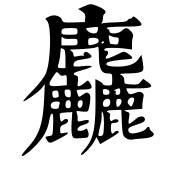
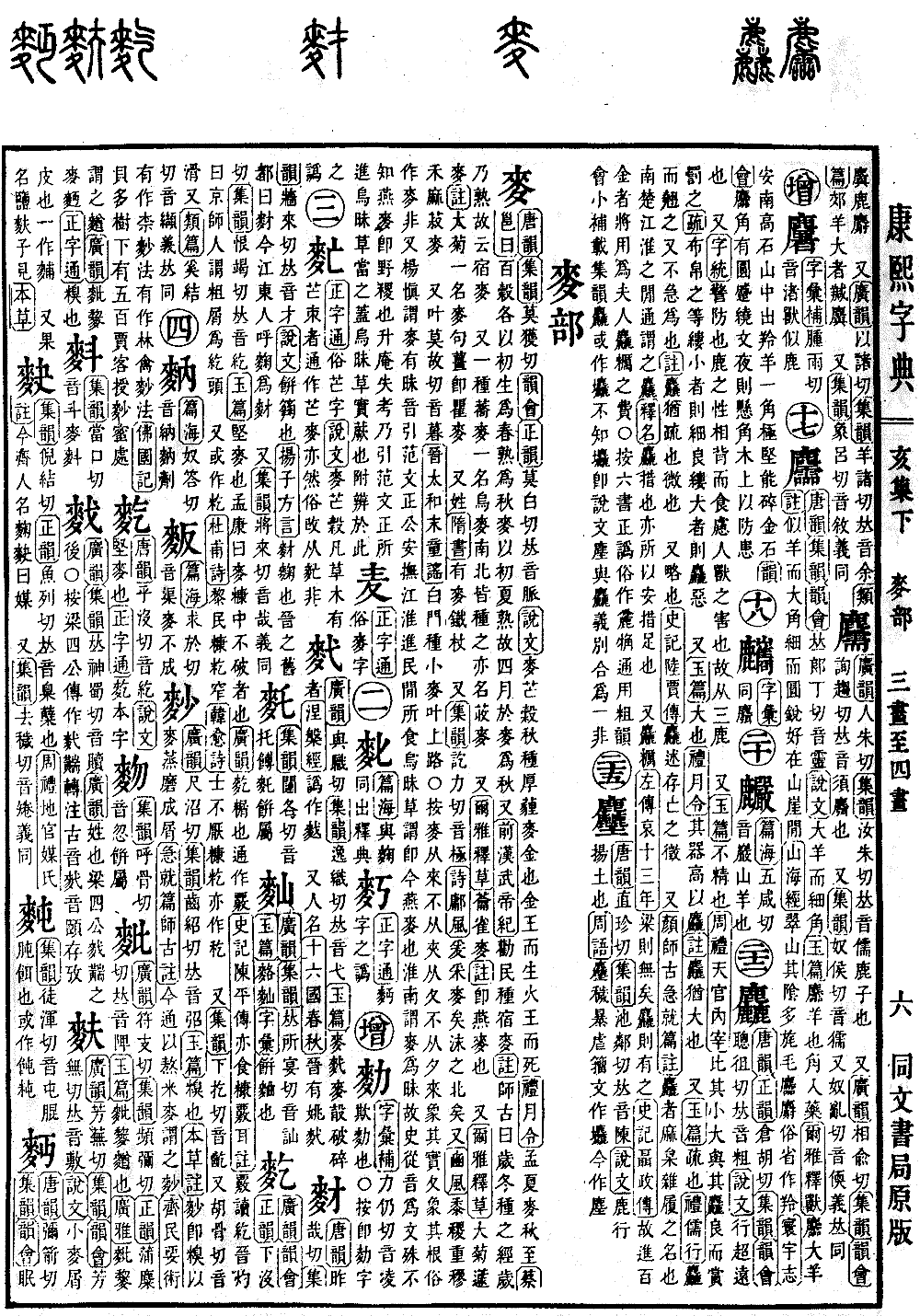
Hai Collection, Lower Volume
Radical: Deer (lù)
Kangxi strokes: 33
Page 1512, Entry 06
Pronounced cu. According to the Tang Rhyme (Tangyun) and Zheng Rhyme (Zhengyun), and according to the Compilation of Rhymes (Jiyun) and Rhyme Collection (Yunhui), the sound is cu. According to the Explaining Graphs and Analyzing Characters (Shuowen), it refers to walking a great distance. According to the Record of Characters (Zhitong), it refers to vigilance and defense. The nature of a deer is to eat with its back turned to guard against humans and wild beasts, which is why the character is composed of three deer characters. According to the Jade Chapters (Yupian), it means not fine or refined. According to the Rites of Zhou (Zhouli), Heaven's Officials, Inner Steward, it says to compare their size, and their coarseness and refinement, in order to conduct rewards and punishments. The commentary explains that for items such as cloth, those with thin threads are fine and high-quality, while those with thick threads are coarse and inferior. According to the Jade Chapters (Yupian), it means large. According to the Book of Rites (Liji), Monthly Ordinances, it says those vessels are tall and large. The commentary notes that this character means large. According to the Jade Chapters (Yupian), it means careless or negligent. According to the Book of Rites (Liji), Conduct of Scholars, it says to roughly present it. It also refers to acting without urgency. The commentary notes that this character means negligent or minute. It also means simple or brief. According to the Records of the Grand Historian (Shiji), Biography of Lu Jia, it says to briefly describe the signs of survival and demise. According to Yan Shigu’s commentary on the Rapid Learning (Jijiupian), this character is the name of shoes made from a mixture of hemp and common flax. In the regions of Southern Chu, the Yangtze River, and the Huai River, it is commonly referred to by this name. According to the Explanations of Names (Shiming), it means placement. It is also something used to place the feet upon. It also refers to coarse food. According to the Zuo Tradition (Zuozhuan), Thirteenth Year of Duke Ai, it says the refined is gone, but the coarse remains. According to the Records of the Grand Historian (Shiji), Biography of Nie Zheng, it says therefore a hundred pieces of gold were offered, intended as the cost for the lady’s coarse meals. Note: According to the Correcting Errors in the Six Writings (Liushu Zheng’e), the common characters are written as cu, cu, and are used interchangeably with the standard character for coarse. The Supplement to the Rhyme Collection (Yunhui Xiaobu) records that in the Compilation of Rhymes (Jiyun), this character is sometimes written in a variant form. It is unknown if that is the character for dust in the Explaining Graphs and Analyzing Characters (Shuowen), which has a different meaning than this character; to combine them into one character is incorrect.