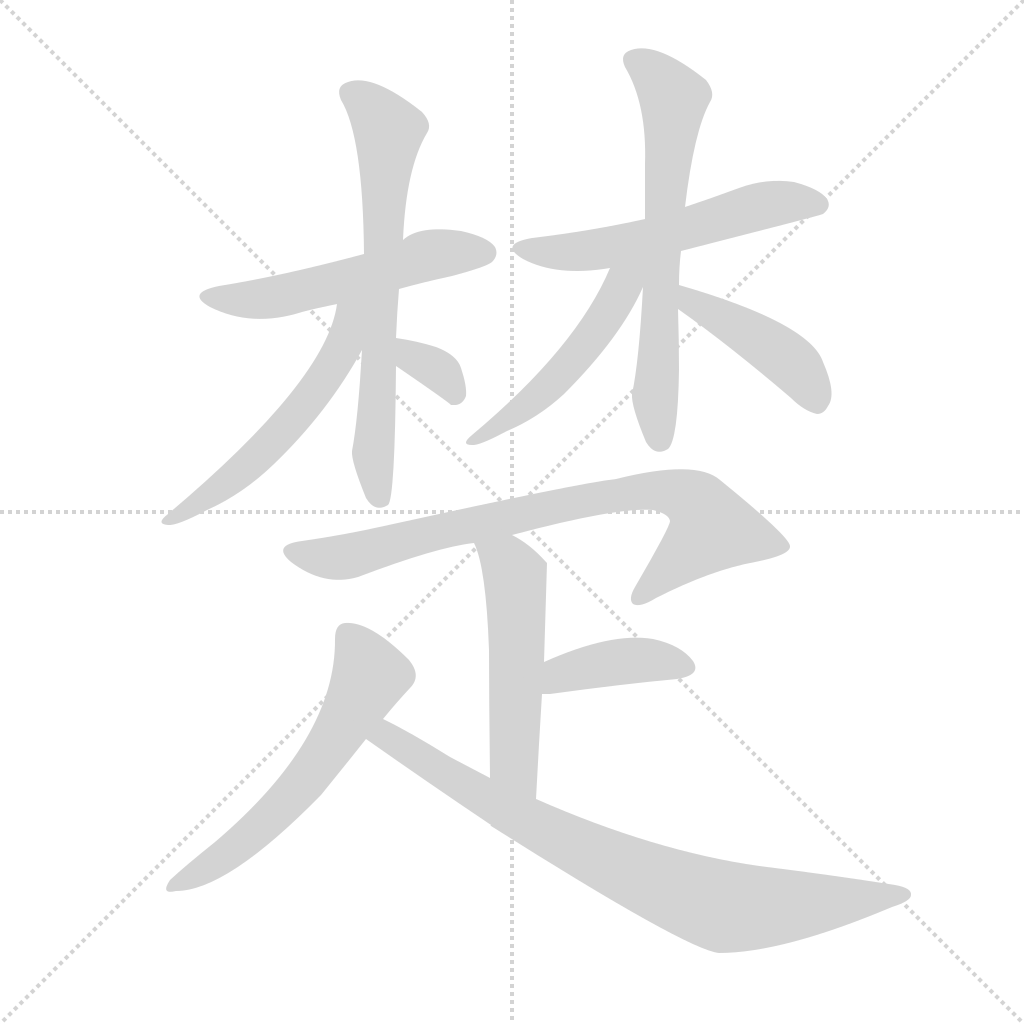
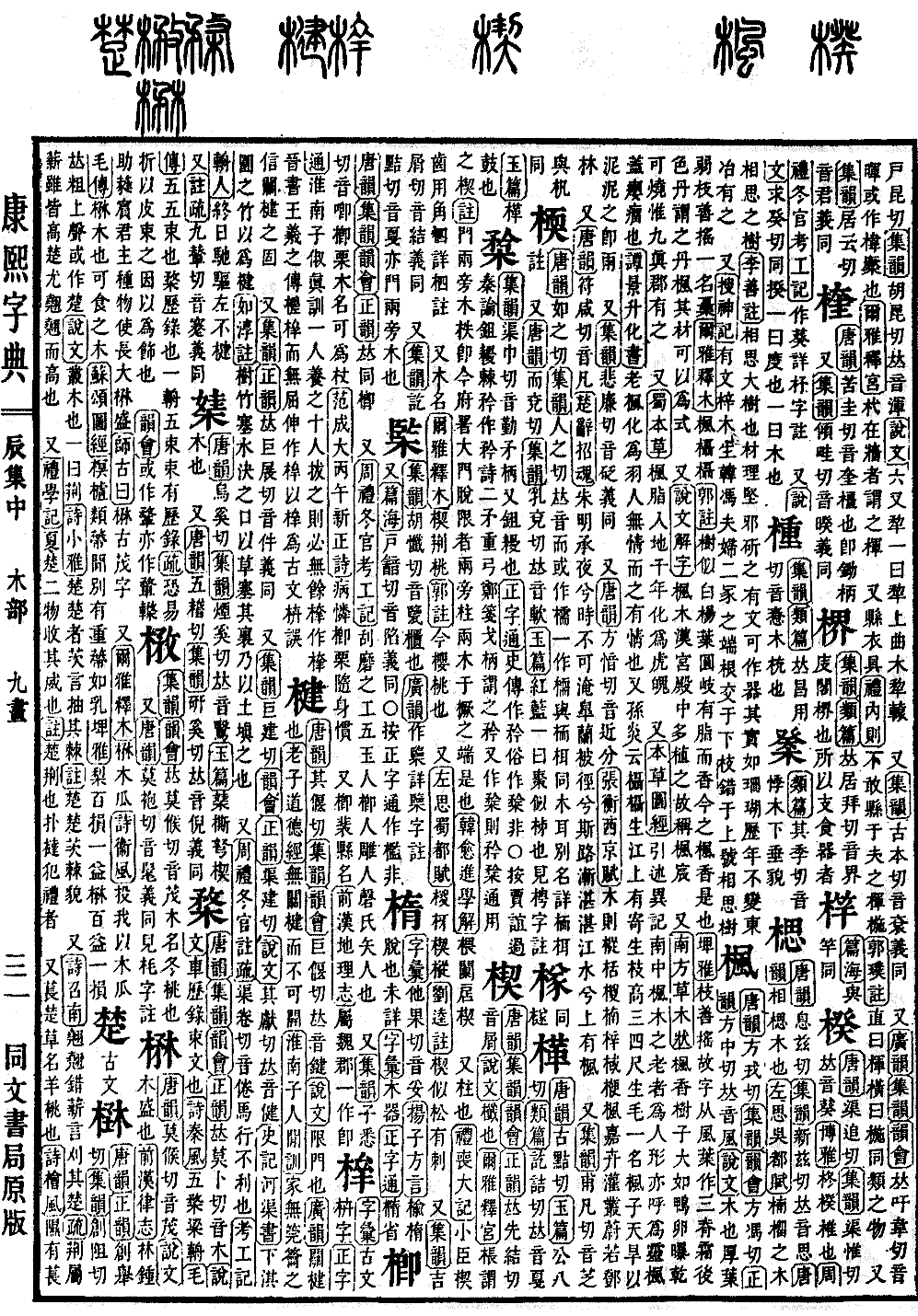
Chen Collection, Middle Volume. Radical: Tree (mù). Kangxi stroke count: 13. Page 539, Entry 23.
Ancient phonology: According to the Tang Rhyme (Tangyun) and Correct Rhyme (Zhengyun), pronounced chu (rising tone). According to the Collected Rhymes (Jiyun), pronounced chu (rising tone). Sometimes written in a variant form.
According to the Explaining Graphs and Analyzing Characters (Shuowen Jiezi), it refers to dense clusters of trees. Another interpretation refers to the vitex shrub.
Book of Odes (Shijing), Lesser Odes (Xiaoya): "Luxuriant are the thorny shrubs, we pull out the thorns." Annotation: Chu-chu describes the appearance of dense, flourishing thorns.
Also, Book of Odes (Shijing), Odes of Shao (Shaonan): "High and lush is the mixed firewood, we cut the vitex." Commentary: This belongs to the vitex variety. Although firewood is generally tall, the vitex is especially prominent and tall.
Also, Book of Rites (Liji), Record on the Subject of Education (Xueji): "The birch and the vitex are two objects used to maintain decorum." Annotation: Chu refers to the vitex shrub, used to punish those who violate ritual decorum.
Also, chang-chu, the name of a plant. This is the yangtao (kiwifruit). Book of Odes (Shijing), Odes of Gui (Guifeng): "In the marshlands grows the yangtao, swaying softly are its branches."
Also, chu-chu, describing an appearance that is vivid and neat. Book of Odes (Shijing), Odes of Gui (Guifeng): "Wings of the mayfly, garments vivid and neat."
Also, xin-chu, referring to pain, alternatively written as chu. Lu Ji, Poem to Younger Brother Shiheng: "Resolute and filled with bitter pain."
Also refers to the name of a state. Book of Documents (Shangshu), Tribute of Yu (Yugong): It belongs to the region of Jingzhou; during the Zhou dynasty, Xiong Yi was first enfeoffed here.
Also refers to the Three Chu, a place name. Records of the Grand Historian (Shiji), Biographies of the Money-makers (Huozhichuan): Huaipei and Runan commanderies constitute West Chu. East of Pengcheng, including Donghai, Wu, and Guangling, constitute East Chu. Hengshan, Jiujiang, Jiangnan, Yuzhang, and Changsha constitute South Chu.
Also refers to the southern region. Book of the Later Han (Houhanshu), Ode on the Expedition (Chushisong) by Shi Cen: "The northern wind transforms the South." Li Shan's commentary: Shuo refers to the north, and Chu refers to the south.
Also a surname. Zuo Commentary (Zuozhuan): Records Chuqiu, where the Jin state performed turtle divination, and Chu Long, a retainer of Zhao Xiangzi.
Also, according to the Tang Rhyme (Tangyun) and Dictionary of Rhymes (Yunhui), pronounced chu (falling tone). It means sharp or keen.
Also the name of a tree. Found in Mount Li.
Also, according to the Collected Characters (Leipian), pronounced shu. Du Fu, Poem Sending off Meng Twelve: "In the autumn wind the bamboo of Chu is cold, in the night snow the plum of Gong is spring."
Also, phonetically modified to match the rhyme, pronounced miao. Book of the Former Han (Qianhanshu), Biography of King Yuan of Chu: "Of the four sons of the high ancestor, the eldest died early. The second son was king, and his legacy is here in Chu."