Yin Collection, Upper Volume
Radical: Roof (mián)
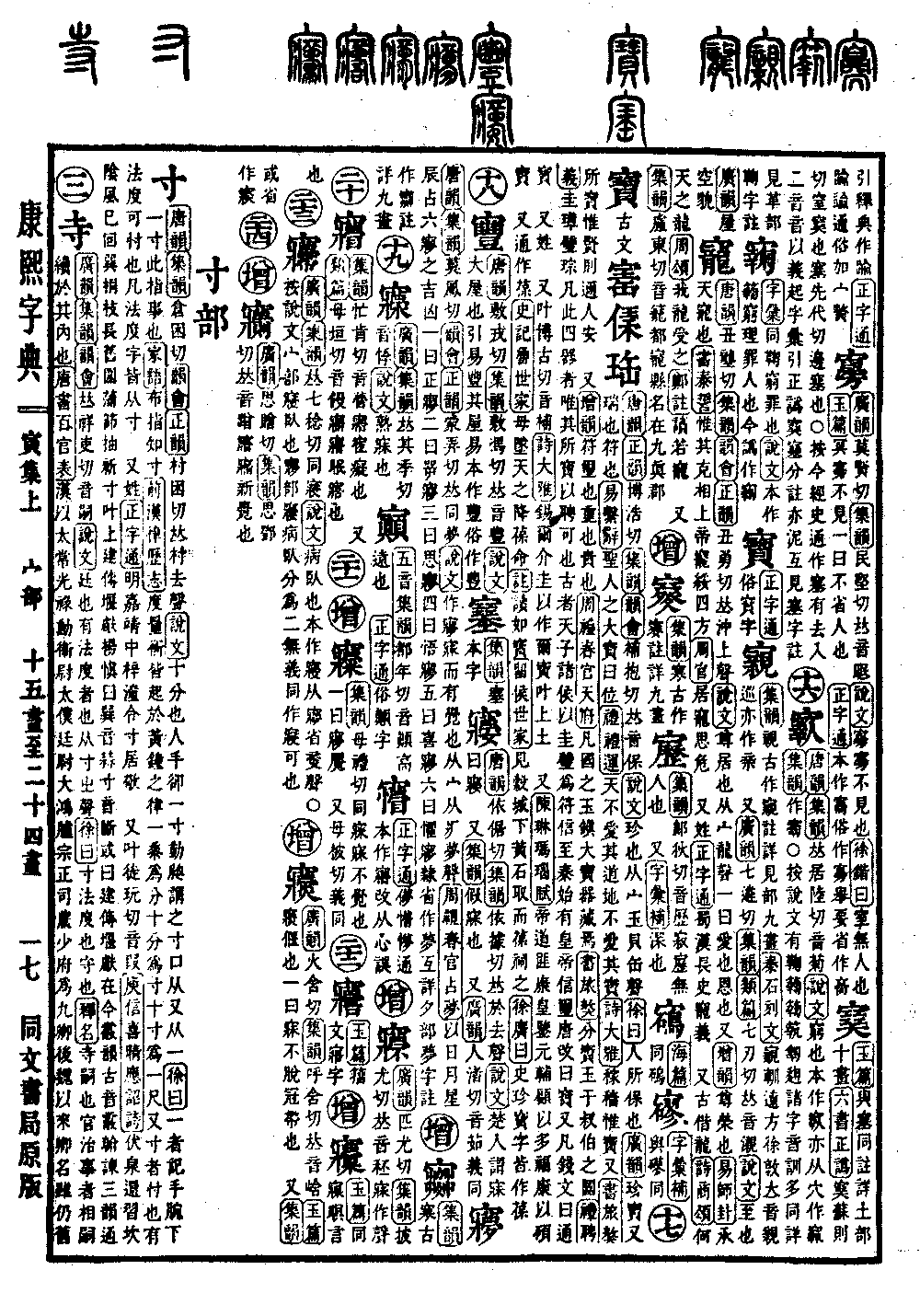
寵
Kangxi strokes: 19
Page 293, Entry 07
Tang Dynasty Rhyme Dictionary (Tangyun) states it is pronounced chǒng. Collected Rhymes (Jiyun), Rhyme Compilation (Yunhui), and Correct Rhymes (Zhengyun) state it is pronounced chǒng. It is read as chǒng (rising tone).
Explaining Graphs and Analyzing Characters (Shuowen) states it refers to a noble residence. The graph is formed with Roof (mián) as the radical and Dragon (lóng) as the phonetic element. Another explanation is that it means to love or to bestow favor.
Supplementary Rhymes (Zengyun) states it signifies honor and glory.
Book of Changes (Yijing), Hexagram of the Army (Shigua): To receive the favor of Heaven.
Book of Documents (Shujing), Great Declaration (Taishi): Only he can assist, and God favors and pacifies the four quarters.
Rites of Zhou (Zhouguan): One who dwells in a position of high honor and favor should consider the danger.
Also used as a surname.
Standard Character Mastery (Zhengzitong): During the Shu Han period, there was a senior official named Chong Yi.
Also used in antiquity as a loan character for dragon (lóng).
Book of Odes (Shijing), Eulogies of Shang (Shangsong): To receive the favor of Heaven.
Eulogies of Zhou (Zhousong): We gloriously receive this mandate.
Zheng Xuan commentary: Here, dragon (lóng) is read as chǒng (favor).
Collected Rhymes (Jiyun) states it is pronounced lóng.
Doucong is the name of a county, located in Jiuzhen Commandery.